


European stocks edged higher on Friday as investors treaded cautiously ahead of a critical G20 meeting where the outcome of US-China trade talks would be closely monitored against the backdrop of a slowing global economy.
US President Donald Trump was yesterday set to hold a meeting with Chinese President Xi Jinping (習近平) and markets were nervous over whether the outcome of that meeting would produce progress in ending the year-long trade spat that has dented growth in global markets.
The pan-European STOXX 600 ended up 0.7 percent at 384.87 points, little changed from last week’s 384.76.
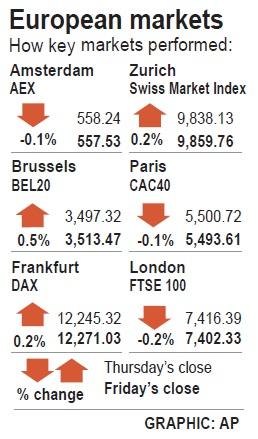
Germany’s trade-sensitive DAX on Friday outperformed other major indices, rising 1 percent on the strength of top lender Deutsche Bank AG. It was up 0.5 percent for the week.
“People don’t know what to think before the upcoming meeting, so we’re likely to see a lot of instability, uncertainty and a general lack of direction, which will be resolved only at the end of the weekend,” said Josh Mahoney, market analyst at IG in London.
“I’d err on the side of caution, we aren’t going to see a major breakthrough on trade, but maybe we will see plans for further discussions down the line and that in itself could give some sort of boost to markets to say it’s not necessarily over quite yet.”
Trump yesterday said he eased restrictions on Huawei Technologies Co (華為) as part of a trade truce with Beijing, removing an immediate threat looming over the global economy even as a lasting peace remains elusive.
He said Xi had promised to buy “tremendous” amounts of US agricultural products in exchange.
The uncertainty in markets caused by conflicting reports on trade in the week leading up to the G20 meet in Japan stalled a rally in stocks and set the main index on pace to post its first weekly loss this month.
Still, the STOXX 600 is up about 3.9 percent this month on expectations that major central banks would be more accommodative to counter the impact of the tariff dispute that helped the index recoup most of its steep losses last month.
Deutsche Bank rose 3.1 percent after it passed an annual health check by the US Federal Reserve, clearing a second rigorous hurdle at a critical time for the German lender in tests that measure banks’ ability to weather a major economic downturn.
“Deutsche Bank was one of the leading lights of European banking, and the idea now is that if we are seeing increased stability in the firm, there is potential for them to be pairing up with another bank, so it’s a value play right now,” Mahoney said.
Travel and leisure stocks surged 1 percent, the most among major European sectors, after shares of Madame Tussauds owner Merlin Entertainments PLC jumped 14 percent.
Merlin said it would be acquired by Lego A/S’ founding family and private equity firm Blackstone Group in a deal valuing the company and its debt at nearly £6 billion (US$7.6 billion).
Additional reporting by Bloomberg
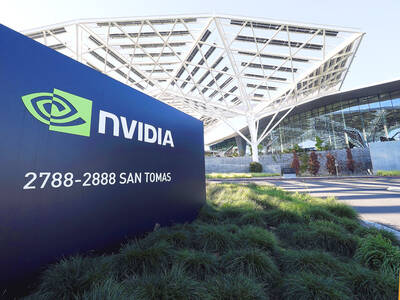
CHIP RACE: Three years of overbroad export controls drove foreign competitors to pursue their own AI chips, and ‘cost US taxpayers billions of dollars,’ Nvidia said China has figured out the US strategy for allowing it to buy Nvidia Corp’s H200s and is rejecting the artificial intelligence (AI) chip in favor of domestically developed semiconductors, White House AI adviser David Sacks said, citing news reports. US President Donald Trump on Monday said that he would allow shipments of Nvidia’s H200 chips to China, part of an administration effort backed by Sacks to challenge Chinese tech champions such as Huawei Technologies Co (華為) by bringing US competition to their home market. On Friday, Sacks signaled that he was uncertain about whether that approach would work. “They’re rejecting our chips,” Sacks
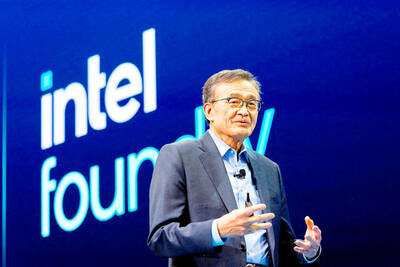
NATIONAL SECURITY: Intel’s testing of ACM tools despite US government control ‘highlights egregious gaps in US technology protection policies,’ a former official said Chipmaker Intel Corp has tested chipmaking tools this year from a toolmaker with deep roots in China and two overseas units that were targeted by US sanctions, according to two sources with direct knowledge of the matter. Intel, which fended off calls for its CEO’s resignation from US President Donald Trump in August over his alleged ties to China, got the tools from ACM Research Inc, a Fremont, California-based producer of chipmaking equipment. Two of ACM’s units, based in Shanghai and South Korea, were among a number of firms barred last year from receiving US technology over claims they have
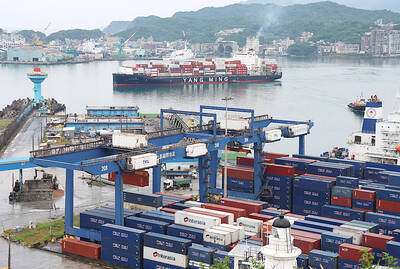
Taiwan’s exports soared 56 percent year-on-year to an all-time high of US$64.05 billion last month, propelled by surging global demand for artificial intelligence (AI), high-performance computing and cloud service infrastructure, the Ministry of Finance said yesterday. Department of Statistics Director-General Beatrice Tsai (蔡美娜) called the figure an unexpected upside surprise, citing a wave of technology orders from overseas customers alongside the usual year-end shopping season for technology products. Growth is likely to remain strong this month, she said, projecting a 40 percent to 45 percent expansion on an annual basis. The outperformance could prompt the Directorate-General of Budget, Accounting and
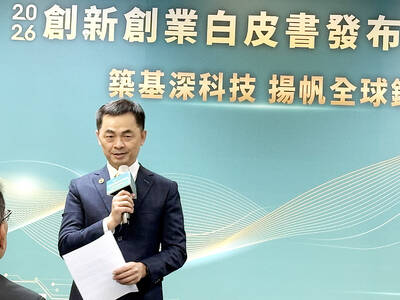
BARRIERS: Gudeng’s chairman said it was unlikely that the US could replicate Taiwan’s science parks in Arizona, given its strict immigration policies and cultural differences Gudeng Precision Industrial Co (家登), which supplies wafer pods to the world’s major semiconductor firms, yesterday said it is in no rush to set up production in the US due to high costs. The company supplies its customers through a warehouse in Arizona jointly operated by TSS Holdings Ltd (德鑫控股), a joint holding of Gudeng and 17 Taiwanese firms in the semiconductor supply chain, including specialty plastic compounds producer Nytex Composites Co (耐特) and automated material handling system supplier Symtek Automation Asia Co (迅得). While the company has long been exploring the feasibility of setting up production in the US to address


 RSS
RSS