


Wall Street on Friday finished a milestone-setting week on a downbeat note after a late flurry of selling nudged stocks lower, ending the market’s four-day winning streak.
Even with the modest losses, the market delivered its third straight weekly gain, with the benchmark S&P 500 hovering just below its record-high close from a day earlier.
That milestone, which eclipsed the benchmark index’s last record close on April 30, came amid a swift turnaround for stocks this month that has erased losses from a steep sell-off last month.
The major US stock indices are up more than 7 percent this month and are holding on to gains of more than 14 percent for the year.
Investors have been reassured by statements from the US Federal Reserve this month that suggest the central bank is prepared to cut interest rates in response to a slowing global economy.
At the same time, traders remain concerned that corporate profits might suffer should the kind of economic slowdown that would prompt the Fed to cut rates take hold.
A mixed batch of economic data on Friday did not have much of an effect on trading, which remained mostly muted as investors took a breather after a four-day rally.
“Some of the information we’ve gotten today hasn’t been all that impactful to kind of change the price action we saw this week,” J.P. Morgan Private Bank global investment specialist Ioana Martin said.
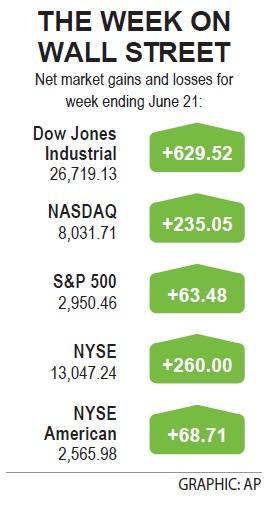
The S&P 500 on Friday dipped 3.72 points, or 0.1 percent, to 2,950.46, but rose 2.2 percent from a close of 2,886.98 on June 14.
The Dow Jones Industrial Average on Friday dropped 34.04 points, or 0.1 percent, to 26,719.13, jumping 2.4 percent from 26,089.61 a week earlier.
The NASDAQ Composite on Friday fell 19.63 points, or 0.2 percent, to 8,031.71, but surged 3 percent from 7,796.66 on June 14.
Smaller company stocks fared worse than the rest of the market. The Russell 2000 on Friday slumped 13.87 points, or 0.9 percent, to 1,549.63, but still gained 1.8 percent for the week.
Trading was wobbly for much of Friday as investors sized up a mixed batch of economic data.
A report on manufacturing for this month came in below analysts’ forecasts. A separate report was more encouraging, indicating that sales of previously occupied US homes increased last month.
The modest dip cut into some of the market’s gains from Thursday, but did little to dent Wall Street’s rally this month.
All told, the S&P 500 is up 17.7 percent this year, while the Dow is up 14.5 percent. The NASDAQ, which is heavily weighted with technology stocks, is up 21.1 percent for the year. The Russell 2000 is up 14.9 percent.
The biggest uncertainty looming over the market remains a US trade war with China. Stocks opened the week higher and rallied since then after US President Donald Trump said that he planned to meet with Chinese President Xi Jinping (習近平) next week at the G20 summit in Japan to discuss their ongoing trade conflict.
Both nations’ leaders have lately signaled a willingness to resolve the dispute.
Meanwhile, the Fed has signaled that it is willing to cut interest rates to stabilize the US economy if the trade dispute crimps growth. That has helped drive the market’s rebound this month.
“At this point it’s not so much a question about whether the Fed is going to be accommodative or not, it’s just what that magnitude is going to be,” Martin said.
Looking ahead, next week’s G20 summit is likely to be the next big market mover, she said.
“That hopefully gives us a little bit more color on the trade situation,” Martin added.
Technology stocks took some of the heaviest losses on Friday, with chipmakers leading the way. Micron Technology Inc dropped 2.6 percent and Advanced Micro Devices Inc lost 3 percent.
Industrial stocks also fell. Snap-on Inc dropped 3.7 percent.
Healthcare stocks notched solid gains. Humana Inc climbed 4.4 percent, while UnitedHealth Group Inc added 1.8 percent.
Communications stocks also rose, with video game publisher Electronic Arts Inc leading the way. The stock gained 2.3 percent.
Energy stocks climbed for the second day in a row along with the price of crude oil. Baker Hughes gained 3.3 percent and Valero Energy Corp added 2.7 percent.
Used car retailer CarMax Inc rose 3.2 percent after it blew past Wall Street’s fiscal first-quarter profit and revenue forecasts.
Staffing company Korn Ferry plunged 17.5 percent after reporting weak revenue in its fiscal fourth quarter and issuing a profit forecast that mostly fell short of analysts’ expectations.
Additional reporting by staff writer

GROWING OWINGS: While Luxembourg and China swapped the top three spots, the US continued to be the largest exposure for Taiwan for the 41st consecutive quarter The US remained the largest debtor nation to Taiwan’s banking sector for the 41st consecutive quarter at the end of September, after local banks’ exposure to the US market rose more than 2 percent from three months earlier, the central bank said. Exposure to the US increased to US$198.896 billion, up US$4.026 billion, or 2.07 percent, from US$194.87 billion in the previous quarter, data released by the central bank showed on Friday. Of the increase, about US$1.4 billion came from banks’ investments in securitized products and interbank loans in the US, while another US$2.6 billion stemmed from trust assets, including mutual funds,
Micron Memory Taiwan Co (台灣美光), a subsidiary of US memorychip maker Micron Technology Inc, has been granted a NT$4.7 billion (US$149.5 million) subsidy under the Ministry of Economic Affairs A+ Corporate Innovation and R&D Enhancement program, the ministry said yesterday. The US memorychip maker’s program aims to back the development of high-performance and high-bandwidth memory chips with a total budget of NT$11.75 billion, the ministry said. Aside from the government funding, Micron is to inject the remaining investment of NT$7.06 billion as the company applied to participate the government’s Global Innovation Partnership Program to deepen technology cooperation, a ministry official told the
AI TALENT: No financial details were released about the deal, in which top Groq executives, including its CEO, would join Nvidia to help advance the technology Nvidia Corp has agreed to a licensing deal with artificial intelligence (AI) start-up Groq, furthering its investments in companies connected to the AI boom and gaining the right to add a new type of technology to its products. The world’s largest publicly traded company has paid for the right to use Groq’s technology and is to integrate its chip design into future products. Some of the start-up’s executives are leaving to join Nvidia to help with that effort, the companies said. Groq would continue as an independent company with a new chief executive, it said on Wednesday in a post on its Web
Taiwan Semiconductor Manufacturing Co (TSMC, 台積電), the world’s leading advanced chipmaker, officially began volume production of its 2-nanometer chips in the fourth quarter of this year, according to a recent update on the company’s Web site. The low-key announcement confirms that TSMC, the go-to chipmaker for artificial intelligence (AI) hardware providers Nvidia Corp and iPhone maker Apple Inc, met its original roadmap for the next-generation technology. Production is currently centered at Fab 22 in Kaohsiung, utilizing the company’s first-generation nanosheet transistor technology. The new architecture achieves “full-node strides in performance and power consumption,” TSMC said. The company described the 2nm process as


 RSS
RSS