


Walmart Inc on Thursday said it would pay US$282 million to settle a seven-year-long investigation into whether its overseas units in Mexico, Brazil, China and India breached the US Foreign Corrupt Practices Act.
The retailer is to pay more than US$144 million to settle charges by the US Securities and Exchange Commission (SEC) and about US$138 million to resolve parallel criminal charges by the US Department of Justice, court and regulatory filings showed.
In a separate regulatory filing, Walmart said that the US$282 million was part of a “global settlement” and ended all act-related investigations into the retailer and its overseas businesses.
The Justice Department launched an investigation of the retailer after a series of New York Times articles in 2012 described alleged bribes paid by Walmart in Mexico to obtain permits to build stores there.
The reports spurred a wide-reaching investigation by the department into the behavior of Walmart subsidiaries around the globe, including in Mexico, Brazil, China and India.
“Walmart profited from rapid international expansion, but in doing so chose not to take necessary steps to avoid corruption,” Assistant Attorney General Brian Benczkowski of the Justice Department’s Criminal Division said on Thursday.
“In numerous instances, senior Walmart employees knew of failures of its anticorruption-related internal controls involving foreign subsidiaries and yet Walmart failed for years to implement sufficient controls comporting with US criminal laws,” Benczkowski said.
The Justice Department said that the failures led Walmart’s subsidiaries in Mexico, India, Brazil and China to hire third-party intermediaries and allowed these intermediaries to make improper payments to government officials to obtain store permits and licenses.
Walmart did not voluntarily disclose the conduct in Mexico and only disclosed the conduct in Brazil, China and India after the US government had already begun investigating the situation in Mexico, the department said.
Charles Cain, head of the SEC Enforcement Division’s Foreign Corrupt Practices Unit, said: “Walmart valued international growth and cost-cutting over compliance.”
The retailer’s chief executive officer said that Walmart had enhanced its “policies, procedures and systems and invested tremendous resources globally into ethics and compliance.”
Walmart also said it had spent more than US$900 million on related matters, including inquiries, investigations and its global compliance program, in the past seven years.
As part of the settlement, Walmart Brazil has entered a guilty plea in the US District Court for the Eastern District of Virginia, the retailer said.
According to court filings, from about 2009 to 2010, Walmart Brazil knowingly led its parent to maintain false records, which then made it into the company’s consolidated financial statements.
Walmart Brazil and its employees recorded US$527,000 in payments to an intermediary for assistance in acquiring construction permits, as a payment to certain construction companies, the court filings show.
The intermediary’s ability to obtain licenses and permits quickly “by sorting things out like magic” earned the intermediary the nickname “sorceress” or “genie” within Walmart Brazil, the court filings said.

GROWING OWINGS: While Luxembourg and China swapped the top three spots, the US continued to be the largest exposure for Taiwan for the 41st consecutive quarter The US remained the largest debtor nation to Taiwan’s banking sector for the 41st consecutive quarter at the end of September, after local banks’ exposure to the US market rose more than 2 percent from three months earlier, the central bank said. Exposure to the US increased to US$198.896 billion, up US$4.026 billion, or 2.07 percent, from US$194.87 billion in the previous quarter, data released by the central bank showed on Friday. Of the increase, about US$1.4 billion came from banks’ investments in securitized products and interbank loans in the US, while another US$2.6 billion stemmed from trust assets, including mutual funds,
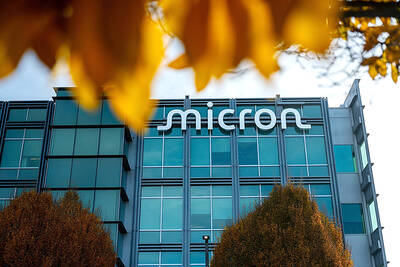
Micron Memory Taiwan Co (台灣美光), a subsidiary of US memorychip maker Micron Technology Inc, has been granted a NT$4.7 billion (US$149.5 million) subsidy under the Ministry of Economic Affairs A+ Corporate Innovation and R&D Enhancement program, the ministry said yesterday. The US memorychip maker’s program aims to back the development of high-performance and high-bandwidth memory chips with a total budget of NT$11.75 billion, the ministry said. Aside from the government funding, Micron is to inject the remaining investment of NT$7.06 billion as the company applied to participate the government’s Global Innovation Partnership Program to deepen technology cooperation, a ministry official told the

AI TALENT: No financial details were released about the deal, in which top Groq executives, including its CEO, would join Nvidia to help advance the technology Nvidia Corp has agreed to a licensing deal with artificial intelligence (AI) start-up Groq, furthering its investments in companies connected to the AI boom and gaining the right to add a new type of technology to its products. The world’s largest publicly traded company has paid for the right to use Groq’s technology and is to integrate its chip design into future products. Some of the start-up’s executives are leaving to join Nvidia to help with that effort, the companies said. Groq would continue as an independent company with a new chief executive, it said on Wednesday in a post on its Web

Taiwan Semiconductor Manufacturing Co (TSMC, 台積電), the world’s leading advanced chipmaker, officially began volume production of its 2-nanometer chips in the fourth quarter of this year, according to a recent update on the company’s Web site. The low-key announcement confirms that TSMC, the go-to chipmaker for artificial intelligence (AI) hardware providers Nvidia Corp and iPhone maker Apple Inc, met its original roadmap for the next-generation technology. Production is currently centered at Fab 22 in Kaohsiung, utilizing the company’s first-generation nanosheet transistor technology. The new architecture achieves “full-node strides in performance and power consumption,” TSMC said. The company described the 2nm process as


 RSS
RSS