


Taiwan’s economy is expected to improve in the third quarter on the back of robust investment and private consumption, while the central bank is likely to keep interest rates unchanged by the end of this year, Cathay Financial Holding Co (國泰金控) said yesterday.
The economy is likely to bottom out this quarter, instead of in the first quarter previously predicted by the team, as exports were weaker than expected, said Hsu Chih-chiang (徐之強), an economics professor at National Central University who heads a research team commissioned by Cathay Financial.
“While we previously expected a decline in exports to taper in the second quarter, US President Donald Trump’s tweets last month and his lifting of tariffs from 10 to 25 percent have weakened global trade, including in Taiwan,” Hsu told a news conference in Taipei.
Exports have contracted year-on-year for seven consecutive months through last month, as an increase in exports to the US could not offset a shipment decrease to China, Hsu said.
The Directorate-General of Budget, Accounting and Statistics (DGBAS) has forecast that exports would drop 1.17 percent annually this year.
Reporting a pessimistic export outlook, the research team forecast that annual GDP growth for the second quarter would be about 1.7 percent, slightly down from 1.78 percent the previous quarter, Hsu said.
However, the economy is expected to recover in the third and fourth quarters to record 2.5 percent growth, supported by rising investment, steadily growing private consumption and stable public policies, he said.
An investment totaling NT$375 billion (US$11.96 billion) by 73 Taiwanese companies that have gained approval to return home would be a pillar of economic growth, Hsu said.
Domestic investment this year would advance 3.67 percent year-on-year, lower than the DGBAS’ forecast of 5.39 percent, Hsu added.
“Not all applicants will implement their investment plans in Taiwan this year, even though they have gained government approvals, as their decisions might be delayed by uncertainty derived from the trade dispute,” Hsu said.
With the presidential election approaching, the government is expected to keep policies stable, which would help the economy, he said.
The central bank is expected to keep its policy rates unchanged today and for the second half of this year, but the possibility of a rate cut would rise if the economy continues to slow in the following quarters and if the bank predicts that the US and China cannot resolve their disputes, Hsu said.
Cathay Financial retained its 2.2 percent GDP growth forecast for the year, he added.
Hsu’s team in March successfully forecast that GDP growth for the first quarter would decline from the previous quarter.

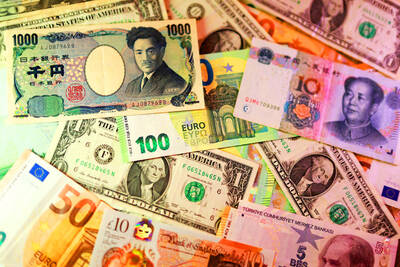
Taiwan’s foreign exchange reserves fell below the US$600 billion mark at the end of last month, with the central bank reporting a total of US$596.89 billion — a decline of US$8.6 billion from February — ending a three-month streak of increases. The central bank attributed the drop to a combination of factors such as outflows by foreign institutional investors, currency fluctuations and its own market interventions. “The large-scale outflows disrupted the balance of supply and demand in the foreign exchange market, prompting the central bank to intervene repeatedly by selling US dollars to stabilize the local currency,” Department of Foreign

Intel Corp is joining Elon Musk’s long-shot effort to develop semiconductors for Tesla Inc, Space Exploration Technologies Corp and xAI, marking a surprising twist in the chipmaker’s comeback bid. Intel would help the Terafab project “refactor” the technology in a chip factory, the company said on Tuesday in a post on X, Musk’s social media platform. That is a stage in the development process that typically helps make chips more powerful or reliable. The chipmaker’s shares jumped 4.2 percent to US$52.91 in New York trading on Tuesday. The Terafab project is a grand plan by Musk to eventually manufacture his own chips for
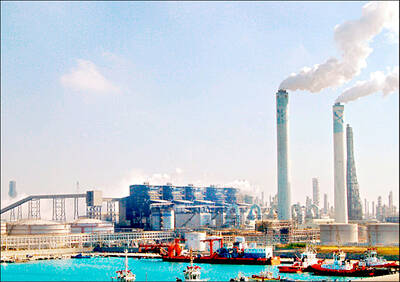
Taiwan Power Co (Taipower, 台電) yesterday said it plans to resume operations at two coal-fired power generators for three months to boost security of electricity supply as liquefied natural gas (LNG) supply risks are running high due to the Middle East conflict. The two coal-fired power generators are at Mailiao Power Plant in Yunlin County’s Mailiao Township (麥寮). The plant, operated by Formosa Plastics Group (台塑集團), supplied electricity to Taipower’s power grid until the end of last year. Taipower’s decision came about one month after Minister of Economic Affairs Kung Ming-hsin (龔明鑫) on March 10 said that the nation had no imminent
UNCERTAINTIES: Sales in the current quarter are expected to grow, but the impact of the volatile global political and economic situation should be monitored, Hon Hai said Hon Hai Precision Industry Co (鴻海精密) yesterday reported a 29.68 percent year-on-year rise in quarterly sales, a sign of sustained artificial intelligence (AI) demand during the first weeks of war in the Middle East. Revenue for the first quarter grew to NT$2.13 trillion (US$66.6 billion), while analysts on average were looking for NT$2.14 trillion. On a quarterly basis, revenue fell 18.18 percent, said Hon Hai, known internationally as Foxconn Technology Group (富士康科技集團). Concerns about a rush to build power-guzzling data centers are growing in the face of escalating conflict in the Middle East, which is putting pressure on global shipping


 RSS
RSS