


Contract electronics manufacturer Wistron Corp (緯創) yesterday said that it aims to set up a production facility in the US as the trade dispute between Washington and Beijing rages on.
“We sell one-third of our products in the US,” Wistron chairman Simon Lin (林憲銘) said at the annual shareholders’ meeting in Taipei, adding that the company is seeking to move one-third of its production out of China.
“We already have a site on the [US] west coast, but it is more oriented toward PM [product management], R&D [research and development] and sales,” Lin said.
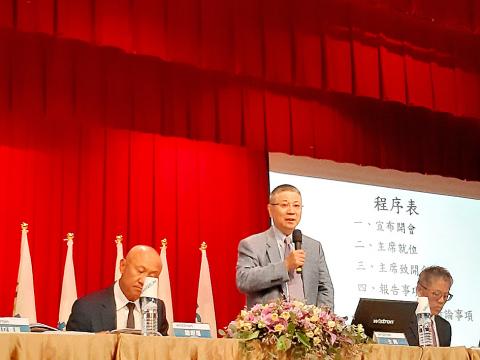
Photo: CNA
The company also has an after-sales service center in Dallas, Texas, but it is equally unsuitable for production, he said.
“We are currently considering three sites ... one in Texas, one on the east coast and another on the west coast,” Lin added.
The company is more interested in renting an existing facility to cut costs, he said.
“Normally, it would take us six to nine months to set up a production site,” but that process could be shortened to three months if, for example, Washington levied tariffs on another US$300 billion of Chinese goods, he said.
Given the unpredictable nature of relations between the US and China, Wistron had previously expanded production in countries such as Mexico, the Czech Republic, India, Malaysia and the Philippines.
Major clients agree that Wistron should keep two-thirds of its production in China, but a number of new customers are demanding specific products and recommending moving all production out of China, Lin said.
“For the new clients, we will move entire production lines to Malaysia, or back to the Hsinchu Science Park (新竹科學園區) in Taiwan,” Lin said, adding that the company has negotiated with clients to share the rising relocation costs.
The company might expand production capacity in Taiwan, because the plant in Hsinchu has reached full capacity, he said.
Wistron is relocating production for notebooks to Southeast Asia and also plans to move production of smartphone products, he added.
The company’s facilities in India mainly manufacture products that apply Internet of Things technologies to ATM payment gateways, but India has not been as supportive of the business sector as China, Lin said.
Most companies in India must wait more than four months to start a business there, while the Indian workforce lacks the consistency and discipline that their Chinese counterpart excel at, he added.
Overall, the trade war has an impact on the electronic components industry and the greatest challenge for the supply chain is the management of logistics, Lin said.
At the meeting, shareholders approved a proposal to distribute a cash dividend of NT$1.5 per share, representing a payout ratio of 85.23 percent based on last year’s earnings per share of NT$1.76.
That also implies a dividend yield of 6.28 percent based on the stock’s closing price of NT$23.9 in Taipei trading yesterday.
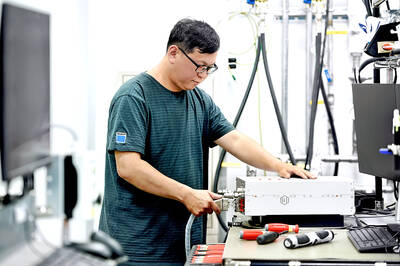
SEMICONDUCTORS: The German laser and plasma generator company will expand its local services as its specialized offerings support Taiwan’s semiconductor industries Trumpf SE + Co KG, a global leader in supplying laser technology and plasma generators used in chip production, is expanding its investments in Taiwan in an effort to deeply integrate into the global semiconductor supply chain in the pursuit of growth. The company, headquartered in Ditzingen, Germany, has invested significantly in a newly inaugurated regional technical center for plasma generators in Taoyuan, its latest expansion in Taiwan after being engaged in various industries for more than 25 years. The center, the first of its kind Trumpf built outside Germany, aims to serve customers from Taiwan, Japan, Southeast Asia and South Korea,

Gasoline and diesel prices at domestic fuel stations are to fall NT$0.2 per liter this week, down for a second consecutive week, CPC Corp, Taiwan (台灣中油) and Formosa Petrochemical Corp (台塑石化) announced yesterday. Effective today, gasoline prices at CPC and Formosa stations are to drop to NT$26.4, NT$27.9 and NT$29.9 per liter for 92, 95 and 98-octane unleaded gasoline respectively, the companies said in separate statements. The price of premium diesel is to fall to NT$24.8 per liter at CPC stations and NT$24.6 at Formosa pumps, they said. The price adjustments came even as international crude oil prices rose last week, as traders
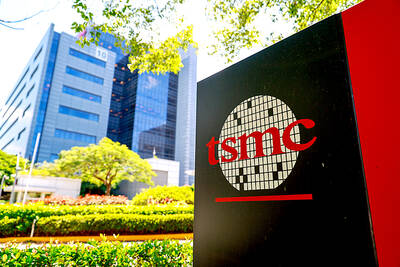
Taiwan Semiconductor Manufacturing Co (TSMC, 台積電), which supplies advanced chips to Nvidia Corp and Apple Inc, yesterday reported NT$1.046 trillion (US$33.1 billion) in revenue for last quarter, driven by constantly strong demand for artificial intelligence (AI) chips, falling in the upper end of its forecast. Based on TSMC’s financial guidance, revenue would expand about 22 percent sequentially to the range from US$32.2 billion to US$33.4 billion during the final quarter of 2024, it told investors in October last year. Last year in total, revenue jumped 31.61 percent to NT$3.81 trillion, compared with NT$2.89 trillion generated in the year before, according to
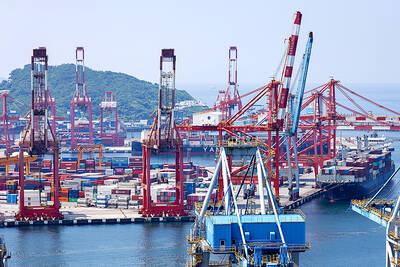
PRECEDENTED TIMES: In news that surely does not shock, AI and tech exports drove a banner for exports last year as Taiwan’s economic growth experienced a flood tide Taiwan’s exports delivered a blockbuster finish to last year with last month’s shipments rising at the second-highest pace on record as demand for artificial intelligence (AI) hardware and advanced computing remained strong, the Ministry of Finance said yesterday. Exports surged 43.4 percent from a year earlier to US$62.48 billion last month, extending growth to 26 consecutive months. Imports climbed 14.9 percent to US$43.04 billion, the second-highest monthly level historically, resulting in a trade surplus of US$19.43 billion — more than double that of the year before. Department of Statistics Director-General Beatrice Tsai (蔡美娜) described the performance as “surprisingly outstanding,” forecasting export growth


 RSS
RSS