


The Small and Medium Enterprise Administration (SMEA) on Monday unveiled a joint innovation center set up in collaboration with Amazon Web Services (AWS), Amazon.com Inc’s cloud-computing arm.
The new center is situated in the Start-up Terrace, an innovation park in New Taipei City’s Linkou District (林口), and is aimed at fostering unicorn start-ups, the SMEA said.
AWS is not investing in the innovation center, but it is providing cloud-computing resources and other material to start-ups, as well as international marketing experience and training, SMEA Deputy Director-General Betty Hu (胡貝蒂) told the Taipei Times by telephone yesterday.
“They [start-ups] might have good ideas or products, but often lack consistent business models and financial planning capabilities,” Hu said, adding that the innovation center would provide a common training platform.
AWS corporate vice president and managing director for greater China Alex Yung (容永康) last week said that AWS would train about 2,000 professionals a year by holding courses, workshops and seminars at the center.
The SMEA said it is working on increasing the number of start-ups to 150 within three years from about 70 now.
The SMEA has also signed memorandums of understanding with the Malaysian Global Innovation & Creativity Centre and Thailand’s True Digital Park in order to boost exchanges between start-ups in the three nations, it said.
CHIP RACE: Three years of overbroad export controls drove foreign competitors to pursue their own AI chips, and ‘cost US taxpayers billions of dollars,’ Nvidia said China has figured out the US strategy for allowing it to buy Nvidia Corp’s H200s and is rejecting the artificial intelligence (AI) chip in favor of domestically developed semiconductors, White House AI adviser David Sacks said, citing news reports. US President Donald Trump on Monday said that he would allow shipments of Nvidia’s H200 chips to China, part of an administration effort backed by Sacks to challenge Chinese tech champions such as Huawei Technologies Co (華為) by bringing US competition to their home market. On Friday, Sacks signaled that he was uncertain about whether that approach would work. “They’re rejecting our chips,” Sacks
Taiwan’s long-term economic competitiveness will hinge not only on national champions like Taiwan Semiconductor Manufacturing Co. (TSMC, 台積電) but also on the widespread adoption of artificial intelligence (AI) and other emerging technologies, a US-based scholar has said. At a lecture in Taipei on Tuesday, Jeffrey Ding, assistant professor of political science at the George Washington University and author of "Technology and the Rise of Great Powers," argued that historical experience shows that general-purpose technologies (GPTs) — such as electricity, computers and now AI — shape long-term economic advantages through their diffusion across the broader economy. "What really matters is not who pioneers

BUBBLE? Only a handful of companies are seeing rapid revenue growth and higher valuations, and it is not enough to call the AI trend a transformation, an analyst said Artificial intelligence (AI) is entering a more challenging phase next year as companies move beyond experimentation and begin demanding clear financial returns from a technology that has delivered big gains to only a small group of early adopters, PricewaterhouseCoopers (PwC) Taiwan said yesterday. Most organizations have been able to justify AI investments through cost recovery or modest efficiency gains, but few have achieved meaningful revenue growth or long-term competitive advantage, the consultancy said in its 2026 AI Business Predictions report. This growing performance gap is forcing executives to reconsider how AI is deployed across their organizations, it said. “Many companies
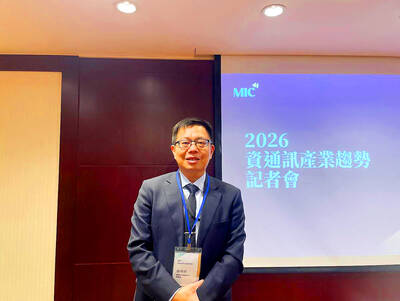
COST PRESSURE: Global PC brands such as HP Inc are expected to cope with the situation by either raising prices or downgrading their products, a researcher said Global PC shipments are expected to grow by a mere 0.3 percent to about 180 million units next year, as a surge in memory prices has added cost pressure on manufacturers, the Market Intelligence and Consulting Institute (MIC) said at a news conference in Taipei yesterday. As major memorychip suppliers such as Samsung Electronics Co and Micron Technology Inc shift resources and production capacity toward high-bandwidth memory, which is used primarily in servers and offers higher margins, the supply of low-power DRAM used in PCs and smartphones has been squeezed, tightening supply-demand conditions and pushing up prices, MIC ICT Industry Research


 RSS
RSS