


Crisis-hit Nissan Motor Co yesterday revealed full-year net profit at a near-decade low and forecast a further decline as it battles to recover after the shock arrest of its talismanic former chairman Carlos Ghosn.
The Japanese firm’s bottom-line profit for the fiscal year to March fell 57.3 percent to ¥319.1 billion (US$2.9 billion), the lowest since 2009-2010 when the company was struggling in the wake of the global financial crisis.
Sales fell 3.2 percent with operating profit down for a third straight year, said Nissan — which is allied with France’s Renault SA and fellow Japanese automaker Mitsubishi Motors Co.
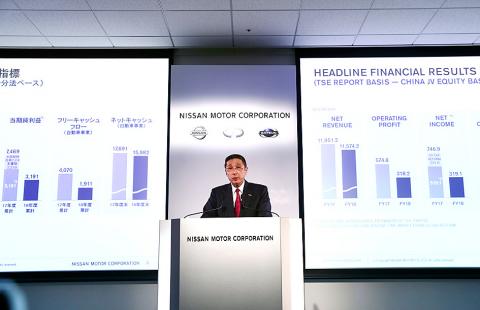
Photo: AFP
The results were in line with its revision announced last month.
For the year to March next year, Nissan said its net profit would nearly halve further to ¥170 billion, with sales projected to fall 2.4 percent.
The results came as Ghosn, now released on bail, awaits his fate after prosecutors hit him with a fourth set of charges over alleged financial misconduct.
Among other accusations, authorities suspect he syphoned off about US$5 million for his personal use from money transferred from Nissan to a dealership in Oman.
Ghosn denies that charge and insists he is innocent of all allegations against him.
Tokyo prosecutors have filed a request to revise the content of their indictment of Ghosn for aggravated breach of trust, providing further details on alleged cash transfers involving the former Nissan chairman and a Saudi Arabian friend, Kyodo news reported.
Separately, Nissan is looking to invest in a Chinese electric vehicle start-up, according to people familiar with the matter, to provide it with a greater footprint in the world’s biggest market for new-energy vehicles.
The Japanese company wants to buy a stake of as much as 25 percent in a Chinese electric vehicle maker and it has narrowed the potential targets to start-ups including WM Motor Technology Co (威馬汽車), Zhejiang Hozon New Energy Automobile Co (合眾新能源汽車) and CHJ Automotive Co (車和家), said the people, asking not to be named as the plan is not public.
The plans signal that Nissan is looking to push ahead with ambitions in electric vehicles started when Ghosn was still chairman.
While Ghosn was arrested in November last year on charges of financial misconduct, throwing Nissan’s alliance with Renault into turmoil, the Japanese automaker cannot afford to take its eye off the Chinese market, with rivals including Volkswagen AG and Tesla Inc doubling down in the nation.
Additional reporting by Bloomberg

Nvidia Corp chief executive officer Jensen Huang (黃仁勳) on Monday introduced the company’s latest supercomputer platform, featuring six new chips made by Taiwan Semiconductor Manufacturing Co (TSMC, 台積電), saying that it is now “in full production.” “If Vera Rubin is going to be in time for this year, it must be in production by now, and so, today I can tell you that Vera Rubin is in full production,” Huang said during his keynote speech at CES in Las Vegas. The rollout of six concurrent chips for Vera Rubin — the company’s next-generation artificial intelligence (AI) computing platform — marks a strategic
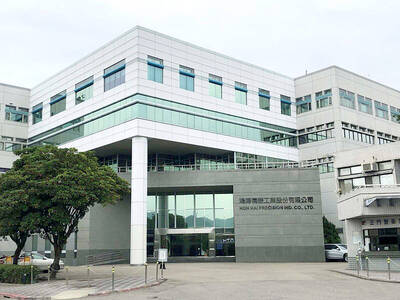
REVENUE PERFORMANCE: Cloud and network products, and electronic components saw strong increases, while smart consumer electronics and computing products fell Hon Hai Precision Industry Co (鴻海精密) yesterday posted 26.51 percent quarterly growth in revenue for last quarter to NT$2.6 trillion (US$82.44 billion), the strongest on record for the period and above expectations, but the company forecast a slight revenue dip this quarter due to seasonal factors. On an annual basis, revenue last quarter grew 22.07 percent, the company said. Analysts on average estimated about NT$2.4 trillion increase. Hon Hai, which assembles servers for Nvidia Corp and iPhones for Apple Inc, is expanding its capacity in the US, adding artificial intelligence (AI) server production in Wisconsin and Texas, where it operates established campuses. This

Garment maker Makalot Industrial Co (聚陽) yesterday reported lower-than-expected fourth-quarter revenue of NT$7.93 billion (US$251.44 million), down 9.48 percent from NT$8.76 billion a year earlier. On a quarterly basis, revenue fell 10.83 percent from NT$8.89 billion, company data showed. The figure was also lower than market expectations of NT$8.05 billion, according to data compiled by Yuanta Securities Investment and Consulting Co (元大投顧), which had projected NT$8.22 billion. Makalot’s revenue this quarter would likely increase by a mid-teens percentage as the industry is entering its high season, Yuanta said. Overall, Makalot’s revenue last year totaled NT$34.43 billion, down 3.08 percent from its record NT$35.52
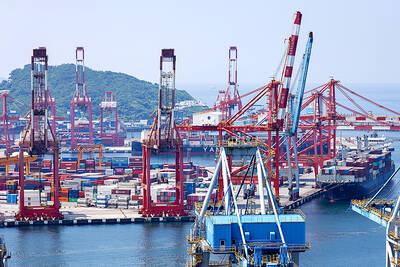
PRECEDENTED TIMES: In news that surely does not shock, AI and tech exports drove a banner for exports last year as Taiwan’s economic growth experienced a flood tide Taiwan’s exports delivered a blockbuster finish to last year with last month’s shipments rising at the second-highest pace on record as demand for artificial intelligence (AI) hardware and advanced computing remained strong, the Ministry of Finance said yesterday. Exports surged 43.4 percent from a year earlier to US$62.48 billion last month, extending growth to 26 consecutive months. Imports climbed 14.9 percent to US$43.04 billion, the second-highest monthly level historically, resulting in a trade surplus of US$19.43 billion — more than double that of the year before. Department of Statistics Director-General Beatrice Tsai (蔡美娜) described the performance as “surprisingly outstanding,” forecasting export growth


 RSS
RSS