


Local shares on Friday closed slightly lower after the market reacted to the US’ increase of punitive tariffs on US$200 billion of imported Chinese goods that took effect at noon in Taipei, dealers said.
The bellwether electronics sector led the downturn, but some investors parked their funds in select old economy and financial stocks to lend some support to the broader market, they said.
The TAIEX on Friday ended down 20.68 points, or 0.19 percent, at 10,712.99, after moving between 10,669.39 and 10,834.69. Turnover was NT$124.49 billion (US$4.02 billion).
That was a drop of 3.5 percent from a close of 11,096.30 on May 3.
The market opened up 0.17 percent and rose to the day’s high at about 10am on a technical rebound from a session earlier, when the weighted index ended down 1.74 percent because of ongoing trade friction between the US and China, dealers said.
However, with the TAIEX surpassing 10,800 points and the increase in punitive tariffs on imported Chinese goods from 10 percent to 25 percent taking effect, selling set in to pull the market into negative territory before some late buying limited the losses, they said.
“The earlier gains were simply technical in nature from the plunge a session earlier,” Hua Nan Securities Co (華南永昌證券) analyst Kevin Su (蘇俊宏) said.
“Concerns over the global trade issue still dictated market sentiment, in particular the implementation of the 25 percent tariffs,” he said.
The US announced that it would carry out the tariff increase against China, effective from 12:01am on Friday, after the first day of the latest round of trade talks in Washington on Thursday did not yield satisfactory results.
“We have to pay close attention to how the ongoing trade talks will proceed after the negotiations resume Friday,” Su said.
“The market is also worried about potential new 25 percent tariffs on an additional US$325 billion of Chinese goods as US President Donald Trump threatened on Sunday [last week],” he said.
The electronics sector continued to dominate the movement of the broader market throughout the session on Friday, Su said.
The subindex for the sector closed down 0.37 percent at 439.41, off a high of 445.33.
Among the falling large-cap tech stocks, contract chipmaker Taiwan Semiconductor Manufacturing Co (TSMC, 台積電), the most heavily weighted stock on the local market, fell 0.19 percent to close at NT$256, with 18.6 million shares changing hands, after hitting a high of NT$259.
Hon Hai Precision Industry Co (鴻海精密), an assembler of Apple Inc’s iPhones that is second to TSMC in terms of market cap, lost 0.71 percent to end at NT$83.70, off a high of NT$85.60, while Largan Precision Co (大立光), a supplier of smartphone camera lenses to Apple, rose 1.02 percent to close at NT$4,455 amid optimism over its sales this month.
Among the gaining old economy stocks, food conglomerate Uni-President Enterprises Corp (統一企業) rose 1.05 percent to close at NT$77.30, Formosa Chemicals & Fibre Corp (台灣化纖) added 0.94 percent to end at NT$107 and Formosa Plastics Corp (台灣塑膠) gained 0.92 percent to close at NT$109.50.
In the financial sector, which closed up 0.05 percent, CTBC Bank (中信銀行) rose 1.68 percent to end at NT$21.20 and Shanghai Commercial & Savings Bank (上海商業儲蓄銀行) added 0.80 percent to close at NT$50.70, while Cathay Financial Holding Co (國泰金控) fell 0.69 percent to end at NT$43.20.
Foreign institutional investors on Friday sold a net NT$3.78 billion in shares, Taiwan Stock Exchange data showed.
“While foreign institutional investors dumped their holdings today, I’m guessing government-led funds stood on the buy side to prevent the TAIEX from falling further at a time of rising trade tensions,” Su said.
“The market is still facing stiff technical resistance ahead of 10,800 points for the moment,” he added.
Elsewhere on Friday, Shanghai led gains across most Asian markets at the end of a torrid week for equities, with investors keeping a eye on the China-US trade talks after Washington hiked tariffs.
Equities in Asia started well as dealers took heart from positive comments from Trump on the prospects for a deal, but the region turned negative as the threatened levies kicked in and China vowed to hit back, saying that it “deeply” regretted the US move.
However, Shanghai and Hong Kong bounced back on hopes that the economic superpowers would be able to reach a deal to avert a trade war that most observers warn could shatter global growth and batter markets.
The tariffs came into effect after the first day of high-stakes negotiations in Washington between Chinese Vice Premier Liu He (劉鶴), US Trade Representative Robert Lighthizer and US Secretary of the Treasury Steven Mnuchin.
After a week in which trading floors have been a sea of red, regional equities were given a lift by Trump saying that he had received a “beautiful letter” from Chinese President Xi Jinping (習近平) and that it was “possible” to get a deal.
The Shanghai Composite, which from Monday to Thursday lost more than 7 percent, on Friday ended up 88.26 points, or 3.1 percent, at 2,939.21, but plunged 4.5 percent from a close of 3,078.34 on April 30, the last day of trading before a long weekend for International Workers’ Day.
Meanwhile, Hong Kong’s Hang Seng on Friday piled on 239.17 points, or 0.8 percent, to close at 28,550.24, but dropped 3.9 percent from 29,699.11 on April 30.
Seoul’s KOSPI on Friday edged up 6.03 points, or 0.3 percent, to 2,108.04, plummeting 4 percent from a close of 2,196.32 on May 3, as investors brushed off news that North Korea had tested a long-range weapon, which is likely to raise tensions after a breakdown of denuclearization talks with the US.
Sydney and Singapore each added 0.3 percent.
However, Tokyo’s Nikkei 225 on Friday slid 57.21 points, or 0.3 percent, to 21,344.92, a drop of 4.1 percent from a close of 22,258.73 on April 26, the last day of trading before a long national holiday to celebrate the ascension of Japanese Emperor Naruhito to the Chrysanthemum Throne.
Wellington, Manila and Mumbai also fell.
“Given the deadline has now passed, there is the possibility that tariffs could still be avoided given that US officials allowed for goods currently in transit to be exempt from the new tariff increases,” CMC Markets UK chief market analyst Michael Hewson said. “Which means there is a potential window, albeit a limited one, for an agreement to be hammered out.”
“Markets will be in a holding pattern as we await the outcome of the meeting,” Australia and New Zealand Banking Group Ltd head of Asia research Khoon Goh said. “If there is a breakdown and the tariffs go up, then we will see a risk-off tone in markets.”
That tariffs were to rise midway through the talks gave “precious little time to come up with something that satisfies both sides,” Oanda Corp senior market analyst Jeffrey Halley said.
Although markets were up, “the peace is fragile, and it won’t take much today to panic investors into heading for the exit door en masse,” he added.
Halley also warned that while Trump praised Xi’s letter, it was hard “to see how either of these two presidents will ever manage to really share the toys and play nicely on the global stage.”
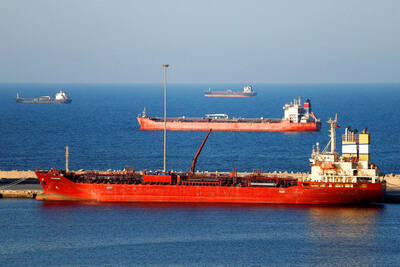
HORMUZ ISSUE: The US president said he expected crude prices to drop at the end of the war, which he called a ‘minor excursion’ that could continue ‘for a little while’ The United Arab Emirates (UAE) and Kuwait started reducing oil production, as the near-closure of the crucial Strait of Hormuz ripples through energy markets and affects global supply. Abu Dhabi National Oil Co (ADNOC) is “managing offshore production levels to address storage requirements,” the company said in a statement, without giving details. Kuwait Petroleum Corp said it was lowering production at its oil fields and refineries after “Iranian threats against safe passage of ships through the Strait of Hormuz.” The war in the Middle East has all but closed Hormuz, the narrow waterway linking the Persian Gulf to the open seas,
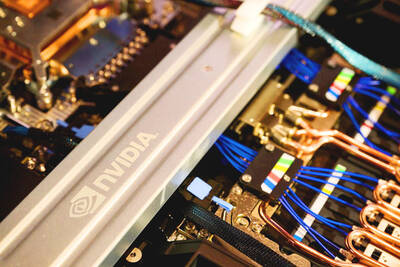
RATIONING: The proposal would give the Trump administration ample leverage to negotiate investments in the US as it decides how many chips to give each country US officials are debating a new regulatory framework for exporting artificial intelligence (AI) chips and are considering requiring foreign nations to invest in US AI data centers or security guarantees as a condition for granting exports of 200,000 chips or more, according to a document seen by Reuters. The rules are not yet final and could change. They would be the first attempt to regulate the flow of AI chips to US allies and partners since US President Donald Trump’s administration said it rescinded its predecessor’s so-called AI diffusion rules. Those rules sought to keep a significant amount of AI

Apple Inc increased iPhone production in India by about 53 percent last year and now makes a quarter of its marquee devices there, reflecting the US company’s efforts to avoid tariffs on China. The company assembled about 55 million iPhones in India last year, up from 36 million a year earlier, people familiar with the matter said, asking not to be named because the numbers aren’t public. Apple makes about 220 million to 230 million iPhones a year globally, with India’s share of the total increasing rapidly. Apple has accelerated its expansion in the world’s most populous country in recent years, bolstered
HEADWINDS: The company said it expects its computer business, as well as consumer electronics and communications segments to see revenue declines due to seasonality Pegatron Corp (和碩) yesterday said it aims to grow its artificial intelligence (AI) server revenue more than 10-fold this year from last year, driven by orders from neocloud solutions clients and large cloud service providers. The electronics manufacturing service provider said AI server revenue growth would be driven primarily by the Nvidia Corp GB300 server platform. Server shipments are expected to increase each quarter this year, with the second half likely to outperform the first half, it said. The AI server market is expected to broaden this year as more inference applications emerge, which would drive demand for system-on-chip, application-specific integrated circuits


 RSS
RSS