


Luckin Coffee Inc (瑞幸咖啡), an ambitious start-up that is challenging Starbucks Corp in the race to dominate China’s growing coffee culture, is seeking to raise as much as US$510 million in its US initial public offering (IPO).
The Xiamen-based company said in a filing on Monday that it is planning to sell 30 million US depositary shares for US$15 to US$17 each.
At that range, it would be the sixth-largest of the 53 IPOs on US exchanges so far this year, according to data compiled by Bloomberg.
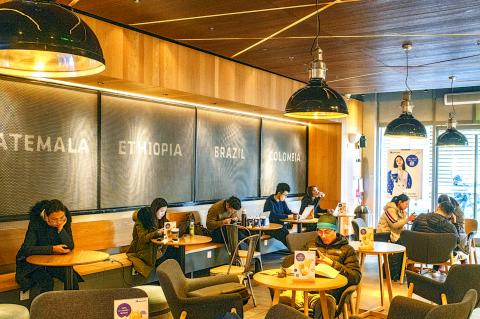
Photo: Bloomberg
It would also top the company’s earlier plan for a US$300 million share sale described previously by people familiar with the matter.
Including a private placement for about US$50 million with Louis Dreyfus Co, Luckin would have a value of as much as US$4 billion at US$17 a share based on the shares to be outstanding after the listing, according to the filing.
Luckin is spending millions of US dollars a year opening outlets to unseat Starbucks as China’s top coffee company. Since its inception in June 2017, Luckin has quickly expanded into 2,370 stores in 28 cities, with backing from investors including Singapore sovereign wealth fund GIC Pte and China International Capital Corp (中國國際金融).
By the end of this year, Luckin aims to become the largest coffee network in China in terms of number of stores.
It faces an uphill battle against Starbucks, which entered China 20 years ago and dominates with more than half of the market last year, according to Euromonitor.
Luckin held only a 2.1 percent share last year. Starbucks has more than 3,700 outlets in the country and is also expanding at break-neck speed, opening a new store about every 15 hours. It is aiming to have 6,000 sites in China by 2023.
Chasing the entrenched rival has been costly. Luckin said it is burning through US$130 million a year and might continue to see losses in the future.
The company reported a net loss of US$241 million for last year, on total revenue of US$125 million. It lost US$82 million on revenue of US$71 million during the first quarter.
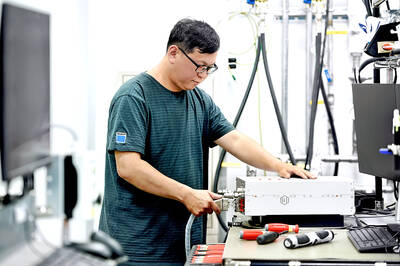
SEMICONDUCTORS: The German laser and plasma generator company will expand its local services as its specialized offerings support Taiwan’s semiconductor industries Trumpf SE + Co KG, a global leader in supplying laser technology and plasma generators used in chip production, is expanding its investments in Taiwan in an effort to deeply integrate into the global semiconductor supply chain in the pursuit of growth. The company, headquartered in Ditzingen, Germany, has invested significantly in a newly inaugurated regional technical center for plasma generators in Taoyuan, its latest expansion in Taiwan after being engaged in various industries for more than 25 years. The center, the first of its kind Trumpf built outside Germany, aims to serve customers from Taiwan, Japan, Southeast Asia and South Korea,
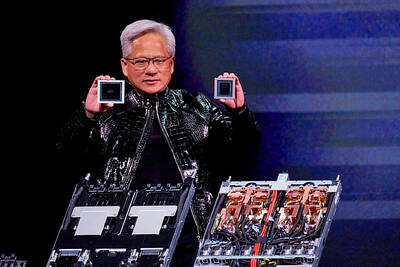
Nvidia Corp chief executive officer Jensen Huang (黃仁勳) on Monday introduced the company’s latest supercomputer platform, featuring six new chips made by Taiwan Semiconductor Manufacturing Co (TSMC, 台積電), saying that it is now “in full production.” “If Vera Rubin is going to be in time for this year, it must be in production by now, and so, today I can tell you that Vera Rubin is in full production,” Huang said during his keynote speech at CES in Las Vegas. The rollout of six concurrent chips for Vera Rubin — the company’s next-generation artificial intelligence (AI) computing platform — marks a strategic

Gasoline and diesel prices at domestic fuel stations are to fall NT$0.2 per liter this week, down for a second consecutive week, CPC Corp, Taiwan (台灣中油) and Formosa Petrochemical Corp (台塑石化) announced yesterday. Effective today, gasoline prices at CPC and Formosa stations are to drop to NT$26.4, NT$27.9 and NT$29.9 per liter for 92, 95 and 98-octane unleaded gasoline respectively, the companies said in separate statements. The price of premium diesel is to fall to NT$24.8 per liter at CPC stations and NT$24.6 at Formosa pumps, they said. The price adjustments came even as international crude oil prices rose last week, as traders
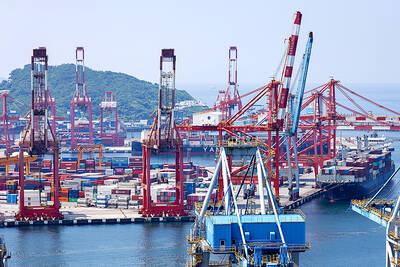
PRECEDENTED TIMES: In news that surely does not shock, AI and tech exports drove a banner for exports last year as Taiwan’s economic growth experienced a flood tide Taiwan’s exports delivered a blockbuster finish to last year with last month’s shipments rising at the second-highest pace on record as demand for artificial intelligence (AI) hardware and advanced computing remained strong, the Ministry of Finance said yesterday. Exports surged 43.4 percent from a year earlier to US$62.48 billion last month, extending growth to 26 consecutive months. Imports climbed 14.9 percent to US$43.04 billion, the second-highest monthly level historically, resulting in a trade surplus of US$19.43 billion — more than double that of the year before. Department of Statistics Director-General Beatrice Tsai (蔡美娜) described the performance as “surprisingly outstanding,” forecasting export growth


 RSS
RSS