


Chunghwa Telecom Co (中華電信) aims to increase the number of multimedia-on-demand (MOD) subscribers by 10 percent this year, thanks to a major regulatory change, the nation’s biggest telecom said yesterday.
The National Communication Commission (NCC) earlier this year eased restrictions on Chunghwa Telecom’s MOD business, known as Internet TV, allowing the company greater flexibility in content offerings and increased profitability.
“In January, the NCC allowed us to package MOD channels freely to satisfy user demand. We believe that the change will give us a more favorable market environment and help us grow the MOD business,” Chunghwa Telecom chairman Sheih Chi-mau (謝繼茂) told an investors’ conference.
The company has teamed up with Netflix Inc along with other strategic partners to enrich its content offering, he said.
However, the company said that it could take longer to turn around the MOD business, which has been losing money since its inception 14 years ago.
Its MOD business briefly broke even last quarter after the subscriber base reached 2.05 million, the company said.
The business added 72,000 subscribers last year, from 1.3 million at the end of 2017, it said, adding that the total is expected to reach 2.2 million this year.
“A complete turnaround might take a year or two,” deputy spokeswoman Shen Fu-fu (沈馥馥) said, citing company estimates.
“To break even, the average revenue per user [ARPU] would need to be a bit higher [than the current level],” Shen said.
The MOD business had an ARPU of about NT$432 last quarter, totaling NT$889 million (US$28.77 million) in revenue.
The company’s core mobile business this year, as indicated by the segment’s ARPU, continues to be trapped in a downward spiral, the company said.
“As SIM card-only adoption continues to decrease and the handset replacement cycle becomes longer, we expect the decline in the segment’s ARPU to persist,” Sheih said.
To avert the downtrend, the company plans to launch more handsets bundled with rate plans and other incentive services to boost service revenue and the company’s margin, he said.
First-quarter revenue fell 4.3 percent year-on-year to NT$51.33 billion — below the company’s guidance of NT$52.43 billion to NT$52.72 billion — due to lower mobile revenue amid price competition, it said.
Net profit shrank 4.3 percent annually to NT$8.3 billion, meeting the company’s guidance of between NT$8.25 billion and NT$8.43 billion. Earnings per share were NT$1.08 for last quarter.
The company plans to spend NT$29 billion on equipment this year, higher than the NT$28.6 billion last year. Most investment would be to improve fiber optic, broadband and cloud-based infrastructure.
Capital spending would be the lowest in five years.


Taiwan’s foreign exchange reserves fell below the US$600 billion mark at the end of last month, with the central bank reporting a total of US$596.89 billion — a decline of US$8.6 billion from February — ending a three-month streak of increases. The central bank attributed the drop to a combination of factors such as outflows by foreign institutional investors, currency fluctuations and its own market interventions. “The large-scale outflows disrupted the balance of supply and demand in the foreign exchange market, prompting the central bank to intervene repeatedly by selling US dollars to stabilize the local currency,” Department of Foreign

Intel Corp is joining Elon Musk’s long-shot effort to develop semiconductors for Tesla Inc, Space Exploration Technologies Corp and xAI, marking a surprising twist in the chipmaker’s comeback bid. Intel would help the Terafab project “refactor” the technology in a chip factory, the company said on Tuesday in a post on X, Musk’s social media platform. That is a stage in the development process that typically helps make chips more powerful or reliable. The chipmaker’s shares jumped 4.2 percent to US$52.91 in New York trading on Tuesday. The Terafab project is a grand plan by Musk to eventually manufacture his own chips for
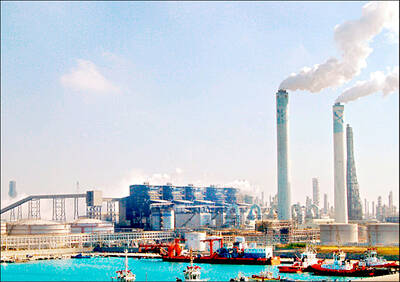
Taiwan Power Co (Taipower, 台電) yesterday said it plans to resume operations at two coal-fired power generators for three months to boost security of electricity supply as liquefied natural gas (LNG) supply risks are running high due to the Middle East conflict. The two coal-fired power generators are at Mailiao Power Plant in Yunlin County’s Mailiao Township (麥寮). The plant, operated by Formosa Plastics Group (台塑集團), supplied electricity to Taipower’s power grid until the end of last year. Taipower’s decision came about one month after Minister of Economic Affairs Kung Ming-hsin (龔明鑫) on March 10 said that the nation had no imminent

ENERGY ISSUES: The TSIA urged the government to increase natural gas and helium reserves to reduce the impact of the Middle East war on semiconductor supply stability Chip testing and packaging service provider ASE Technology Holding Co (日月光投控) yesterday said it planned to invest more than NT$100 billion (US$3.15 billion) in building a new advanced chip testing facility in Kaohsiung to keep up with customer demand driven by the artificial intelligence (AI) boom. That would be included in the company’s capital expenditure budget next year, ASE said. There is also room to raise this year’s capital spending budget from a record-high US$7 billion estimated three months ago, it added. ASE would have six factories under construction this year, another record-breaking number, ASE chief operating officer Tien Wu


 RSS
RSS