


The nation’s exports last month contracted 4.4 percent from a year earlier to US$28.68 billion, after an 8.8 percent decline in February, as demand for electronics remained soft in the traditional slow season, the Ministry of Finance said yesterday.
However, improving business confidence might nudge outbound shipments temporarily back into growth territory this month, as the US and China negotiate further and seek to end their trade differences, the ministry said.
“Exports have a moderate chance of increasing by 2.5 percent this month, as companies recover some confidence,” Department of Statistics Director-General Beatrice Tsai (蔡美娜) said.
The increase might not be enough to reverse a quarterly decline for the April-to-June period, when technology brands typically remain low key ahead of the release of next-generation models in the fall, Tsai said.
Taiwan is home to major contract manufacturers of electronics components critical to smartphones, laptops, TVs and peripheral devices, the ministry said in a report, but flagging smartphone sales caused electronics shipments to fall 13.3 percent to US$9.14 billion.
Electronics shipments form the bulk of overall exports, a 31.9 percent share, the report said, adding that semiconductor shipments in particular shrank 12.9 percent to US$8.1 billion.
Hsinchu-based Taiwan Semiconductor Manufacturing Co (台積電) has signaled that its performance should improve each quarter this year, raising hopes that the worst is over, Tsai said.
A brighter outlook helps explain why imports of capital equipment advanced 34.9 percent to US$5.18 billion, with purchases by local semiconductor firms increasing 83.1 percent, Tsai added.
Capacity expansion and needed upgrades pushed up imports by 6.6 percent to US$25.56 billion, decreasing the trade surplus by 48.1 percent from a year earlier to US$3.12 billion, the report said.
Stabilizing prices for oil and raw materials also lent support to businesses, as a decline in the export of products from base metals, chemicals and minerals eased in a range from 4.5 to 8.9 percent, from a double-digit percentage pace in February, it said.
First-quarter exports contracted 4.2 percent from last year, worse than the 2.81 percent drop projected by the Directorate-General of Budget, Accounting and Statistics in February.
Imports fared better than expected with a 0.8 percent decline, compared with a predicted 2.46 percent retreat. The statistics agency is due to update its growth forecast next month.
The US-China trade dispute helped cut Taiwan’s dependence on Chinese markets by 3.01 percentage points and ASEAN markets by 1.53 percentage points, as some companies based in China relocated to avoid extra tariffs imposed by Washington on Chinese exports, the ministry said.
The US increased as an export destination by 2.87 percentage points, while South Korea increased by 1.02 percentage points, it added.

Elon Musk’s lieutenants have reached out to chip industry suppliers, including Applied Materials Inc, Tokyo Electron Ltd and Lam Research Corp, for his envisioned Terafab, early steps in an audacious and likely arduous attempt to break into the production of cutting-edge chips. Staff working for the joint venture between Tesla Inc and Space Exploration Technologies Corp (SpaceX) have sought price quotes and delivery times for an array of chipmaking gear, people familiar with the matter said. In past weeks, they’ve contacted makers of photomasks, substrates, etchers, depositors, cleaning devices, testers and other tools, according to the people, who asked not to
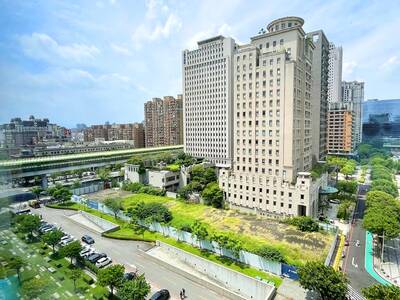
Taichung reported the steepest fall in completed home prices among the six special municipalities in the first quarter of this year, data compiled by Taiwan Realty Co (台灣房屋) showed yesterday. From January through last month, the average transaction price for completed homes in Taichung fell 8 percent from a year earlier to NT$299,000 (US$9,483) per ping (3.3m²), said Taiwan Realty, which compiled the data based on the government’s price registration platform. The decline could be attributed to many home buyers choosing relatively affordable used homes to live in themselves, instead of newly built homes in the city’s prime property market, Taiwan Realty
The government yesterday approved applications by Alphabet Inc’s Google to invest NT$27.08 billion (US$859.98 million) in Taiwan, the Ministry of Economic Affairs said in a statement. The Department of Investment Review approved two investments proposed by Google, with much of the funds to be used for data processing and electronic information supply services, as well as inventory procurement businesses in the semiconductor field, the ministry said. It marks the second consecutive year that Google has applied to increase its investment in Taiwan. Google plans to infuse NT$25.34 billion into Charter Investments Ltd (特許投資顧問) through its Singapore-based subsidiary Fructan Holdings Singapore Pte Ltd, and

JET JUICE: The war on Iran’s secondary effects have seen fuel prices skyrocket, knocking flight schedules down to earth in return as airlines struggle with costs Airline passengers should brace for more irritation in the next few months as carriers worldwide cancel flights and ground planes to cope with stratospheric increases in jet-fuel prices. Dutch flag carrier KLM is the latest company to cut its schedule, saying on Thursday that it would scrap 80 return flights at Amsterdam’s Schiphol Airport in the coming month. That puts it in the same league as United Airlines Holdings Inc, Deutsche Lufthansa AG and Cathay Pacific Airways Ltd, which have all pruned itineraries to mitigate costs. Global capacity for next month has been reduced by about 3 percentage points, with all


 RSS
RSS