


Taiwan Mobile Co (台灣大哥大) yesterday said it is to create a huge 5G ecosystem by leveraging the company’s strengths and collaborating with AppWorks Venture (之初創投) to incubate more technology start-ups, a move that is to play a crucial part in boosting the telecom’s market capital to US$100 billion in the next decade.
The company’s new president, Jamie Lin (林之晨), cofounder of start-up accelerator AppWorks, proposed the plan.
Lin was handpicked by Taiwan Mobile chairman Daniel Tsai (蔡明忠) and took the position on Monday.
Taiwan Mobile is the telecom arm of Fubon Financial Holding Co (富邦金控), which is owned by the Tsai family.
Lin, 41, is the youngest executive in the history of the nation’s telecom industry.
His appointment came as local telecoms are scrambling to transform into technology service providers in the 5G era.
“I set a mid-to-long-term target to expand the company’s operations. We have identified Momo.com Inc (富邦媒體) as our growth [driver] in the second leg,” Lin told a media briefing.
Momo.com, a TV and online retailer, could be developed into an enormous retail company like Amazon.com, Lin said.
“We are seeking to build third, fourth and even fifth legs of growth [drivers],” Lin said. “Our goal is to create a multinational company with a market value of US$100 billion in 10 to 15 years.”
Taiwan Mobile, the nation’s No. 2 telecom, was valued at NT$37.79 billion (US$1.23 billion) after its shares closed at NT$110.5 yesterday in Taipei trading.
The company has about 3.42 billion outstanding shares.
Asked how to achieve the “eye-popping” goal, Lin said that Taiwan Mobile is to provide technology-based services by leveraging the strength of Fubon’s subsidiaries, including Momo.com and cable TV system operator Kbro Co (凱擘).
It is important to create a 5G ecosystem with AppWorks and other companies to offer new services for every vertical sector, he said.
“Telecoms are no longer relying on selling bandwidth or mobile phones” to generate revenue, Lin said. “Telecoms will become more like software providers, which is an area I am good at.”
Lin gave the example of offering virtual reality services for basketball fans to watch US National Basketball Association games.
Taiwan Mobile has worked with AppWorks on six or seven projects, and more are coming, Lin said, adding that it is considering investing in AppWorks.
AppWorks has helped create 328 technology start-ups and expects to absorb 70 teams per year.

Nvidia Corp chief executive officer Jensen Huang (黃仁勳) on Monday introduced the company’s latest supercomputer platform, featuring six new chips made by Taiwan Semiconductor Manufacturing Co (TSMC, 台積電), saying that it is now “in full production.” “If Vera Rubin is going to be in time for this year, it must be in production by now, and so, today I can tell you that Vera Rubin is in full production,” Huang said during his keynote speech at CES in Las Vegas. The rollout of six concurrent chips for Vera Rubin — the company’s next-generation artificial intelligence (AI) computing platform — marks a strategic
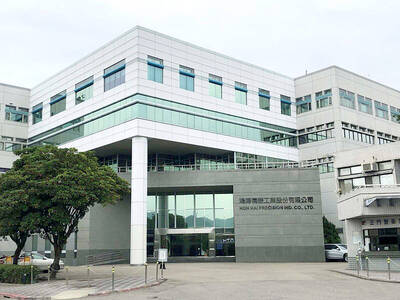
REVENUE PERFORMANCE: Cloud and network products, and electronic components saw strong increases, while smart consumer electronics and computing products fell Hon Hai Precision Industry Co (鴻海精密) yesterday posted 26.51 percent quarterly growth in revenue for last quarter to NT$2.6 trillion (US$82.44 billion), the strongest on record for the period and above expectations, but the company forecast a slight revenue dip this quarter due to seasonal factors. On an annual basis, revenue last quarter grew 22.07 percent, the company said. Analysts on average estimated about NT$2.4 trillion increase. Hon Hai, which assembles servers for Nvidia Corp and iPhones for Apple Inc, is expanding its capacity in the US, adding artificial intelligence (AI) server production in Wisconsin and Texas, where it operates established campuses. This

Garment maker Makalot Industrial Co (聚陽) yesterday reported lower-than-expected fourth-quarter revenue of NT$7.93 billion (US$251.44 million), down 9.48 percent from NT$8.76 billion a year earlier. On a quarterly basis, revenue fell 10.83 percent from NT$8.89 billion, company data showed. The figure was also lower than market expectations of NT$8.05 billion, according to data compiled by Yuanta Securities Investment and Consulting Co (元大投顧), which had projected NT$8.22 billion. Makalot’s revenue this quarter would likely increase by a mid-teens percentage as the industry is entering its high season, Yuanta said. Overall, Makalot’s revenue last year totaled NT$34.43 billion, down 3.08 percent from its record NT$35.52

PRECEDENTED TIMES: In news that surely does not shock, AI and tech exports drove a banner for exports last year as Taiwan’s economic growth experienced a flood tide Taiwan’s exports delivered a blockbuster finish to last year with last month’s shipments rising at the second-highest pace on record as demand for artificial intelligence (AI) hardware and advanced computing remained strong, the Ministry of Finance said yesterday. Exports surged 43.4 percent from a year earlier to US$62.48 billion last month, extending growth to 26 consecutive months. Imports climbed 14.9 percent to US$43.04 billion, the second-highest monthly level historically, resulting in a trade surplus of US$19.43 billion — more than double that of the year before. Department of Statistics Director-General Beatrice Tsai (蔡美娜) described the performance as “surprisingly outstanding,” forecasting export growth


 RSS
RSS