


Equity investors are advised to pick stocks that have stable profitability and growth potential, or switch to defensive stocks as the local bourse appears to be about to encounter technical corrections after a strong rebound over the past few weeks, analysts said.
“The main bourse has rebounded recently along with the climb in US equities, with the TAIEX reaching 10,439.24 points on Friday to hit the highest level this year, in part because of investor optimism toward the US Federal Reserve’s monetary policy and the US-China trade talks,” Jih Sun Securities Investment Trust Co (日盛投信) fund manager Chang Ya-wei (張亞瑋) said in a note on Friday.
However, local equities might be confined to narrow-range trading in the near future, because of the market’s worries over recent economic data released by the US and China, which pointed to a potential downside risk to the business climate, he said.
The year-to-date upturn in stocks might also lead some investors to lock in profits for the time being, pushing the market toward consolidation, he added.
Against this backdrop, Jih Sun’s suggestions for investors are to pick companies that have steady business operations, better market visibility and high dividend yields, such as those engaged in the 5G, Internet of Things, server, optical lens and lithium-ion battery businesses.
Performance of local equities going forward might also depend on the progress of inventory adjustments in the electronics supply chains and how companies in tech and non-tech sectors react to the ongoing US-China trade spat, Allianz Global Investors Taiwan Ltd (安聯投信) said.
Another adviser said that the best strategy is to look for companies with well-managed cash flows and high dividends in an economic downturn.
“Those with higher than 100 percent in the operating cash flow-to-capex ratio and the operating cash flow-to-net income ratio are relatively well-positioned to generate strong cash flows to fund capital expenditure needs,” Yuanta Securities Investment Consulting Co (元大投顧) analyst Vincent Chen (陳豊丰) said in a note. “This also indicates that those companies have less need to support their capital expenditure requirements by means of debt or equity fundraising.”
Companies offering decent dividend yields are also worthy of further exploration if investors are to seek defensive plays, he added.
Taiwan’s equity benchmarks have regained some stability this quarter after a terrible previous quarter that was driven by a global market rout.
The TAIEX has gained 7.32 percent so far this year, and the TPEX for mainly small-capitalization stocks has risen 11.42 percent. The Formosa Index, which tracks the performance of the main board and the over-the-counter market, has increased 7.68 percent over the same period.
All of those strong showings might buoy investors as the market approaches the end of this quarter, but analysts said that listed companies’ revenue performance for last month and their financial results for the first quarter could soon serve as a reality check for the market, before seeing the TAIEX test the yearly moving average of about 10,451 points.
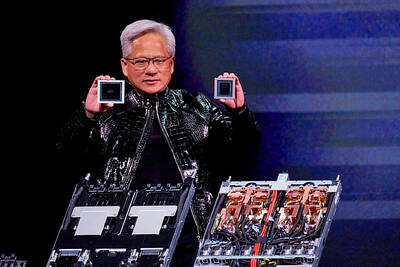
Nvidia Corp chief executive officer Jensen Huang (黃仁勳) on Monday introduced the company’s latest supercomputer platform, featuring six new chips made by Taiwan Semiconductor Manufacturing Co (TSMC, 台積電), saying that it is now “in full production.” “If Vera Rubin is going to be in time for this year, it must be in production by now, and so, today I can tell you that Vera Rubin is in full production,” Huang said during his keynote speech at CES in Las Vegas. The rollout of six concurrent chips for Vera Rubin — the company’s next-generation artificial intelligence (AI) computing platform — marks a strategic
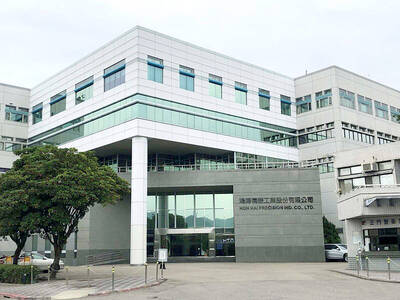
REVENUE PERFORMANCE: Cloud and network products, and electronic components saw strong increases, while smart consumer electronics and computing products fell Hon Hai Precision Industry Co (鴻海精密) yesterday posted 26.51 percent quarterly growth in revenue for last quarter to NT$2.6 trillion (US$82.44 billion), the strongest on record for the period and above expectations, but the company forecast a slight revenue dip this quarter due to seasonal factors. On an annual basis, revenue last quarter grew 22.07 percent, the company said. Analysts on average estimated about NT$2.4 trillion increase. Hon Hai, which assembles servers for Nvidia Corp and iPhones for Apple Inc, is expanding its capacity in the US, adding artificial intelligence (AI) server production in Wisconsin and Texas, where it operates established campuses. This
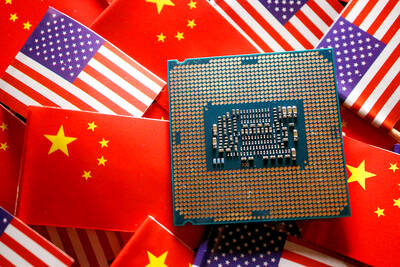
US President Donald Trump on Friday blocked US photonics firm HieFo Corp’s US$3 million acquisition of assets in New Jersey-based aerospace and defense specialist Emcore Corp, citing national security and China-related concerns. In an order released by the White House, Trump said HieFo was “controlled by a citizen of the People’s Republic of China” and that its 2024 acquisition of Emcore’s businesses led the US president to believe that it might “take action that threatens to impair the national security of the United States.” The order did not name the person or detail Trump’s concerns. “The Transaction is hereby prohibited,”
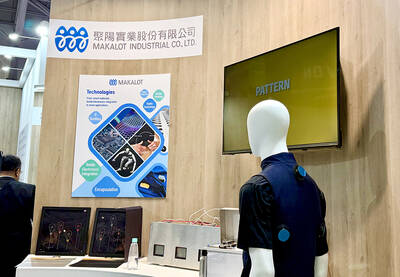
Garment maker Makalot Industrial Co (聚陽) yesterday reported lower-than-expected fourth-quarter revenue of NT$7.93 billion (US$251.44 million), down 9.48 percent from NT$8.76 billion a year earlier. On a quarterly basis, revenue fell 10.83 percent from NT$8.89 billion, company data showed. The figure was also lower than market expectations of NT$8.05 billion, according to data compiled by Yuanta Securities Investment and Consulting Co (元大投顧), which had projected NT$8.22 billion. Makalot’s revenue this quarter would likely increase by a mid-teens percentage as the industry is entering its high season, Yuanta said. Overall, Makalot’s revenue last year totaled NT$34.43 billion, down 3.08 percent from its record NT$35.52


 RSS
RSS