

Taiwan is studying a bid to host a top meeting of Central America’s main regional bank, people with knowledge of the matter said, in its latest effort to break China’s diplomatic squeeze.
The nation is considering applying to host the 60th annual board meeting of the Central American Bank for Economic Integration (CABEI) next year, said the people, who asked not to be identified because the details have not been made public.
The bank is one of the few international organizations of which Taiwan is a full member under its official name, the Republic of China.
The lender is scheduled to decide on the host for next year at its board meeting in Argentina next month.
A decision to host the board meeting in Taiwan could prompt an angry response from China, which has increased pressure on countries and multinational companies to avoid any actions that could imply sovereign status for Taiwan.
The Chinese Communist Party views Taiwan as part of Chinese territory and routinely blocks its participation in most international organizations.
China has learned of Taiwan’s wish to host the meeting and is lobbying its allies in the region, including Cuba and Panama, to block the bid, people with knowledge of the matter said.
China is also in talks with members of CABEI to join the organization, with one of its main conditions being that the bank drop its recognition of Taiwan as a separate nation, the people said.
Taiwan, which holds a 10 percent stake in the bank, needs members holding at least two-thirds of the lender’s shares to support its proposal to host the meeting.
Another person said that the Ministry of Finance was close to deciding whether to officially submit a bid, but was uncertain whether Taiwan could muster sufficient support among the other members.
A bid would also need to be agreed to by President Tsai Ing-wen (蔡英文) and Premier Su Tseng-chang (蘇貞昌).
Latin American and Caribbean nations have long been a stronghold of diplomatic support for Taiwan, favoring official ties with the nation over China.
While four of the bank’s 13 other members officially recognize Taiwan, El Salvador, the Dominican Republic and Panama have switched recognition to Beijing since Tsai was elected in May 2016.
Minister of Finance Su Jain-rong (蘇建榮) represents Taiwan on the bank’s board.
A spokesman for the ministry declined to comment.
Taiwan, along with the likes of Argentina, Mexico and Spain, is one of six members of the bank from outside Central America and its only Asian member.
Taipei last hosted a board meeting in 1995.
CABEI is one of the supranational institutions able to issue bonds in Taiwan. Since 2014, it has issued approximately US$1.1 billion of notes.
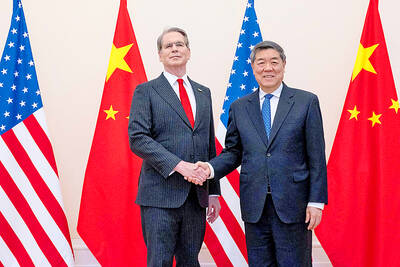
MINIMAL EXPECTATIONS: Analysts think that the two sides are likely to aim for ‘status quo’-level agreements, maintaining civility, without major trade breakthroughs US Secretary of the Treasury Scott Bessent and Chinese Vice Premier He Lifeng (何立峰) were set to meet yesterday to try to set up potential agreements on artificial intelligence (AI), tariffs and critical minerals for a summit in Washington this week between US President Donald Trump and Chinese President Xi Jinping (習近平). The meetings at JPMorgan Chase & Co’s headquarters in Manhattan, which included US Trade Representative Jamieson Greer, were due to start at about 10:30am on Sunday morning and were expected to run all day. Key topics would be the status of a US-China trade truce that is set to expire

MORE DATA CENTERS: Microsoft’s Taiwan-area general manager said the corporation is looking to add two more data centers in northern Taiwan over the next few years Microsoft Corp plans to double its data centers in Taiwan from two facilities to four, Microsoft Taiwan general manager Sean Pien (卞志祥) said yesterday. “Over the past two to three years, we have consistently seen demand outstrip supply, and we expect that situation to continue over the next two to three years,” Pien said on the sidelines of a news conference in Taipei. The data center sites would mainly be in northern Taiwan to meet customer demand and reduce the risk of operational disruptions caused by a single event, he said, without saying their exact locations. Microsoft enabled the first phase of
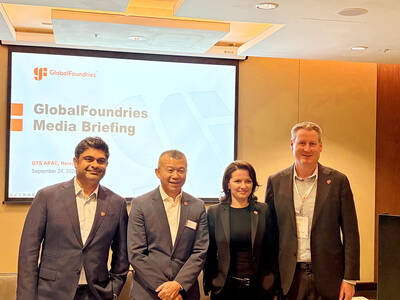
GlobalFoundries Inc yesterday said it plans to accelerate global capacity optimization and expansion to accommodate exponential growth in radio frequency (RF) and other chips driven by the artificial intelligence (AI) boom. Singapore will pay a vital role in the company’s capacity expansion, alongside production line optimizations across its manufacturing sites, GlobalFoundries Asia Pacific head Vincent Feng (范曾文) told a news conference in Hsinchu City. “Many might be surprised to hear that the RF market is thriving now. We are gearing up for a massive capacity expansion, and it is all being driven by AI,” Feng said. He declined to disclose details of the
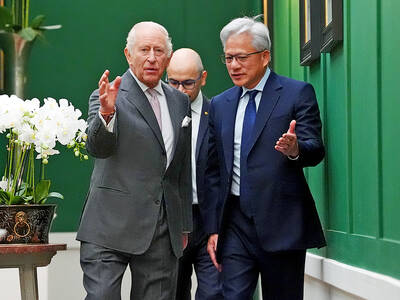
SAFEGUARDING AI: Nvidia CEO Jensen Huang maintained a bullish stance despite concerns about artificial intelligence safety and growing calls for an industry slowdown Nvidia Corp chief executive officer Jensen Huang (黃仁勳) expects to sell twice as many chips in the coming year, fueled by the spread of artificial intelligence (AI) across different industries. AI is of great benefit to a variety of sectors, Huang told reporters on the sidelines of an event convened by King Charles III in Scotland on Thursday. Nvidia is the top seller of AI accelerators, chips used to develop and run AI models. Huang is maintaining his bullish stance at a time when concerns are growing about AI. Industry leaders have discussed slowing down development of the technology over fears that


 RSS
RSS