


DBS Bank Ltd (星展銀行) has lowered its GDP growth forecast for Taiwan this year to 1.9 percent, down from the 2.2 percent it estimated in December last year, as the economy faces increasing downside risks from the tech sector in the near term.
DBS said it would maintain its economic growth forecast for South Korea at 2.6 percent this year, despite its tech sector also slowing rapidly since the fourth quarter last year.
“Taiwan is more vulnerable than South Korea to the tech slowdown, given its higher exposure to the tech sector and higher reliance on external trade,” Singapore-based DBS economist Ma Tieying (馬鐵英) said in a report on Friday.
Electronics account for more than 40 percent of Taiwan’s total exports, while exports of overall goods and services account for 77 percent of the country’s GDP, DBS said.
In contrast, South Korea has a relatively diversified industrial structure, comprised of not only electronics, which account for one-third of total exports, but also automobiles, vessels and commodities, the lender said.
South Korea’s exports-to-GDP ratio is also relatively low at 55 percent, it said.
With the near-term outlook for the tech sector remaining challenging and a comprehensive rollout of 5G networks likely emerging next year to provide a solid catalyst, while a substantial recovery in Chinese demand would also take time to materialize, DBS said Taiwan faces more headwinds in the coming months.
The bank’s GDP forecast came after the economy grew only 1.76 percent annually in the final quarter of last year, marking the slowest growth in 10 quarters, as exports deteriorated, and domestic consumption and investment also lost steam, the Directorate-General of Budget, Accounting and Statistics (DGBAS) reported on Thursday last week.
The DGBAS cut its GDP growth forecast for last year by 0.06 percentage points to 2.6 percent from its previous forecast, while it retained its forecast of 2.41 percent for this year, although the figure risks a downward revision if headwinds increase, it said.
Faced with growing uncertainty in external trade, “South Korea is better prepared than Taiwan in terms of domestic policy support,” Ma said.
In South Korea, government spending is proposed to increase by 8.5 percent this year and the fiscal deficit ratio is to modestly widen by 0.1 percentage points to 1.8 percent of GDP, as policymakers in Seoul want to step up fiscal efforts to boost the economy, she said.
However, “fiscal consolidation remains on the government’s policy agenda” in Taiwan, Ma said, referring to total expenditure in the government’s general budget for this year rising just 1.6 percent to NT$1.998 trillion from NT$1.967 trillion a year earlier, “which is aimed to bring the fiscal account to a roughly balanced position this year,” she said.
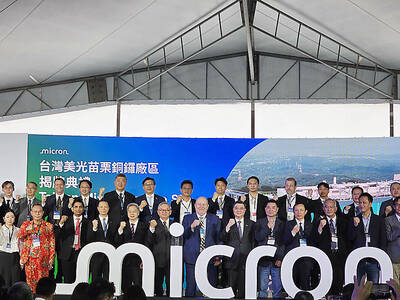
UNPRECEDENTED PACE: Micron Technology has announced plans to expand manufacturing capabilities with the acquisition of a new chip plant in Miaoli Micron Technology Inc unveiled a newly acquired chip plant in Miaoli County yesterday, as the company expands capacity to meet growing demand for advanced DRAM chips, including high-bandwidth memory chips amid the artificial intelligence boom. The plant in Miaoli County’s Tongluo Township (銅鑼), which Micron acquired from Powerchip Semiconductor Manufacturing Corp (力積電) for US$1.8 billion, is expected to make a sizeable capacity contribution to the company from fiscal 2028, the company said in a statement. It would be an extended production site of Micron’s large-scale manufacturing hub in Taichung, the company said. As the global semiconductor industry is racing to reach US$1 trillion
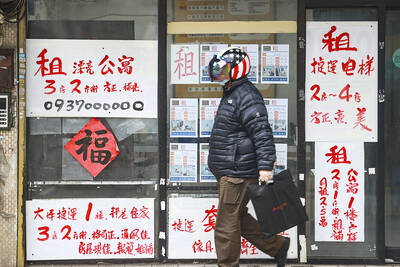
A man walks past real-estate advertisements outside a house in Taipei yesterday. The central bank yesterday said it plans to establish an “Inflation-at-Risk” gauge as a supplementary tool for observing inflation, as policymakers express wish to communicate more effectively with the public when making inflation forecasts.
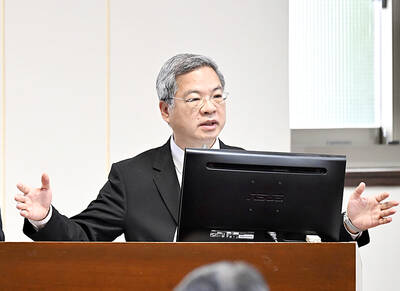
ABOVE LEGAL REQUIREMENT: The Ministry of Economic Affairs is prepared if LNG supply is disrupted, with more than the legal requirement of 11 days of inventory Taiwan has largely secured liquefied natural gas (LNG) supplies through May and arranged about half of June’s supply, Minister of Economic Affairs Kung Ming-hsin (龔明鑫) said yesterday. Since the Middle East conflict began on Feb. 28, Taiwan’s LNG inventories have remained more than 12 days, exceeding the legal requirement of 11 days, indicating no major supply concerns for domestic gas and electricity, Kung said at a meeting of the legislature’s Economics Committee in Taipei. The ministry aims to increase the figure to 14 days by the end of next year, he said. While one or two LNG or crude oil shipments for May

Memory chip stocks extended their losses yesterday after Alphabet Inc’s Google publicized research that could allow more efficient use of the storage needed for artificial intelligence (AI) development. SK Hynix Inc and Samsung Electronics Co, South Korean leaders in the market, fell more than 6 percent and about 5 percent respectively in Seoul. In the US, Micron Technology Inc, Western Digital Corp and Sandisk Corp slid more than 2 percent in pre-market trading, after they all closed lower on Wednesday. Memory companies have been on a tear in recent months as the rapid development of AI infrastructure triggered a spike in chip


 RSS
RSS