


Australia’s TPG Telecom Ltd yesterday said it has abandoned building its mobile telephone network because it relied on Huawei Technologies Co (華為) equipment that has been banned by Australia’s government on security grounds.
The nascent network is the first commercial casualty in Australia of the ban announced in August last year, and comes as Western nations restrict market access to Huawei over allegations that China could use its equipment for espionage. Huawei denies the allegations.
Broadband Internet provider TPG said in a statement that it chose Huawei as a supplier because it offered a simple upgrade path from the 4G network under construction to 5G.
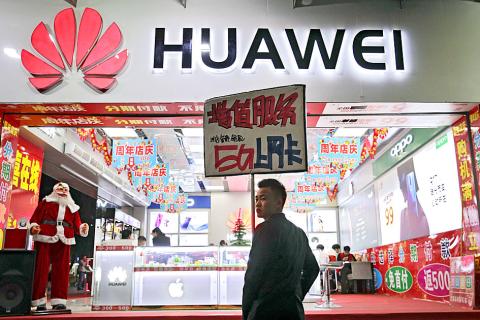
Photo: AP
“That upgrade path has now been blocked,” TPG said. “It does not make commercial sense to invest further shareholder funds.”
TPG said it made the decision now because the project had reached a point where it would have had to place new orders.
It did not elaborate on the fate of the completed part of the network, but said it does not expect any impact on this year’s earnings.
Huawei called TPG’s announcement “extremely disappointing.”
“Australians will now miss out on cheaper and more affordable mobile services,” Huawei spokesman Jeremy Mitchell said in an e-mailed statement.
TPG shares touched a six-week peak following its announcement and closed up 3 percent.
The cancelation has cost it A$100 million (US$71.63 million), but is widely seen as eliminating duplication under the A$15 billion merger it has agreed with the Australian arm of Britain’s Vodafone Group PLC.
TPG’s announcement also buoyed shares elsewhere in the sector, with those of Telstra Corp Ltd rising 8 percent to a more than three-month high as investors expected relief from profit-margin pressure in the price-competitive sector. The broader market closed down 0.5 percent.
“You take one network out and then, obviously, in the end, for customers you’ve got less choice,” independent telecom analyst Paul Budde said. “This will be a relief for Telstra and others.”
TPG’s move adds to pressure Huawei is facing globally after the US and its allies initiated measures to restrict market access for the Chinese firm and compatriot ZTE Corp (中興), citing espionage risk.
Australia’s intelligence agencies feared that if mobile operators use Huawei’s equipment, the company could develop a means of collecting data at the request of China’s government.
Operators in Europe such as BT and Orang, have already removed Huawei’s equipment or taken steps to limit its future use, while Vodafone has paused its use.
In Australia, Vodafone and Optus, which use Huawei’s 4G equipment, must now design 5G systems based only on Nokia Oyj or Ericsson technology, a process TPG executive chairman David Teoh said would likely be costly.

ENERGY ISSUES: The TSIA urged the government to increase natural gas and helium reserves to reduce the impact of the Middle East war on semiconductor supply stability Chip testing and packaging service provider ASE Technology Holding Co (日月光投控) yesterday said it planned to invest more than NT$100 billion (US$3.15 billion) in building a new advanced chip testing facility in Kaohsiung to keep up with customer demand driven by the artificial intelligence (AI) boom. That would be included in the company’s capital expenditure budget next year, ASE said. There is also room to raise this year’s capital spending budget from a record-high US$7 billion estimated three months ago, it added. ASE would have six factories under construction this year, another record-breaking number, ASE chief operating officer Tien Wu

The EU and US are nearing an agreement to coordinate on producing and securing critical minerals, part of a push to break reliance on Chinese supplies. The potential deal would create incentives, such as minimum prices, that could advantage non-Chinese suppliers, according to a draft of an “action plan” seen by Bloomberg. The EU and US would also cooperate on standards, investments and joint projects, as well as coordinate on any supply disruptions by countries like China. The two sides are additionally seeking other “like-minded partners” to join a multicountry accord to help create these new critical mineral supply chains, which feed into

For weeks now, the global tech industry has been waiting for a major artificial intelligence (AI) launch from DeepSeek (深度求索), seen as a benchmark for China’s progress in the fast-moving field. More than a year has passed since the start-up put Chinese AI on the map in early last year with a low-cost chatbot that performed at a similar level to US rivals. However, despite reports and rumors about its imminent release, DeepSeek’s next-generation “V4” model is nowhere in sight. Speculation is also swirling over the geopolitical implications of which computer chips were chosen to train and power the new
TECH WINNERS: Taiwan and South Korea reported robust trade, which suggests that they have critical advantages in the rapidly expanding AI supply chain, an official said Exports last month surged to a new high, as booming demand tied to artificial intelligence (AI) infrastructure fueled shipments of advanced technology components, underscoring the nation’s pivotal role in the global semiconductor supply chain. Outbound shipments climbed to US$80.18 billion, the highest ever for a single month, rising 61.8 percent from a year earlier and marking the 29th consecutive month of growth, the Ministry of Finance said yesterday. “The surge was driven primarily by global investment in AI infrastructure,” Department of Statistics Director-General Beatrice Tsai (蔡美娜) said. The mass production of next-generation AI computing systems has accelerated procurement across the semiconductor supply


 RSS
RSS