


The nation’s major telecoms yesterday called on the regulator to reduce the spectrum usage fee for 5G wireless networks and to extend the license duration to 20 years, to help alleviate the financial burden from costly 5G network deployment.
The call came as local telecoms are hesitant to spend a lot of money on 5G networks, because most of them are still making losses on 4G networks after a fevered bidding war in a 2013 auction inflated license fees to NT$118.65 billion (US$3.84 billion).
Fierce competition has since drained their profits.
“The investment on a 5G network is even more costly, meaning a longer time to turn a profit on the network,” Far EasTone Telecommunications Co Ltd (遠傳電信) president Yvonne Li (李彬) told a 5G forum in Taipei yesterday arranged by the Taiwan Communications Society.
“Reasonable license fees and spectrum usage fee will be vital for the adoption of 5G technology,” Li said.
As 5G networks are designed to be denser and more base station-heavy than 4G networks, telecoms would see the cost of upgrading to a 5G network more than double from when they deployed a 4G network, Taiwan Star Co (台灣之星) president Cliff Lai (賴弦五) told the forum.
“With slim average revenue per user [ARPU], Taiwan’s telecoms cannot afford the pricey 5G network deployment,” Lai said.
Local telecoms have seen average 4G ARPU dip 32 percent to NT$555 in the second quarter this year, Lai said, citing National Communications Commission (NCC) data.
The NCC should cut the spectrum usage fee from NT$10.67 million per megahertz, Li said
The regulator only charges a small administration management fee for the licensed spectrum in the US, the UK, France and Singapore, Li added.
Extending 5G licenses to 20 years from the 15 years for 4G and 3G licenses would also help ease the financial burden on telecoms and speed up network installation, Li and Lai said.
In addition, Li suggested that the NCC limit the number of licenses to three, given the limited availability of the spectrum.
A contiguous 100 megahertz bandwidth is considered the optimal capacity for a 5G network, she said.
The NCC has allocated a 3.6 gigahertz band totaling 270 megahertz for 5G licenses. The regulator is set to auction the 5G spectrum in 2020.
Taiwan Mobile Co (台灣大哥大) president James Cheng (鄭俊卿) urged the regulator to amend the regulations so that telecoms could join forces and build shared 5G networks.
Expensive equipment, high power consumption and huge antennae are among many hurdles when installing a 5G network, he said.
Asia Pacific Telecom Co (亞太電信) president Huang Nan-ren (黃南仁) backed Cheng’s proposal, saying that building shared 5G networks would be more cost and energy efficient than installing separate networks.
Chunghwa Telecom Co (中華電信) president Sheih Chi-mau (謝繼茂) opposed the idea of operating shared 5G networks, saying that it would only be feasible in remote areas, while Li also disagreed with Cheng’s proposal.


Taiwan’s foreign exchange reserves fell below the US$600 billion mark at the end of last month, with the central bank reporting a total of US$596.89 billion — a decline of US$8.6 billion from February — ending a three-month streak of increases. The central bank attributed the drop to a combination of factors such as outflows by foreign institutional investors, currency fluctuations and its own market interventions. “The large-scale outflows disrupted the balance of supply and demand in the foreign exchange market, prompting the central bank to intervene repeatedly by selling US dollars to stabilize the local currency,” Department of Foreign

Intel Corp is joining Elon Musk’s long-shot effort to develop semiconductors for Tesla Inc, Space Exploration Technologies Corp and xAI, marking a surprising twist in the chipmaker’s comeback bid. Intel would help the Terafab project “refactor” the technology in a chip factory, the company said on Tuesday in a post on X, Musk’s social media platform. That is a stage in the development process that typically helps make chips more powerful or reliable. The chipmaker’s shares jumped 4.2 percent to US$52.91 in New York trading on Tuesday. The Terafab project is a grand plan by Musk to eventually manufacture his own chips for
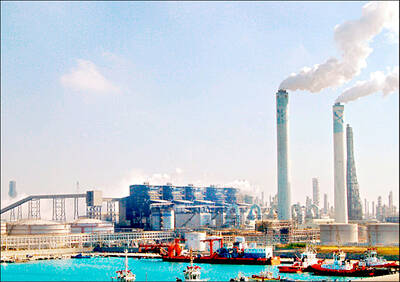
Taiwan Power Co (Taipower, 台電) yesterday said it plans to resume operations at two coal-fired power generators for three months to boost security of electricity supply as liquefied natural gas (LNG) supply risks are running high due to the Middle East conflict. The two coal-fired power generators are at Mailiao Power Plant in Yunlin County’s Mailiao Township (麥寮). The plant, operated by Formosa Plastics Group (台塑集團), supplied electricity to Taipower’s power grid until the end of last year. Taipower’s decision came about one month after Minister of Economic Affairs Kung Ming-hsin (龔明鑫) on March 10 said that the nation had no imminent

Some robotaxi passengers were left stranded in the middle of fast-moving traffic in a major Chinese city after their driverless vehicles stopped running, according to police and media reports on Wednesday. A preliminary investigation indicates more than 100 robotaxis came to a halt because of a “system malfunction,” police in the city of Wuhan said in a statement, without elaborating. No injuries were reported. One passenger told Chinese media that their robotaxi stopped after turning a corner. An instruction on a screen read: “Driving system malfunction. Staff are expected to arrive in 5 minutes.” After no one showed up, the passenger pushed


 RSS
RSS