


Indonesia’s rupiah yesterday weakened past 15,000 per US dollar for the first time in 20 years amid a souring of sentiment toward emerging-nation assets and as oil prices jumped.
The currency has tumbled almost 10 percent this year as rising US interest rates have boosted the dollar and as the nation’s current-account deficit has left the economy exposed to the financial turmoil that afflicted Turkey and Argentina.
Crude prices have almost tripled since February 2016, putting pressure on the oil-importing nation.

Photo: AFP
“Given the rise in US interest rates, higher oil prices, which may see a wider trade deficit, and a stronger dollar in recent days, it was proving difficult for Bank Indonesia to hold the line at 15,000,” said Khoon Goh (吳昆), head of research at Australia and New Zealand Banking Group Ltd in Singapore. “If sentiment doesn’t improve, we risk further weakness towards the 15,200 region.”
The rupiah has weakened, even as Bank Indonesia has consistently intervened to limit its decline and raised interest rates five times since May.
The currency dropped to as low as 15,025 per dollar, the weakest since the Asian financial crisis in July 1998.
“Indonesia is now a net importer of oil, so the higher crude prices and weaker rupiah are fanning concern that inflation will quicken,” said Toru Nishihama, emerging-market economist at Dai-ichi Life Research Institute in Tokyo. “With oil prices rising, the Fed normalizing policy and Indonesia having fiscal and current-account deficits, negative speculation is harder to contain.”
Indonesia’s bond have also been under pressure. The benchmark 10-year bond yield yesterday climbed nine basis points to 8.1 percent, having increased from 6.32 percent at the end of last year.
The nation’s key stock index has declined 7 percent this year.
In addition to raising borrowing costs, Bank Indonesia has announced the introduction of domestic non-deliverable forwards, which it says would provide an alternative for companies wanting to hedge dollar exposure and help reduce rupiah volatility.
Indonesia is also close to finalizing incentives for exporters holding billions of dollars in banks to encourage them to convert the funds into rupiah, as the central bank steps up efforts to shield the local currency from a global emerging-market rout.


Taiwan’s foreign exchange reserves fell below the US$600 billion mark at the end of last month, with the central bank reporting a total of US$596.89 billion — a decline of US$8.6 billion from February — ending a three-month streak of increases. The central bank attributed the drop to a combination of factors such as outflows by foreign institutional investors, currency fluctuations and its own market interventions. “The large-scale outflows disrupted the balance of supply and demand in the foreign exchange market, prompting the central bank to intervene repeatedly by selling US dollars to stabilize the local currency,” Department of Foreign

Intel Corp is joining Elon Musk’s long-shot effort to develop semiconductors for Tesla Inc, Space Exploration Technologies Corp and xAI, marking a surprising twist in the chipmaker’s comeback bid. Intel would help the Terafab project “refactor” the technology in a chip factory, the company said on Tuesday in a post on X, Musk’s social media platform. That is a stage in the development process that typically helps make chips more powerful or reliable. The chipmaker’s shares jumped 4.2 percent to US$52.91 in New York trading on Tuesday. The Terafab project is a grand plan by Musk to eventually manufacture his own chips for
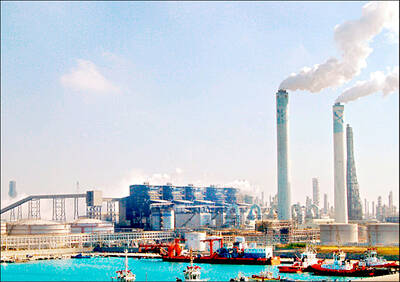
Taiwan Power Co (Taipower, 台電) yesterday said it plans to resume operations at two coal-fired power generators for three months to boost security of electricity supply as liquefied natural gas (LNG) supply risks are running high due to the Middle East conflict. The two coal-fired power generators are at Mailiao Power Plant in Yunlin County’s Mailiao Township (麥寮). The plant, operated by Formosa Plastics Group (台塑集團), supplied electricity to Taipower’s power grid until the end of last year. Taipower’s decision came about one month after Minister of Economic Affairs Kung Ming-hsin (龔明鑫) on March 10 said that the nation had no imminent

Some robotaxi passengers were left stranded in the middle of fast-moving traffic in a major Chinese city after their driverless vehicles stopped running, according to police and media reports on Wednesday. A preliminary investigation indicates more than 100 robotaxis came to a halt because of a “system malfunction,” police in the city of Wuhan said in a statement, without elaborating. No injuries were reported. One passenger told Chinese media that their robotaxi stopped after turning a corner. An instruction on a screen read: “Driving system malfunction. Staff are expected to arrive in 5 minutes.” After no one showed up, the passenger pushed


 RSS
RSS