


US bank stocks buckled on Friday, even after several reported fatter profits than analysts expected, and the sharp declines overshadowed gains elsewhere in the market to drag the S&P 500 lower.
JPMorgan Chase & Co and several other financial titans marked the unofficial start of the earnings reporting season, and expectations were high for them, as they are for most major companies.
Wall Street is forecasting the strongest growth in seven years for S&P 500 companies, and the hope has been that healthy profit reports in coming weeks will steady the market following a rough couple of months.
However, high expectations can be as much a burden as cause for optimism.
JPMorgan Chase reported its biggest-ever profit and topped analysts’ expectations, but investors were already anticipating the good news that it delivered, such as healthier trading revenue, and took note of things like an increase in charge-offs for credit cards.
JPMorgan Chase shares fell 2.7 percent to US$110.30 to lop off most of the big gains made earlier in the week.
The S&P 500 on Friday fell 7.69 points, or 0.3 percent, to 2,656.30. The loss pared the index’s gain for the week to 2 percent from 2,604.47 on April 6.
The Dow Jones Industrial Average on Friday dropped 122.91, or 0.5 percent, to 24,360.14, but rose 1.8 percent from a close of 23,932.76 a week earlier.
The NASDAQ Composite on Friday lost 33.60, or 0.5 percent, to close at 7,106.65, rising 2.8 percent from 6,915.11 on April 6.
As a group, financial stocks in the S&P 500 fell 1.6 percent, more than double the loss for any of the other 10 sectors that make up the index.
PNC Financial Services Group Inc had one of the biggest losses in the S&P 500 after reporting first-quarter results that fell short of some analysts’ expectations. It dropped 4.1 percent to US$145.46.
Wells Fargo & Co fell 3.4 percent to US$50.89 and Citigroup Inc dropped 1.6 percent to US$71.01, even though both reported profits that beat expectations.
The possibility of a significant settlement with federal regulators hung over Wells Fargo’s results.
After weeks where fears about a possible US-China trade war dominated the market, many analysts along Wall Street were expecting strong profit reports to divert investors’ attention.
Over the long term, stock prices tend to track the progress of corporate profits.
Expectations for profit growth this year might have climbed so high, particularly following Washington’s recent overhaul of the tax code, that they might be setting the stage for future disappointment, James Investment Research Inc portfolio manager Matthew Watson said.
“In the near term, it looks like companies are beating expectations in general,” Watson said. “Our concern comes over the next 12 months.”
Outside financial stocks, other areas of the US market were stronger.
Energy stocks in the S&P 500 jumped 1.1 percent after the price of oil continued its strong climb.
Alaska Air Group Inc jumped to the biggest gain in the S&P 500 after it gave an updated forecast for first-quarter revenue trends that was better than what it had previously given. Shares rose 6.1 percent to US$63.95.
Airline stocks have been strong after Delta Air Lines Inc reported stronger-than-expected earnings on Thursday. Delta rose a total of 2.8 percent from Thursday to Friday.
Broadcom Corp had one of the biggest gains in the S&P 500 after it said it would repurchase up to US$12 billion of its stock. The technology company rose 3.1 percent to US$246.94.
Additional reporting by staff writer
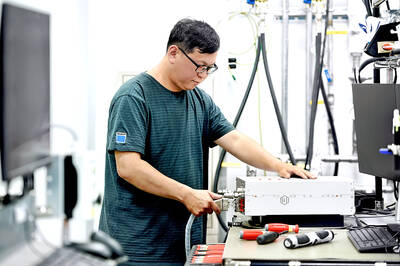
SEMICONDUCTORS: The German laser and plasma generator company will expand its local services as its specialized offerings support Taiwan’s semiconductor industries Trumpf SE + Co KG, a global leader in supplying laser technology and plasma generators used in chip production, is expanding its investments in Taiwan in an effort to deeply integrate into the global semiconductor supply chain in the pursuit of growth. The company, headquartered in Ditzingen, Germany, has invested significantly in a newly inaugurated regional technical center for plasma generators in Taoyuan, its latest expansion in Taiwan after being engaged in various industries for more than 25 years. The center, the first of its kind Trumpf built outside Germany, aims to serve customers from Taiwan, Japan, Southeast Asia and South Korea,

Gasoline and diesel prices at domestic fuel stations are to fall NT$0.2 per liter this week, down for a second consecutive week, CPC Corp, Taiwan (台灣中油) and Formosa Petrochemical Corp (台塑石化) announced yesterday. Effective today, gasoline prices at CPC and Formosa stations are to drop to NT$26.4, NT$27.9 and NT$29.9 per liter for 92, 95 and 98-octane unleaded gasoline respectively, the companies said in separate statements. The price of premium diesel is to fall to NT$24.8 per liter at CPC stations and NT$24.6 at Formosa pumps, they said. The price adjustments came even as international crude oil prices rose last week, as traders

Taiwan Semiconductor Manufacturing Co (TSMC, 台積電), which supplies advanced chips to Nvidia Corp and Apple Inc, yesterday reported NT$1.046 trillion (US$33.1 billion) in revenue for last quarter, driven by constantly strong demand for artificial intelligence (AI) chips, falling in the upper end of its forecast. Based on TSMC’s financial guidance, revenue would expand about 22 percent sequentially to the range from US$32.2 billion to US$33.4 billion during the final quarter of 2024, it told investors in October last year. Last year in total, revenue jumped 31.61 percent to NT$3.81 trillion, compared with NT$2.89 trillion generated in the year before, according to
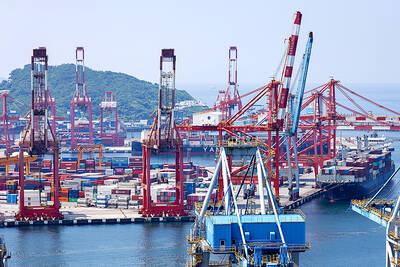
PRECEDENTED TIMES: In news that surely does not shock, AI and tech exports drove a banner for exports last year as Taiwan’s economic growth experienced a flood tide Taiwan’s exports delivered a blockbuster finish to last year with last month’s shipments rising at the second-highest pace on record as demand for artificial intelligence (AI) hardware and advanced computing remained strong, the Ministry of Finance said yesterday. Exports surged 43.4 percent from a year earlier to US$62.48 billion last month, extending growth to 26 consecutive months. Imports climbed 14.9 percent to US$43.04 billion, the second-highest monthly level historically, resulting in a trade surplus of US$19.43 billion — more than double that of the year before. Department of Statistics Director-General Beatrice Tsai (蔡美娜) described the performance as “surprisingly outstanding,” forecasting export growth


 RSS
RSS