


Fears of a trade war between the world’s two largest economies on Friday jolted China’s markets, with the country’s main stock indices tumbling the most in six weeks, while Japanese shares were the biggest losers in the region.
Chinese shares fell sharply after Beijing unveiled plans for tariffs on up to US$3 billion of US imports in retaliation for US duties on steel and aluminum products from China and other countries that went into effect on Friday.
The MSCI Asia-Pacific index on Friday fell 2.6 percent to 171.97, down 3.5 percent from last week’s 178.13.
US President Donald Trump also on Thursday signed a memorandum that could impose tariffs on up to US$60 billion of imports from China, although the measures have a 30-day consultation period.
China urged the US to “pull back from the brink,” while its embassy in Washington vowed Beijing would “fight to the end” in any trade war.
The Shanghai Composite index on Friday closed down 3.6 percent at 3,152.76 points, its lowest close since Feb. 9 and also down 3.6 percent for the week.
China’s blue-chip CSI300 index on Friday fell 2.9 percent to 3,891.47, its lowest close since Feb. 12 and down 4 percent for the week.
In Hong Kong, the Hang Seng Index closed 2.5 percent lower at 30,309.2, its lowest since March 7 and down about 4 percent for the week.
All three indices suffered their biggest daily percentage drops since Feb. 9. It was also their worst weekly performance in six weeks.
The weighted index on the Taiwan Stock Exchange on Friday closed down 182.51 points, or 1.66 percent, at 10,823.33. That brought the TAIEX’s weekly loss to 1.9 percent.
Tariffs proposed by Trump could reduce China’s GDP growth by 0.1 percent this year, UBS Securities head of China Strategy Gao Ting said.
In a separate note on Friday, the UBS chief investment office said it saw a 20 to 30 percent probability of “damaging retaliation” by China to US trade actions.
More than 400 Chinese stocks on Friday plunged by the maximum allowed 10 percent, led by tech and materials firms targeted or seen as being most affected by the US tariffs.
The tech-heavy start-up board index ChiNextP closed down 5 percent, while an index tracking major material firms dropped 4 percent.
Bucking the broader trend, a slew of local agriculture firms surged, including agricultural products processors, seed and pork producers, as they are seen benefiting from China’s potential retaliatory measures against the US.
For the short term, analysts expect soured sentiment for equity markets, though many saw a limited effect.
“Strategically, we remain optimistic about Chinese assets, as the rising trade tensions better highlight the importance of [China’s] stress on more quality rather than quantity of its economic growth,” Shenwan Hongyuan securities wrote in a note.
In Hong Kong, sectors fell across the board, dragged down by IT and industrial firms.
An IT sub-index tumbled 4.3 percent, as the bellwether Tencent Holdings Ltd (騰訊) extended losses. Tencent fell more than 4 percent after Naspers Ltd revealed a plan to cut its stake in the Chinese Internet giant.
Japanese shares suffered the worst of the losses in Asia trading on Friday, exacerbated by the strong yen, with the Nikkei 225 Stock Average slumping 4.5 percent to close at an October last year low while the TOPIX retreated 3.6 percent to the lowest since September.
For the week, the Nikkei 225 lost 5 percent, while the TOPIX fell 4 percent.
South Korea’s KOSPI shed 3.2 this week and Australia’s S&P/ASX 200 fell 2.2 percent.
Additional reporting by staff writer, with CNA
CHIP RACE: Three years of overbroad export controls drove foreign competitors to pursue their own AI chips, and ‘cost US taxpayers billions of dollars,’ Nvidia said China has figured out the US strategy for allowing it to buy Nvidia Corp’s H200s and is rejecting the artificial intelligence (AI) chip in favor of domestically developed semiconductors, White House AI adviser David Sacks said, citing news reports. US President Donald Trump on Monday said that he would allow shipments of Nvidia’s H200 chips to China, part of an administration effort backed by Sacks to challenge Chinese tech champions such as Huawei Technologies Co (華為) by bringing US competition to their home market. On Friday, Sacks signaled that he was uncertain about whether that approach would work. “They’re rejecting our chips,” Sacks
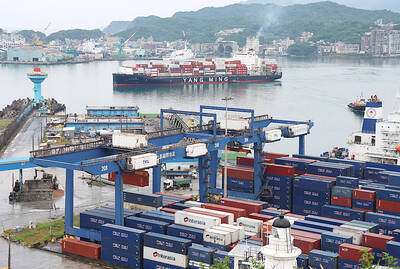
Taiwan’s exports soared 56 percent year-on-year to an all-time high of US$64.05 billion last month, propelled by surging global demand for artificial intelligence (AI), high-performance computing and cloud service infrastructure, the Ministry of Finance said yesterday. Department of Statistics Director-General Beatrice Tsai (蔡美娜) called the figure an unexpected upside surprise, citing a wave of technology orders from overseas customers alongside the usual year-end shopping season for technology products. Growth is likely to remain strong this month, she said, projecting a 40 percent to 45 percent expansion on an annual basis. The outperformance could prompt the Directorate-General of Budget, Accounting and
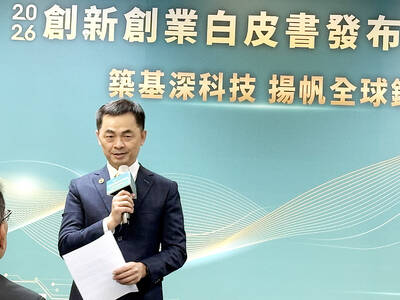
BARRIERS: Gudeng’s chairman said it was unlikely that the US could replicate Taiwan’s science parks in Arizona, given its strict immigration policies and cultural differences Gudeng Precision Industrial Co (家登), which supplies wafer pods to the world’s major semiconductor firms, yesterday said it is in no rush to set up production in the US due to high costs. The company supplies its customers through a warehouse in Arizona jointly operated by TSS Holdings Ltd (德鑫控股), a joint holding of Gudeng and 17 Taiwanese firms in the semiconductor supply chain, including specialty plastic compounds producer Nytex Composites Co (耐特) and automated material handling system supplier Symtek Automation Asia Co (迅得). While the company has long been exploring the feasibility of setting up production in the US to address

OPTION: Uber said it could provide higher pay for batch trips, if incentives for batching is not removed entirely, as the latter would force it to pass on the costs to consumers Uber Technologies Inc yesterday warned that proposed restrictions on batching orders and minimum wages could prompt a NT$20 delivery fee increase in Taiwan, as lower efficiency would drive up costs. Uber CEO Dara Khosrowshahi made the remarks yesterday during his visit to Taiwan. He is on a multileg trip to the region, which includes stops in South Korea and Japan. His visit coincided the release last month of the Ministry of Labor’s draft bill on the delivery sector, which aims to safeguard delivery workers’ rights and improve their welfare. The ministry set the minimum pay for local food delivery drivers at


 RSS
RSS