


Auto parts maker Tong Yang Industry Co (東陽實業) this year plans to ship electric cars parts to its brand clients, hoping to expand its original equipment manufacturing (OEM) business in China, a company official said yesterday.
“We will provide lightweight plastics components for some Chinese brands, such as NextEV (蔚來汽車) and GAC Mitsubishi Motors Co Ltd (廣汽三菱),” an investor relations officer said by telephone.
Those customized components are expected to drive the company’s sales growth in the foreseeable future, as autonomous cars and electric cars are trending in the global automobile industry, Tong Yang said.
Tong Yang, which entered the Chinese market in the 1990s, has 15 OEM plants and one aftermarket parts plant in China operated in collaboration with major Chinese car brands, including Guangzhou Automobile Group (廣汽集團) and FAW Group (一汽集團).
The company said it aims to meet rising demand in China’s OEM market by continuing capacity expansion through an alliance with Changchun Faway Automobile Components Co (一汽富維).
New plants in Shandong Province’s Qingdao and Hebei Province’s Tianjin are set to start mass production in the second quarter, each with an annual production capacity to supply components for 300,000 cars, Tong Yang said.
The Tainan-headquartered firm said it also expects the innovation center in Guangzhou, China, which became operational last year, to develop more products this year.
Tong Yang plans to invest about NT$3.1 billion (US$105.94 million) in capital expenditure this year, down from nearly NT$3.4 billion last year.
However, the company said it would consider raising its capital spending if necessary.
The company plans to change some of its production lines from oil coatings to more eco-friendly waterborne coatings, to attract more customers from the US and Europe.
The company’s sales decreased 7 percent year-on-year to NT$1.75 billion last month, as the Lunar New Year holiday meant fewer working days.
However, its aggregate revenue for the first two months of the year rose 5 percent annually to NT$3.98 billion, company data showed.
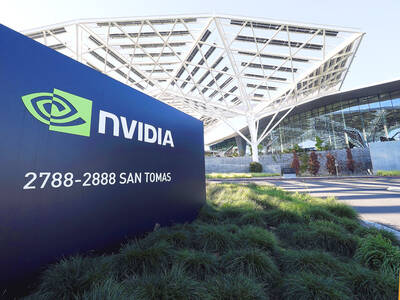
CHIP RACE: Three years of overbroad export controls drove foreign competitors to pursue their own AI chips, and ‘cost US taxpayers billions of dollars,’ Nvidia said China has figured out the US strategy for allowing it to buy Nvidia Corp’s H200s and is rejecting the artificial intelligence (AI) chip in favor of domestically developed semiconductors, White House AI adviser David Sacks said, citing news reports. US President Donald Trump on Monday said that he would allow shipments of Nvidia’s H200 chips to China, part of an administration effort backed by Sacks to challenge Chinese tech champions such as Huawei Technologies Co (華為) by bringing US competition to their home market. On Friday, Sacks signaled that he was uncertain about whether that approach would work. “They’re rejecting our chips,” Sacks

NATIONAL SECURITY: Intel’s testing of ACM tools despite US government control ‘highlights egregious gaps in US technology protection policies,’ a former official said Chipmaker Intel Corp has tested chipmaking tools this year from a toolmaker with deep roots in China and two overseas units that were targeted by US sanctions, according to two sources with direct knowledge of the matter. Intel, which fended off calls for its CEO’s resignation from US President Donald Trump in August over his alleged ties to China, got the tools from ACM Research Inc, a Fremont, California-based producer of chipmaking equipment. Two of ACM’s units, based in Shanghai and South Korea, were among a number of firms barred last year from receiving US technology over claims they have

It is challenging to build infrastructure in much of Europe. Constrained budgets and polarized politics tend to undermine long-term projects, forcing officials to react to emergencies rather than plan for the future. Not in Austria. Today, the country is to officially open its Koralmbahn tunnel, the 5.9 billion euro (US$6.9 billion) centerpiece of a groundbreaking new railway that will eventually run from Poland’s Baltic coast to the Adriatic Sea, transforming travel within Austria and positioning the Alpine nation at the forefront of logistics in Europe. “It is Austria’s biggest socio-economic experiment in over a century,” said Eric Kirschner, an economist at Graz-based Joanneum

BUBBLE? Only a handful of companies are seeing rapid revenue growth and higher valuations, and it is not enough to call the AI trend a transformation, an analyst said Artificial intelligence (AI) is entering a more challenging phase next year as companies move beyond experimentation and begin demanding clear financial returns from a technology that has delivered big gains to only a small group of early adopters, PricewaterhouseCoopers (PwC) Taiwan said yesterday. Most organizations have been able to justify AI investments through cost recovery or modest efficiency gains, but few have achieved meaningful revenue growth or long-term competitive advantage, the consultancy said in its 2026 AI Business Predictions report. This growing performance gap is forcing executives to reconsider how AI is deployed across their organizations, it said. “Many companies


 RSS
RSS