


Inventec Corp (英業達), one of the two assemblers for Apple Inc’s HomePod, has started shipping the US company’s long-awaited “smart” speaker with an initial shipment of about 1 million units, industry sources said.
“The Taiwanese company has begun HomePod shipments. However, revenue contribution from the product to Inventec is expected to be limited this quarter, as the initial shipment is not large,” a source in HomePod’s supply chain told the Taipei Times by telephone on condition of anonymity.
Hon Hai Precision Industry Co (鴻海精密) is the other assembler of HomePods.
HomePod shipments this year are expected to reach between 10 million and 12 million units, with Inventec and Hon Hai each fulfilling half of the orders, the source said.
Apple unveiled its first voice-controlled smart speaker during the company’s Worldwide Developers Conference in June last year.
HomePod was previously scheduled to hit the markets before the end of last year, but Apple in November issued a statement saying that it needed more time before the product is ready for customers.
Apple at the time said the product would be available early this year in the US, UK and Australia. It did not specify a time frame.
The delay in HomePod’s launch was caused by the fine-tuning of software and hardware integration, said another industry source who also declined to be named due to the sensitivity of the issue.
As the companies in HomePod’s supply chain received a shipment notice from Apple at the beginning of this month, it is believed that the product is to hit the markets soon, the second source said.
Apple had not updated HomePod release information on its Web site as of yesterday.
Inventec and Hon Hai declined to comment on the matter.
In related news, Inventec said it expects revenue to contract by 15 percent this quarter from last quarter’s NT$132.66 billion (US$4.49 billion), as the industry enters a traditional slow season.
Inventec manufactures a wide range of electronics from notebook computers, servers and smartphones, to wearables and wireless earpieces.
In addition to HomePod, Inventec assembles Apple’s AirPod.
Shares of Inventec gained 0.43 percent to close at NT$23.3 in Taipei trading yesterday, while Hon Hai rose 1.63 percent to NT$93.3. The TAIEX rose 0.66 percent.
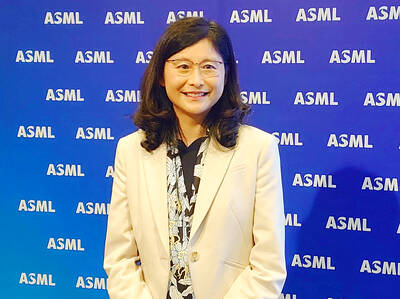
Netherlands-based semiconductor equipment supplier ASML Holding NV yesterday said that it is planning to hire an additional 1,000 people in Taiwan this year in response to growing demand from clients. ASML had previously planned to recruit 600 people this year, but that the plan has been adjusted upward, ASML vice president and ASML Taiwan general manager Grace Wang (汪佳慧) told reporters. ASML has a workforce of more than 4,500 in Taiwan, accounting for about 10 percent of its global total, Wang said. This year’s recruitment campaign would focus on adding people in the customer support, manufacturing and supply chain domains to assist ASML
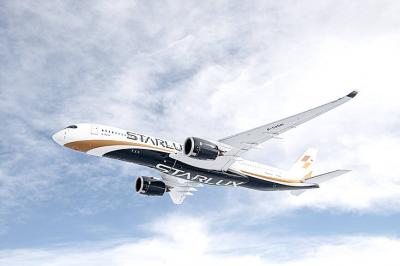
Starlux Airlines Co (星宇航空) today unveiled a long-haul network expansion plan at a shareholders’ meeting in Taipei, including direct flights to Barcelona, Spain, and Zurich, Switzerland, as well as a service connecting Taipei, Sydney and New Zealand. Starlux is to become the first Taiwanese carrier to offer non-stop services to the two European cities, while the inaugural oceanic route is expected to expand transit opportunities within the Australia-New Zealand market, Starlux said. Flight services to Chicago, Dallas, Washington and New York are under evaluation, the airline added. Prior to the shareholders’ meeting, the airline earlier this year announced that it would be

UNDER MICROSCOPE: Taiwan detained three people who allegedly conspired to buy servers in Taiwan and export them using fraudulent documentation, prosecutors said Nvidia Corp chief executive officer Jensen Huang (黃仁勳) on Saturday urged Super Micro Computer Inc to tighten up on compliance after Taiwan detained three people this week for allegedly making fraudulent declarations about artificial intelligence (AI) servers made by its US partner. The development marked the nation’s first crackdown on semiconductor smuggling, which grew after the US slapped restrictions on exports of high-end chips such as Nvidia AI accelerators to China. Nvidia is “rigorous” in explaining regulations to all of its partners, Huang told reporters after arriving in Taipei. “Ultimately Super Micro has to run their own company,” he said in response to

Nvidia Corp yesterday announced that CEO Jensen Huang (黃仁勳) would attend an employee meeting in Taipei tomorrow to celebrate the launch of the company’s Taiwan headquarters project. Huang would attend a gathering at the site of Nvidia’s planned headquarters in Beitou Shilin Technology Park (北投士林科技園區), the company said in a statement. After arriving in Taiwan on Saturday last week, Huang told reporters that he plans to meet with Quanta Computer Inc (廣達) chairman Barry Lam (林百里) and Taiwan Semiconductor Manufacturing Co (TSMC, 台積電) chairman C.C. Wei (魏哲家), and would attend the groundbreaking ceremony for Nvidia’s Taiwan headquarters tomorrow. Nvidia has not yet applied


 RSS
RSS