


E-paper display supplier E Ink Holdings Inc (元太科技) yesterday forecast that revenue this quarter would be little changed from a year earlier — revenue was NT$3.47 billion during the final quarter last year — as robust demand for e-paper displays for electronic shelf labels and new e-notebooks would offset its exit from the LCD business.
However, the forecast represents a decline in revenue of about 28 percent this quarter from last quarter’s NT$4.79 billion (US$158.83 million).
“The company is seeing the slow demand of seasonal effect in the fourth quarter. As evidenced in most fourth quarters, shipments come down after the demand peak in the third quarter,” E Ink spokesman Patrick Chang (張元培) told a teleconference with investors.
“We expect revenue this quarter to reach a level similar to that of the fourth quarter last year,” he said.
However, improvements made to the company’s product portfolio after scrapping the low-margin LCD panel business in the second quarter this year would result in better profitability ahead, Chang said.
In addition, the company expects to see a substantial increase in the shipment of e-paper displays for electronic shelf labels during the second half of this year, as the replacement of traditional paper labels by large-scale retailers gains traction, he said, adding that “China, in particular, is showing strong growth momentum.”
Chinese retailers, such as a new supermarket funded by Alibaba Group Holding Ltd (阿里巴巴), are joining their peers in the US and Europe in adopting electronic shelf labels, E Ink said.
Electronic shelf labels will make up between 15 percent and 20 percent of E Ink’s revenue this year, making them the company’s second-biggest source of revenue, the company projected in August.
E Ink’s latest product diversification efforts saw a positive market increase in its e-paper displays for e-notebooks last quarter, with expectations that the momentum will last through this quarter, the company said.
E-paper displays that are used in e-readers and e-notebooks accounted for 70 percent of the company’s overall revenue last quarter, it said.
E Ink’s product diversification efforts have begun to bear fruit, with gross margin climbing to 43.5 percent last quarter, from 40.1 percent in the second quarter and 38.1 percent in the third quarter last year.
Net profit last quarter soared nearly 130 percent to NT$1.17 billion, hitting the highest level in about 23 quarters, compared with NT$509 million in the same period last year, a filing with the Taiwan Stock Exchange earlier this month showed.
That represented a quarterly growth of 46.9 percent from NT$798 million.
However, uncertainty over royalty income casts a shadow over the company’s long-term profit performance, as the increasing adoption of high-definition organic LED (OLED) panels could reduce demand for high-resolution fringe field switching (FFS) LCD technology developed by Hydis Technologies Co.
FFS was first adopted by Apple Inc about 10 years ago when OLED technology was still being developed.
E Ink expects to book stable royalty income this year, compared with last year’s NT$2.25 billion.
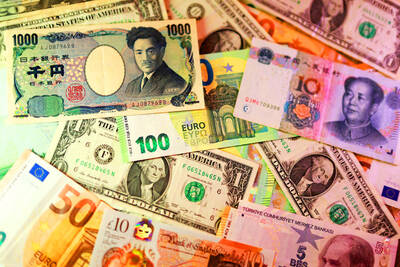
Taiwan’s foreign exchange reserves fell below the US$600 billion mark at the end of last month, with the central bank reporting a total of US$596.89 billion — a decline of US$8.6 billion from February — ending a three-month streak of increases. The central bank attributed the drop to a combination of factors such as outflows by foreign institutional investors, currency fluctuations and its own market interventions. “The large-scale outflows disrupted the balance of supply and demand in the foreign exchange market, prompting the central bank to intervene repeatedly by selling US dollars to stabilize the local currency,” Department of Foreign

ENERGY ISSUES: The TSIA urged the government to increase natural gas and helium reserves to reduce the impact of the Middle East war on semiconductor supply stability Chip testing and packaging service provider ASE Technology Holding Co (日月光投控) yesterday said it planned to invest more than NT$100 billion (US$3.15 billion) in building a new advanced chip testing facility in Kaohsiung to keep up with customer demand driven by the artificial intelligence (AI) boom. That would be included in the company’s capital expenditure budget next year, ASE said. There is also room to raise this year’s capital spending budget from a record-high US$7 billion estimated three months ago, it added. ASE would have six factories under construction this year, another record-breaking number, ASE chief operating officer Tien Wu

The EU and US are nearing an agreement to coordinate on producing and securing critical minerals, part of a push to break reliance on Chinese supplies. The potential deal would create incentives, such as minimum prices, that could advantage non-Chinese suppliers, according to a draft of an “action plan” seen by Bloomberg. The EU and US would also cooperate on standards, investments and joint projects, as well as coordinate on any supply disruptions by countries like China. The two sides are additionally seeking other “like-minded partners” to join a multicountry accord to help create these new critical mineral supply chains, which feed into

For weeks now, the global tech industry has been waiting for a major artificial intelligence (AI) launch from DeepSeek (深度求索), seen as a benchmark for China’s progress in the fast-moving field. More than a year has passed since the start-up put Chinese AI on the map in early last year with a low-cost chatbot that performed at a similar level to US rivals. However, despite reports and rumors about its imminent release, DeepSeek’s next-generation “V4” model is nowhere in sight. Speculation is also swirling over the geopolitical implications of which computer chips were chosen to train and power the new


 RSS
RSS