


China’s financial system is becoming significantly more vulnerable due to high leverage, said central bank governor Zhou Xiaochuan (周小川), who has made a series of blunt warnings about debt levels in the world’s second-largest economy.
Latent risks are accumulating, including some that are “hidden, complex, sudden, contagious and hazardous,” even as the overall health of the financial system remains good, Zhou wrote in an article published on the People’s Bank of China’s Web site late on Saturday.
The nation should toughen regulation and let markets serve the real economy better, Zhou said, adding that the government should also open up markets by relaxing capital controls and reducing restrictions on non-Chinese financial institutions that want to operate in China.
“High leverage is the ultimate origin of macro financial vulnerability,” said Zhou, 69, who is widely expected to retire soon after a record 15-year tenure. “In sectors of the real economy, this is reflected as excessive debt, and in the financial system, this is reflected as credit that has been expanding too quickly.”
The latest in a string of pro-deleveraging rhetoric from the central bank, Zhou’s comments were speculated to have contributed to a rout in Hong Kong shares. They signal that policymakers remain committed to the campaign to reduce borrowing levels across China’s economy.
Concern that regulators might intensify this drive after the Chinese Communist Party’s 19th National Congress last month helped push yields on 10-year sovereign bonds to a three-year high.
Chinese bonds seemed to shrug off the essay early yesterday, with 10-year yields down one basis point to 3.88 percent as of 11:14am in Shanghai, while the cost on five-year notes rose one basis point to 3.95 percent.
Hong Kong’s Hang Seng Index slumped the most in two weeks and the Shanghai Composite Index fell for a third day in a row.
“Investors are very sensitive to any negative news since the market is at a high level,” KGI Asia Ltd executive director Ben Kwong said, referring to the equity move. “Zhou’s comment about financial risks is hurting sentiment.”
Zhou’s essay reads more like an explanation of existing priorities than a sign they are changing direction or pace, Bloomberg Intelligence economists Tom Orlik and Fielding Chen said.
China might shift slightly toward a tighter stance, but macro-prudential rather than monetary policy will do the leg work to limit financial risks, they wrote in a note.
Despite the tough rhetoric around deleveraging in China, measures of credit continue to show expansion, with aggregate financing surging to a six-month high of 1.82 trillion yuan (US$274 billion) in September.
Corporate debt last year surged to 159 percent of the economy, compared with 104 percent 10 years ago, while overall borrowing climbed to 260 percent.
Zhou’s article was included in a book that was published to help the public and party members better comprehend the spirit of the party congress, according to the official Xinhua news agency and information on the central bank’s Web site.

HORMUZ ISSUE: The US president said he expected crude prices to drop at the end of the war, which he called a ‘minor excursion’ that could continue ‘for a little while’ The United Arab Emirates (UAE) and Kuwait started reducing oil production, as the near-closure of the crucial Strait of Hormuz ripples through energy markets and affects global supply. Abu Dhabi National Oil Co (ADNOC) is “managing offshore production levels to address storage requirements,” the company said in a statement, without giving details. Kuwait Petroleum Corp said it was lowering production at its oil fields and refineries after “Iranian threats against safe passage of ships through the Strait of Hormuz.” The war in the Middle East has all but closed Hormuz, the narrow waterway linking the Persian Gulf to the open seas,

Apple Inc increased iPhone production in India by about 53 percent last year and now makes a quarter of its marquee devices there, reflecting the US company’s efforts to avoid tariffs on China. The company assembled about 55 million iPhones in India last year, up from 36 million a year earlier, people familiar with the matter said, asking not to be named because the numbers aren’t public. Apple makes about 220 million to 230 million iPhones a year globally, with India’s share of the total increasing rapidly. Apple has accelerated its expansion in the world’s most populous country in recent years, bolstered

HEADWINDS: The company said it expects its computer business, as well as consumer electronics and communications segments to see revenue declines due to seasonality Pegatron Corp (和碩) yesterday said it aims to grow its artificial intelligence (AI) server revenue more than 10-fold this year from last year, driven by orders from neocloud solutions clients and large cloud service providers. The electronics manufacturing service provider said AI server revenue growth would be driven primarily by the Nvidia Corp GB300 server platform. Server shipments are expected to increase each quarter this year, with the second half likely to outperform the first half, it said. The AI server market is expected to broaden this year as more inference applications emerge, which would drive demand for system-on-chip, application-specific integrated circuits
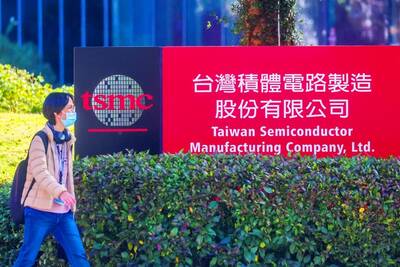
PROJECTION: TSMC said it expects strong growth this year, with revenue in US dollars projected to grow by about 30 percent, outperforming the industry Taiwan Semiconductor Manufacturing Co (TSMC, 台積電) yesterday reported consolidated sales last month reached NT$317.66 billion (US$9.98 billion), the highest ever for the month of February, driven by robust demand for chips built using the company’s advanced 3-nanometer (3nm) process. Last month’s figure was up 22.2 percent from a year earlier, but fell 20.8 percent from January, the world’s largest contract chipmaker said in a statement. For the first two months of the year, TSMC posted cumulative sales of NT$718.91 billion, up 29.9 percent from a year earlier. Analysts attributed the growth to sustained global demand for artificial intelligence (AI) products


 RSS
RSS