


Fubon Financial Holding Co (富邦金控) yesterday said that its banking subsidiary would shift its focus toward individual customers while improving the unit’s online tools.
Incoming Taipei Fubon Commercial Bank president (台北富邦銀行) Roman Cheng (程耀輝) said the company is creating a new platform to consolidate client and product information data across departments to improve cross-selling.
Cheng, who is to assume the role at the beginning of next month, said Fubon Commercial Bank’s customer data is organized according to product classes, which makes it difficult for client relations staff to recommend alternatives for them.
Following the change, first-line financial planners and customer relationship managers across different product departments would be able gain a full picture of a client’s assets allocation at the bank, Cheng said at an earnings conference in Taipei.
“The platform would allow the company to take full advantage of the digital footprint left by customers in past interactions and transactions,” he said.
Loans or other products could be recommended to the bank’s credit cardholders as their financing needs are identified, Cheng said.
The bank’s mobile tools have seen robust growth in the number of users, with personal loan applications made using smartphones totaling NT$300 million (US$9.92 million) since the service was introduced in June.
The bank reported consumer loans in the second quarter of this year rose 4.9 percent quarterly and 9.4 percent from a year earlier to NT$505.29 billion.
Overall, the bank reported total loans of NT$115.1 billion in the second quarter, with consumer loans making up 4.3 percent of the total, company data showed.
Enterprise loans still accounted for the lion’s share of the bank’s loan book, taking up 47.4 percent, followed by housing mortgages at 43.9 percent, data showed.
Cheng said that the bank’s net interest margin, which had dipped from 1.03 percent in the first quarter to 0.98 percent at the end of June, is expected to recover in the second half, as the pace of loan expansion quickens to match high growth in deposits during the first six months.
Loan growth is expected to be propelled by rising demand from self-employed individuals as well as small and medium-sized businesses, he said.
Taipei Fubon Commercial Bank would also trim loans to the government, Cheng added.
The lender’s loan-to-deposit ratio dipped from 83.5 percent a year earlier to 79.8 percent, while the same metric for foreign currencies saw a decline from 48.5 percent last year to 37.1 percent.
Fubon Life Insurance Co (富邦人壽) would see diminishing pressure from elevated hedging costs and foreign exchange-related losses as the strength of the New Taiwan dollar stabilizes over the remainder of the year, Fubon Financial Holding added.
The insurer would also bolster its recurring yield by expanding investments in international bonds and commercial real-estate properties abroad.
Fubon Financial said its net income in the first half dipped 21.2 percent annually to NT$18.7 billion.
Fubon Life Insurance’s net income contribution decreased from NT$23.7 billion in the first six months of last year to NT$18.7 billion in the same period this year, company data showed.
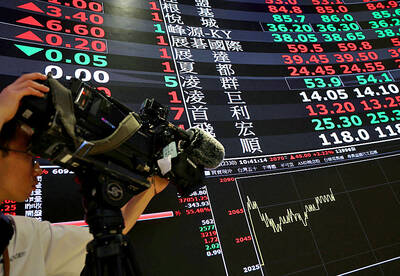
After several years flying high as Asia’s best Nvidia Corp proxy, Taiwan Semiconductor Manufacturing Co (TSMC, 台積電) is increasingly vying with other artificial intelligence (AI) stocks for investor attention. Stock traders are chasing a wider array of beneficiaries as mainstream usage of AI creates demand for hardware beyond the most-advanced chips TSMC makes for Nvidia. Subthemes from the deepening memory crunch to advances in robotics are also luring bids. At the same time, investment caps on single stocks are pushing funds to diversify, while retail investors long familiar with TSMC through its US depositary receipts are being offered a broader set of

UNDER MICROSCOPE: Taiwan detained three people who allegedly conspired to buy servers in Taiwan and export them using fraudulent documentation, prosecutors said Nvidia Corp chief executive officer Jensen Huang (黃仁勳) on Saturday urged Super Micro Computer Inc to tighten up on compliance after Taiwan detained three people this week for allegedly making fraudulent declarations about artificial intelligence (AI) servers made by its US partner. The development marked the nation’s first crackdown on semiconductor smuggling, which grew after the US slapped restrictions on exports of high-end chips such as Nvidia AI accelerators to China. Nvidia is “rigorous” in explaining regulations to all of its partners, Huang told reporters after arriving in Taipei. “Ultimately Super Micro has to run their own company,” he said in response to

TECH RELIANCE: Growth is increasingly reflecting an unequal K-shaped distribution, where technology sectors outperform and other industries struggle, an expert said Standard Chartered Bank has significantly raised its forecast for Taiwan’s economic growth to 9.5 percent this year, up from 7.6 percent previously, citing surging artificial intelligence (AI) demand driving exports, semiconductor production and investment. The upgrade reflects a sustained AI supercycle that continues to fuel demand for advanced chips and technology infrastructure, which form the backbone of Taiwan’s exports, the bank said in a report this week. “We raise our 2026 growth forecast to reflect a much stronger-than-expected first-quarter GDP figure,” Standard Chartered senior economist for greater China and Asia Tommy Wu (胡東安) said in the report. Driven largely by a 35.3 percent
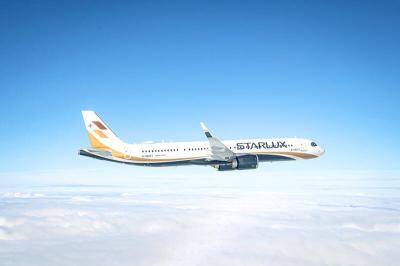
Two of Taiwan’s international carriers, Starlux Airlines Co (星宇航空) and EVA Airways Corp (長榮航空), have retained the five-star airline rating awarded by international airline review organization Skytrax. Starlux was awarded the distinction for a second consecutive year, while EVA Air received it for the 11th straight year, Skytrax said in statements released yesterday and on Thursday last week, respectively. The five-star rating is considered one of the airline industry's highest honors and is awarded following professional audits of airline product and frontline service standards, Skytrax said. The ratings are based on in-depth assessments using unified global quality standards rather than customer review scores


 RSS
RSS