


The former CEO of collapsed bitcoin exchange Mt. Gox is to head to trial in Tokyo next week on charges stemming from the disappearance of hundreds of millions of US dollars worth of the virtual currency from its digital vaults.
Frenchman Mark Karpeles — once the high-flying head of the world’s busiest bitcoin trading platform, who reportedly lived in an US$11,000-a-month penthouse and spent money lavishly, including on prostitutes — is facing embezzlement and data manipulation charges.
“He is keeping calm as the trial gets underway,” his lawyer Kiichi Iino told reporters, adding that Karpeles plans to plead his innocence.
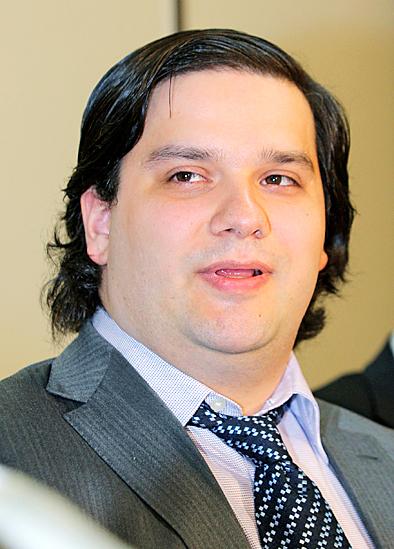
Photo: AFP
The 32-year-old was first arrested in August 2015 and released on bail nearly a year later over allegations he fraudulently manipulated data and pocketed millions worth of bitcoins.
Mt. Gox, which claimed it once hosted around 80 percent of global bitcoin trading, shuttered in 2014 after admitting that 850,000 coins — worth around US$480 million at the time — had disappeared from its vaults.
The Tokyo-based exchange filed for bankruptcy protection soon after the cyber-money went missing, leaving a trail of angry investors calling for answers and denting the virtual currency’s reputation.
Karpeles, who said he is working as an IT consultant, is active on social media and has commented on issues concerning bitcoin, but not on details of his criminal case.
“The charges [against Karpeles] only cover a subset of the issues which were happening at Mt. Gox, so I don’t expect that we will find out most of the information we want to know,” said Kolin Burges, a British investor who said he lost several hundred bitcoins in the Mt. Gox collapse.
“I’ve not had any back yet, but hopefully, eventually all the creditors will get a small percentage of their money back from the bankruptcy distribution,” he said.
Around the time of his 2015 arrest, Karpeles’ mother told the Yomiuri Shimbun that her son was a “genius” who learned computer languages at age three and started making simple programs by the time he was five.
In 2006, Karpeles wrote on his blog that computer crime was “totally contrary to my ethical principles.”
However, four years later, a Paris court sentenced him in absentia to a year in prison for hacking. He had come to Japan to work for a Web development company around 2009 and later got involved with the bitcoin exchange.
In the wake of the Mt. Gox scandal, Japan passed a bill stipulating that all virtual currency exchanges must be regulated by its Financial Services Agency.
Despite the demise of Mt. Gox and concerns about security, bitcoin and hundreds of rival digital currencies are becoming increasingly popular and accepted by merchants worldwide.
Bitcoin remains the most popular. Its market value has ballooned to more than US$42.9 billion, according to the coinmarketcap.com.
The unit has seen wild volatility during its short life, soaring from just a few US cents to around US$2,500 now, more than double its value just a few months ago.
Backers say virtual currencies offer an efficient and anonymous way to store and transfer funds online, but critics argue the lack of legal framework governing the currency, the opaque way it is traded and its volatility make it dangerous.

The domestic unit of the Chinese-owned, Dutch-headquartered chipmaker Nexperia BV will soon be able to produce semiconductors locally within China, according to two company sources. Nexperia is at the center of a global tug-of-war over critical semiconductor technology, with a Dutch court in February ordering a probe into alleged mismanagement at the company. The geopolitical tussle has disrupted supply chains, with some carmakers reportedly forced to cut production due to chip shortages. Local production would allow Nexperia’s domestic arm, Nexperia Semiconductors (China) Ltd (安世半導體中國), to bypass restrictions in place since October on the supply of silicon wafers — etched with tiny components to

Singapore-based ride-hailing and delivery giant Grab Holdings Ltd has applied for regulatory approval to acquire the Taiwan operations of Germany-based Delivery Hero SE's Foodpanda in a deal valued at about US$600 million. Grab submitted the filing to the Fair Trade Commission on Friday last week, with the transaction subject to regulatory review and approval, the company said in a statement yesterday. Its independent governance structure would help foster a healthy and competitive market in Taiwan if the deal is approved, Grab said. Grab, which is listed on the NASDAQ, said in the filing that US-based Uber Technologies Inc holds about 13 percent of
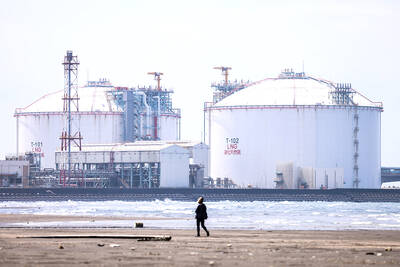
Taiwan is open to joining a global liquefied natural gas (LNG) program if one is created, but on the condition that countries provide delivery even in a scenario where there is a conflict with China, an energy department official said yesterday. While Taiwan’s priority is to have enough LNG at home, the nation is open to exploring potential strategic reserves in other countries such as Japan or South Korea, Energy Administration Deputy Director-General Chen Chung-hsien (陳崇憲) said. While the LNG market does not have a global reserve for emergencies like that of oil, the concept has been raised a few times —

Taiwan Semiconductor Manufacturing Co (TSMC, 台積電) yesterday received government approval to deploy its advanced 3-nanometer (3nm) process at its second fab currently under construction in Japan, the Ministry of Economic Affairs said in a news release. The ministry green-lit the plan for the facility in Kumamoto, which is scheduled to start installing equipment and come online in 2028 with a monthly production capacity of 15,000 12-inch wafers, the ministry said. The Department of Investment Review in June 2024 authorized a US$5.26 billion investment for the facility, slated to manufacture 6- to 12nm chips, significantly less advanced than 3nm process. At a meeting with


 RSS
RSS