


Asustek Computer Inc (華碩), the world’s fourth-largest PC vendor by shipments, might be entering one of its toughest operating periods this year after its ambition to branch out into multiple areas backfired and its core businesses face industry headwinds.
The company’s performance might hit a trough this quarter, after it last quarter posted its lowest net income in 23 quarters at NT$3.65 billion (US$121.18 million).
Asustek CEO Jerry Shen (沈振來) on May 11 attributed the decline to appreciation of the New Taiwan dollar; rising component costs for notebook computers and smartphones; and a product transition ahead of a new smartphone launch.
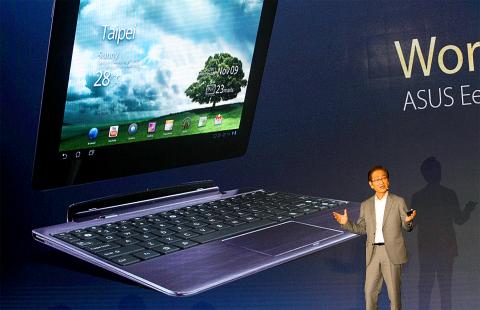
Photo: Chiang Ying-ying, AP
However, the company’s challenges are much bigger than that.
On May 8, Asustek chief operating officer and board member S.Y. Hsu (許先越) tendered his resignation to Shen, chairman Jonney Shih (施崇棠) and chief strategy officer Ted Hsu (徐世昌) via e-mail after more than 20 years at the company.
S.Y. Hsu played a major role in promoting Asustek’s first Eee PC in 2007, which helped the company significantly expand its global market share.
He was also the key player pushing the company’s Zenbook series of notebook computers over the past few years.
Despite S.Y. Hsu avoiding the spotlight since May 8, local media have reported that he resigned after failing to persuade the firm’s management to allocate more resources to his team — including research and development and marketing funding — from the smartphone business.
There has also been speculation about an internal power struggle in the company’s management.
However, Asustek has obviously made significant efforts to keep S.Y. Hsu on board, as he was named one of the key figures to lead the company’s latest restructuring program, which was announced on Friday.
In his new role overseeing both the notebook and desktop PC businesses, S.Y. Hsu is to have more resources and operational power, Asustek said, but added that there is no truth to rumors that an internal power struggle, an imbalance in resource allocations to different business units, or both, had anything to do with his resignation.
Over the past three years, Asustek has ambitiously branched out into various fields, including tablets, smartphones, virtual reality, augmented reality, robotics and artificial intelligence. The company over the past two years allocated more resources to the smartphone segment in a bid to grow handset revenue to above that of notebook’s by next year.
However, none of the new businesses, including smartphones, have eked out stable profits thus far. Moreover, by adding to its motherboard, desktop and notebook segments, the company has stretched its resources thin — in terms of limited capacity for engineers and research and development, while marketing and purchasing managers have been required to juggle several fields at the same time.
Asustek’s strategy of developing its non-PC businesses is correct, as the PC industry has been in decline for years, but it is questionable whether it was wise to extend its reach to so many fields simultaneously while its resources remain limited.
Asustek spokesman Nick Wu (吳長榮) said the company has high hopes that the latest corporate restructuring will optimize its resources and revitalize its momentum.
However, he might be overly optimistic, as a number of key figures remain in the dark about their future roles and the challenges for their tasks.
For instance, Chang Rangoon (張仰光), who previously headed the tablet team and has been named to lead a new gaming business unit as part of the restructuring, on Monday said that he did not know the details of his new operational scope or how many employees his new business unit would have.
“A lot of things have not been finalized. Jerry [Shen] and I have to discuss it,” Chang said on the sidelines of a pre-Computex news conference.
It remains to be seen if Asustek’s corporate restructuring will work in the long term, but concerns linger about the company’s decisionmaking and strategic planning, which could overshadow its performance in the remainder of the year.
SECOND-RATE: Models distilled from US products do not perform the same as the original and undo measures that ensure the systems are neutral, the US’ cable said The US Department of State has ordered a global push to bring attention to what it said are widespread efforts by Chinese companies, including artificial intelligence (AI) start-up DeepSeek (深度求索), to steal intellectual property from US AI labs, according to a diplomatic cable. The cable, dated Friday and sent to diplomatic and consular posts around the world, instructs diplomatic staff to speak to their foreign counterparts about “concerns over adversaries’ extraction and distillation of US AI models.” Distillation is the process of training smaller AI models using output from larger, more expensive ones to lower the costs of training a powerful new
Shares of Taiwan Semiconductor Manufacturing Co (TSMC, 台積電) have repeatedly hit new highs, but an equity analyst said the stock’s valuation remains within a reasonable range and any pullback would likely be technical. The contract chipmaker’s historical price-to-earnings (P/E) ratio has ranged between 20 and 30, Cathay Futures Consultant Co (國泰證期) analyst Tsai Ming-han (蔡明翰) told Central News Agency. With market consensus projecting that TSMC would post earnings per share of about NT$100 (US$3.17) this year, supported by strong global demand for artificial intelligence (AI) applications, and the stock currently trading at a P/E ratio of below 25, Tsai said the valuation
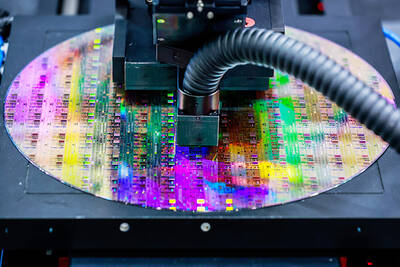
The artificial intelligence (AI) boom has triggered a seismic reshuffling of global equity markets, with Taiwan and South Korea muscling past European nations one by one. With its stock market now valued at nearly US$4.3 trillion, Taiwan surpassed the UK, Europe’s biggest market, earlier this month, data compiled by Bloomberg showed. South Korea is about US$140 billion away from doing the same. The tech-heavy Asian markets have shot past Germany and France in the past seven months. The shift is largely down to massive gains in shares of three companies that provide essential hardware for AI: Taiwan Semiconductor Manufacturing Co (TSMC, 台積電),
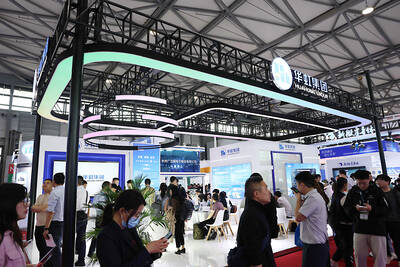
The US Department of Commerce last week ordered multiple chip equipment companies to halt shipments of certain tools to China’s second-largest chipmaker, Hua Hong Semiconductor Ltd (華虹半導體), its latest action to slow the country’s development of advanced chips, two people familiar with the matter said. The department sent letters to at least a handful of companies informing them of restrictions on tools and other materials destined for two Hua Hong facilities US officials believe make China’s most sophisticated chips, the people said. Top US chip equipment companies Lam Research Corp, Applied Materials Inc and KLA Corp, each of which has significant


 RSS
RSS