


Hiwin Technologies Co (上銀科技), the nation’s leading machinery maker, yesterday gave an optimistic sales outlook for the rest of the year, with demand for “smart” equipment and industrial robots tipped to gain strength.
“Hiwin’s current capacity is not enough to satisfy orders from our clients, especially those in the semiconductor industry,” company chairman Eric Chuo (卓永財) told an investors’ conference in Taipei.
As part of the company’s mid-term plan to enlarge overall production capacity, a new plant at the Taichung Refined Mechanics Industrial Park is to start operations by the end of this year, Hiwin said.
With the new plant, the machinery maker aims to double the production volume of industrial robots next year, Chuo said, without elaborating.
Another factory at the Chiayi Dapumei Precision Machinery Park is to be completed in February next year.
The Chiayi plant, which cost the company nearly NT$4 billion (US$132.2 million) to complete the first phase, is to mainly produce linear guideways and ball screws, Hiwin said.
Apart from its core products, the company is also working on research and development of medical equipment, eyeing strong growth potential in the sector.
The company said it is likely to obtain certification for its surgical robots next month and hopes to secure orders from Taiwanese and South Korean customers in the second half of this year.
In the first quarter, the company’s net profit skyrocketed 98.6 percent to NT$286 million from NT$144 million a year earlier, supported by a better product mix, associate vice president Leo Liao (廖克皇) told investors.
That translated into earnings per share of NT$1.04, compared with NT$0.52 a year earlier, company data showed.
“Hiwin’s profitability could have been better last quarter if the New Taiwan dollar had not appreciated drastically against its US counterpart, eroding some profit,” Liao said, adding that losses due to changes in the foreign-exchange rate surged to NT$189 million.
Sales in the period increased 44.3 percent to NT$4.3 billion on an annual basis, bolstered by robust demand for its major products, the company said.
Linear guideways and ball screws remained the major contributors to sales last quarter, taking up 55 percent and 25 percent respectively, it said.
Hiwin shares yesterday rose 6.92 percent to close at NT$208.5 in Taipei trading after the company on Tuesday released its earnings results for the January-to-March period.
They have risen 40.9 percent since the beginning of the year, outperforming the broader market’s 7.2 percent increase over the same period, Taiwan Stock Exchange data showed.

HORMUZ ISSUE: The US president said he expected crude prices to drop at the end of the war, which he called a ‘minor excursion’ that could continue ‘for a little while’ The United Arab Emirates (UAE) and Kuwait started reducing oil production, as the near-closure of the crucial Strait of Hormuz ripples through energy markets and affects global supply. Abu Dhabi National Oil Co (ADNOC) is “managing offshore production levels to address storage requirements,” the company said in a statement, without giving details. Kuwait Petroleum Corp said it was lowering production at its oil fields and refineries after “Iranian threats against safe passage of ships through the Strait of Hormuz.” The war in the Middle East has all but closed Hormuz, the narrow waterway linking the Persian Gulf to the open seas,

Apple Inc increased iPhone production in India by about 53 percent last year and now makes a quarter of its marquee devices there, reflecting the US company’s efforts to avoid tariffs on China. The company assembled about 55 million iPhones in India last year, up from 36 million a year earlier, people familiar with the matter said, asking not to be named because the numbers aren’t public. Apple makes about 220 million to 230 million iPhones a year globally, with India’s share of the total increasing rapidly. Apple has accelerated its expansion in the world’s most populous country in recent years, bolstered
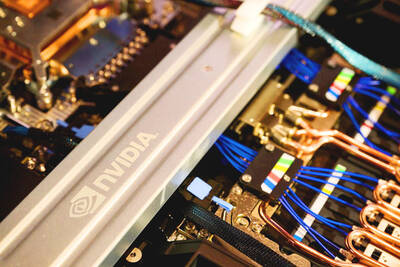
RATIONING: The proposal would give the Trump administration ample leverage to negotiate investments in the US as it decides how many chips to give each country US officials are debating a new regulatory framework for exporting artificial intelligence (AI) chips and are considering requiring foreign nations to invest in US AI data centers or security guarantees as a condition for granting exports of 200,000 chips or more, according to a document seen by Reuters. The rules are not yet final and could change. They would be the first attempt to regulate the flow of AI chips to US allies and partners since US President Donald Trump’s administration said it rescinded its predecessor’s so-called AI diffusion rules. Those rules sought to keep a significant amount of AI
HEADWINDS: The company said it expects its computer business, as well as consumer electronics and communications segments to see revenue declines due to seasonality Pegatron Corp (和碩) yesterday said it aims to grow its artificial intelligence (AI) server revenue more than 10-fold this year from last year, driven by orders from neocloud solutions clients and large cloud service providers. The electronics manufacturing service provider said AI server revenue growth would be driven primarily by the Nvidia Corp GB300 server platform. Server shipments are expected to increase each quarter this year, with the second half likely to outperform the first half, it said. The AI server market is expected to broaden this year as more inference applications emerge, which would drive demand for system-on-chip, application-specific integrated circuits


 RSS
RSS