


The central bank yesterday kept its lenient monetary policy unchanged for the third consecutive quarter, saying the nation’s output gap continued to widen due to a persistent lack of innovation and investment, despite a stable economic recovery.
“Although crude oil and raw material prices will trend up, the inflation outlook remains benign, leaving room for stimulus measures to prop up the economy,” central bank Governor Perng Fai-nan (彭淮南) told a news conference after the bank’s quarterly board meeting.
The bank’s rediscount rate was left unchanged at 1.375 percent, the collateralized loan rate at 1.75 percent and the unsecured loan rate at 3.625 percent.
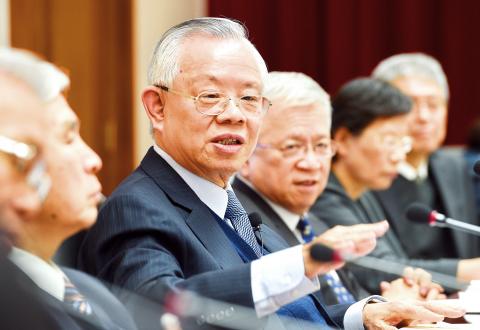
Photo: Peter Lo, Taipei Times
The monetary policymaker expects the consumer price index to rise 1.25 percent this year, higher than the 1.08 percent forecast last month by the Directorate-General of Budget, Accounting and Statistics.
While oil and raw material prices have recovered faster than expected, the appreciation of the New Taiwan dollar has helped ease inflationary pressures, Perng said.
The NT dollar has gained 5.6 percent against the greenback so far this year, which shows that the central bank is not intervening in the foreign-exchange market to keep the local currency weak in a bid to support exports, Perng said, weeks before the US Department of the Treasury is due to update its currency monitoring watch list.
The US put Taiwan on the list in April last year, accusing the central bank of frequent interventions to stem the NT dollar’s appreciation.
The central bank has been refraining from such actions for the past few months and the nation’s trade surplus has been shrinking as imports recover faster than exports, Perng said, adding that the US would, and should, remove Taiwan from the watch list.
Meanwhile, Perng said he welcomes the Cabinet’s plan to spend NT$882.4 billion (US$28.9 billion) to bolster the nation’s physical and digital infrastructure over the next seven-and-a-half years, which might carry GDP growth to above 2 percent this year, from an earlier estimate of 1.92 percent.
“It is desirable and practical to introduce quality public construction projects during the low interest rate environment,” Perng said, adding that the bank’s monetary easing policy is approaching its limit in stimulating the economy.
Regarding the government’s recent changes to labor rules, the central bank also called for a “flexible and secure” labor policy under which the government allows employers and employees more room to work out their plans for working schedules, wages and overtime compensation.
Perng described the labor policy as highly proactive, but with low flexibility, which constrains the nation’s economic freedom and the ease of doing business.
Singapore in 1979 adopted a wage correction policy that required built-in wage increases, which failed within a few years as labor costs outstripped the increase in output, the central bank said, adding that the city-state instituted a flexible wage policy in 1986 to ease labor costs.

In Italy’s storied gold-making hubs, jewelers are reworking their designs to trim gold content as they race to blunt the effect of record prices and appeal to shoppers watching their budgets. Gold prices hit a record high on Thursday, surging near US$5,600 an ounce, more than double a year ago as geopolitical concerns and jitters over trade pushed investors toward the safe-haven asset. The rally is putting undue pressure on small artisans as they face mounting demands from customers, including international brands, to produce cheaper items, from signature pieces to wedding rings, according to interviews with four independent jewelers in Italy’s main

Japanese Prime Minister Sanae Takaichi has talked up the benefits of a weaker yen in a campaign speech, adopting a tone at odds with her finance ministry, which has refused to rule out any options to counter excessive foreign exchange volatility. Takaichi later softened her stance, saying she did not have a preference for the yen’s direction. “People say the weak yen is bad right now, but for export industries, it’s a major opportunity,” Takaichi said on Saturday at a rally for Liberal Democratic Party candidate Daishiro Yamagiwa in Kanagawa Prefecture ahead of a snap election on Sunday. “Whether it’s selling food or

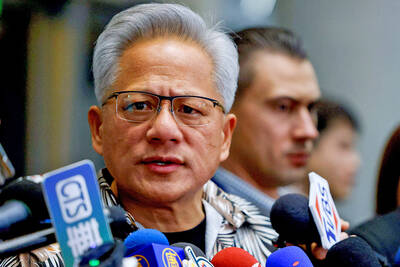
CONCERNS: Tech companies investing in AI businesses that purchase their products have raised questions among investors that they are artificially propping up demand Nvidia Corp chief executive officer Jensen Huang (黃仁勳) on Saturday said that the company would be participating in OpenAI’s latest funding round, describing it as potentially “the largest investment we’ve ever made.” “We will invest a great deal of money,” Huang told reporters while visiting Taipei. “I believe in OpenAI. The work that they do is incredible. They’re one of the most consequential companies of our time.” Huang did not say exactly how much Nvidia might contribute, but described the investment as “huge.” “Let Sam announce how much he’s going to raise — it’s for him to decide,” Huang said, referring to OpenAI
Nvidia Corp’s negotiations to invest as much as US$100 billion in OpenAI have broken down, the Wall Street Journal (WSJ) reported, exposing a potential rift between two of the most powerful companies in the artificial intelligence (AI) industry. The discussions stalled after some inside Nvidia expressed concerns about the transaction, the WSJ reported, citing unidentified people familiar with the deliberations. OpenAI makes the popular chatbot ChatGPT, while Nvidia dominates the market for AI processors that help develop such software. The companies announced the agreement in September last year, saying at the time that they had signed a letter of intent for a strategic


 RSS
RSS