


Pegatron Corp (和碩), one of Apple Inc’s iPhone assemblers, yesterday said that its revenue would climb by between 5 and 10 percent annually this year supported by rising orders from its communication, consumer electronics and computing products.
“We are cautiously optimistic about Pegatron’s operations this year. The communications department is to introduce a product that has significant changes in details, which we believe it will not let consumers down,” Pegatron chief executive officer S.J. Liao (廖賜政) told an investors’ conference at the company’s headquarters in Taipei.
Pegatron’s communications department, which includes smartphone assembling and networking products, contributed 72 percent of overall revenue of NT$360.48 billion (US$11.64 billion) last quarter, company data showed.
The department’s largest client is Apple, which is expected to launch its next-generation iPhone this year to celebrate the 10th anniversary of the device’s launch.
Liao said rising demand for gaming PCs and new gaming consoles would support Pegatron’s computing and consumer electronics businesses this year.
The Pegatron board approved a capital expenditure plan of between US$400 million and US$450 million to significantly expand the company’s production capacity this year to meet customer demand, Pegatron chief financial officer Charles Lin (林秋炭) said.
The capital expenditure is at least double last year’s US$200 million.
Liao said in his outlook for the current quarter that revenue from the non-computing sector, which makes up 87 percent of the firm’s revenue, is to contract by between 35 percent and 40 percent quarter-on-quarter due to the slow season for communications and consumer electronics products.
Revenue will improve significantly in the second half of this year, when communications and consumer electronics clients launch new products, Liao said.
The remarks from the top executives came after the company posted net income of NT$19.34 billion, or NT$7.5 per share, for last year, down 18.7 percent from NT$23.81 billion, or NT$9.23 per share, the previous year.
It was Pegatron’s first annual decline in earnings since the company listed on the Taiwan Stock Exchange in 2010, company data showed.
Gross margin dropped 0.8 percentage points to 5.4 percent last year, while operating margin fell 0.5 percentage points to 2.8 percent, the data showed.
Lin attributed the earnings decline to slowing demand last year.
Combined foreign-exchange losses of NT$4.37 billion also weighed on the earnings performance, he said.
The board approved the distribution of a cash dividend of NT$5 per share. The planned distribution translates into a payout ratio of 66.66 percent, higher than the previous year’s 54.5 percent.
That represents a yield of 6.03 percent based on the company’s closing price of NT$82.8 in Taipei trading yesterday.
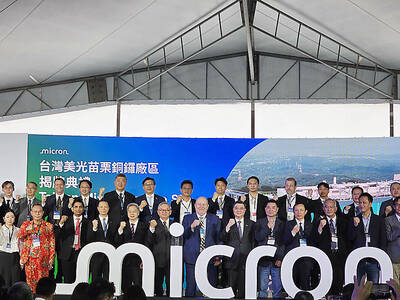
UNPRECEDENTED PACE: Micron Technology has announced plans to expand manufacturing capabilities with the acquisition of a new chip plant in Miaoli Micron Technology Inc unveiled a newly acquired chip plant in Miaoli County yesterday, as the company expands capacity to meet growing demand for advanced DRAM chips, including high-bandwidth memory chips amid the artificial intelligence boom. The plant in Miaoli County’s Tongluo Township (銅鑼), which Micron acquired from Powerchip Semiconductor Manufacturing Corp (力積電) for US$1.8 billion, is expected to make a sizeable capacity contribution to the company from fiscal 2028, the company said in a statement. It would be an extended production site of Micron’s large-scale manufacturing hub in Taichung, the company said. As the global semiconductor industry is racing to reach US$1 trillion

Singapore-based ride-hailing and delivery giant Grab Holdings Ltd has applied for regulatory approval to acquire the Taiwan operations of Germany-based Delivery Hero SE's Foodpanda in a deal valued at about US$600 million. Grab submitted the filing to the Fair Trade Commission on Friday last week, with the transaction subject to regulatory review and approval, the company said in a statement yesterday. Its independent governance structure would help foster a healthy and competitive market in Taiwan if the deal is approved, Grab said. Grab, which is listed on the NASDAQ, said in the filing that US-based Uber Technologies Inc holds about 13 percent of

Taiwan’s food delivery market could undergo a major shift if Singapore-based Grab Holdings Ltd completes its planned acquisition of Delivery Hero SE’s Foodpanda business in Taiwan, industry experts said. Grab on Monday last week announced it would acquire Foodpanda’s Taiwan operations for US$600 million. The deal is expected to be finalized in the second half of this year, with Grab aiming to complete user migration to its platform by the first half of next year. A duopoly between Uber Eats and Foodpanda dominates Taiwan’s delivery market, a structure that has remained intact since the Fair Trade Commission (FTC) blocked Uber Technologies Inc’s

Memory chip stocks extended their losses yesterday after Alphabet Inc’s Google publicized research that could allow more efficient use of the storage needed for artificial intelligence (AI) development. SK Hynix Inc and Samsung Electronics Co, South Korean leaders in the market, fell more than 6 percent and about 5 percent respectively in Seoul. In the US, Micron Technology Inc, Western Digital Corp and Sandisk Corp slid more than 2 percent in pre-market trading, after they all closed lower on Wednesday. Memory companies have been on a tear in recent months as the rapid development of AI infrastructure triggered a spike in chip


 RSS
RSS