


The US should remove Taiwan from its currency watch list next month, as the value of New Taiwan dollar rose rapidly this year and much of the increase in the nation’s foreign-exchange reserves came from interest yields, instead of trading gains, central bank Governor Perng Fai-nan (彭淮南) said yesterday.
“I am confident that Taiwan will not, and should not, remain on the currency monitoring list, if the US applies the same criteria from October last year,” Perng told the legislature’s Finance Committee.
Lawmakers voiced concerns about tension with the US as the world’s largest economy has accused the central bank of intervening in the market to stem the NT dollar’s rise in a bid to help Taiwanese exporters.
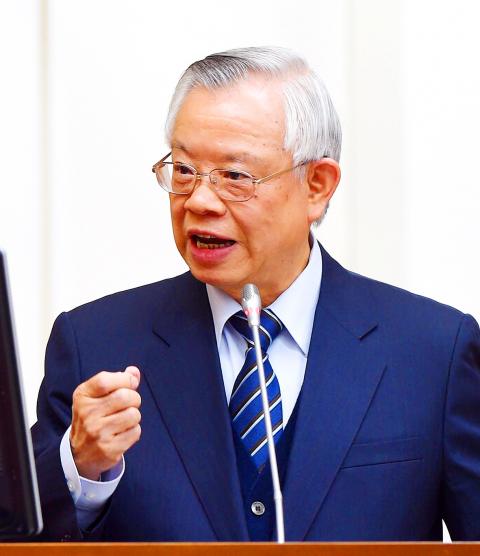
Photo: Chien Jung-fong, Taipei Times
Taiwan is home to the world’s largest contract chipmakers, chip designers and makers of electronic components used in smartphones, personal computers, connected vehicles and Internet of Things applications.
The US Department of the Treasury is due to update its currency monitoring list next month. The criteria it used to back currency manipulation charges include a trade surplus of more than US$20 billion, a current account surplus in excess of 3 percent of GDP and an increase in foreign exchange reserves that is more than 2 percent of GDP.
Thanks to a trade surplus shrinkage, Taiwan is likely to fail only the latter two tests this year, but Perng said that much of foreign-exchange reserves gains came from interest income.
“Foreign-exchange reserves may increase through currency trading or interest income accumulation... The US had underestimated the size of interest income” in Taiwan’s case, Perng said.
In addition, the local currency has appreciated quickly this year, having risen 4.83 percent against the US dollar as of Tuesday last week, making it the best performer next only to the South Korean won, Perng said.
The NT dollar’s quick advance shows no sign of central bank intervention, Perng said, adding that the local currency has held relatively stable these days without abrupt falls toward the end of trading sessions.
Perng attributed the NT dollar’s appreciation to foreign funds inflows of US$5 billion to Asia this year, with Taiwan absorbing US$3 billion.
The governor warned against a trade war, saying it would not benefit either party.
The US is a major exporter of refined petroleum, cars, vehicle parts and agriculture, among other things, he said.
Macquarie Group Ltd reached other observations, saying Taiwan may have seen capital repatriation by Taiwanese firms and individuals from across the Taiwan Strait.
Taiwanese businesspeople have shut down factories in coastal China or moved capital home to cope with risks related to the yuan’s depreciation and aggressive tax investigations by the Chinese government, the Sydney-based firm said in a note on Wednesday.
Despite the capital inflows, the central bank said it did not see funds flowing to the local property market, as luxury homes continue to find it difficult to secure buyers.
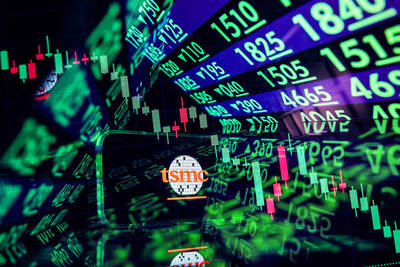
Taiwan Semiconductor Manufacturing Co (TSMC, 台積電) last week recorded an increase in the number of shareholders to the highest in almost eight months, despite its share price falling 3.38 percent from the previous week, Taiwan Stock Exchange data released on Saturday showed. As of Friday, TSMC had 1.88 million shareholders, the most since the week of April 25 and an increase of 31,870 from the previous week, the data showed. The number of shareholders jumped despite a drop of NT$50 (US$1.59), or 3.38 percent, in TSMC’s share price from a week earlier to NT$1,430, as investors took profits from their earlier gains
AI TALENT: No financial details were released about the deal, in which top Groq executives, including its CEO, would join Nvidia to help advance the technology Nvidia Corp has agreed to a licensing deal with artificial intelligence (AI) start-up Groq, furthering its investments in companies connected to the AI boom and gaining the right to add a new type of technology to its products. The world’s largest publicly traded company has paid for the right to use Groq’s technology and is to integrate its chip design into future products. Some of the start-up’s executives are leaving to join Nvidia to help with that effort, the companies said. Groq would continue as an independent company with a new chief executive, it said on Wednesday in a post on its Web

CHINA RIVAL: The chips are positioned to compete with Nvidia’s Hopper and Blackwell products and would enable clusters connecting more than 100,000 chips Moore Threads Technology Co (摩爾線程) introduced a new generation of chips aimed at reducing artificial intelligence (AI) developers’ dependence on Nvidia Corp’s hardware, just weeks after pulling off one of the most successful Chinese initial public offerings (IPOs) in years. “These products will significantly enhance world-class computing speed and capabilities that all developers aspire to,” Moore Threads CEO Zhang Jianzhong (張建中), a former Nvidia executive, said on Saturday at a company event in Beijing. “We hope they can meet the needs of more developers in China so that you no longer need to wait for advanced foreign products.” Chinese chipmakers are in
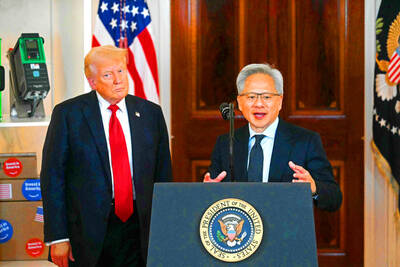
POLICY REVERSAL: The decision to allow sales of Nvidia’s H200 chips to China came after years of tightening controls and has drawn objections among some Republicans US House Republicans are calling for arms-sale-style congressional oversight of artificial intelligence (AI) chip exports as US President Donald Trump’s administration moves to approve licenses for Nvidia Corp to ship its H200 processor to China. US Representative Brian Mast, the Republican chairman of the US House Committee on Foreign Affairs, which oversees export controls, on Friday introduced a bill dubbed the AI Overwatch Act that would require the US Congress to be notified of AI chips sales to adversaries. Any processors equal to or higher in capabilities than Nvidia’s H20 would be subject to oversight, the draft bill says. Lawmakers would have


 RSS
RSS