


Taiwan Pulp and Paper Corp (TPPC, 台灣紙業) chairman Chien Hung-wen (簡鴻文) might relinquish his control of the company in exchange for the Ministry of Finance’s support for his chairmanship at Mega Securities Co (兆豐證券), the Chinese-language Liberty Times (the Taipei Times’ sister newspaper) reported on Friday, citing sources at the ministry.
Chien, the focal point of an intensified boardroom row at the 70-year-old Tainan-based TPPC, filed a request with the ministry on Friday for permission to extend his tenure at the brokerage arm of state-run Mega Financial Holding Co (兆豐金控), the Liberty Times said.
The ministry is a major shareholder of Mega Financial and has the power to appoint heads at the financial firm and its subsidiaries.
Chien turns 65 this year, the official retirement age at Mega Securities, the paper said.
The TPPC’s boardroom dispute between Chien and president Yu Mei-ling (余美玲) has escalated into a proxy fight, leaving investors concerned about corporate governance.
Chien’s request would be granted if he is willing to step down as TPPC chairman by the end of next month, the Liberty Times said.
The company is at risk of being delisted from the local bourse for breaching compliance rules; it faces a deadline next month for its board to recognize last year’s earnings results.
However, Yu said she had little confidence Chien would keep his promise to step down, the Chinese-language Economic Daily News reported on Saturday.
“Judging by Chien’s remarks and actions over the past few months, his attitude has continuously flip-flopped,” the paper quoted Yu as saying.
Board members siding with Yu have continued their efforts to solicit more proxy votes, seeking to oust Chien at an extraordinary meeting scheduled for March 13, the Economic Daily News said.
However, in a half-page advertisement that ran on Friday on the front page of several local newspapers, Chien asked shareholders to show support for him at an extraordinary meeting he has scheduled for March 31.
To attract participants to their rival meetings, the two sides have prepared souvenirs. Those attending the March 13 meeting will receive two tubes of lip balm, while those who attend the March 31 meeting are to receive a convenience store gift voucher worth NT$50, local media reports said.
Chien’s family holds a more than 20 percent stake in TPPC, which gives it two seats on the seven-member board.
He is also chairman of the Taiwan Securities Association (券商公會), which according to its Web site has a mission to protect the interests of stock investors and coordinate between the government and member companies.

Taiwan Semiconductor Manufacturing Co (TSMC, 台積電) last week recorded an increase in the number of shareholders to the highest in almost eight months, despite its share price falling 3.38 percent from the previous week, Taiwan Stock Exchange data released on Saturday showed. As of Friday, TSMC had 1.88 million shareholders, the most since the week of April 25 and an increase of 31,870 from the previous week, the data showed. The number of shareholders jumped despite a drop of NT$50 (US$1.59), or 3.38 percent, in TSMC’s share price from a week earlier to NT$1,430, as investors took profits from their earlier gains
AI TALENT: No financial details were released about the deal, in which top Groq executives, including its CEO, would join Nvidia to help advance the technology Nvidia Corp has agreed to a licensing deal with artificial intelligence (AI) start-up Groq, furthering its investments in companies connected to the AI boom and gaining the right to add a new type of technology to its products. The world’s largest publicly traded company has paid for the right to use Groq’s technology and is to integrate its chip design into future products. Some of the start-up’s executives are leaving to join Nvidia to help with that effort, the companies said. Groq would continue as an independent company with a new chief executive, it said on Wednesday in a post on its Web

CHINA RIVAL: The chips are positioned to compete with Nvidia’s Hopper and Blackwell products and would enable clusters connecting more than 100,000 chips Moore Threads Technology Co (摩爾線程) introduced a new generation of chips aimed at reducing artificial intelligence (AI) developers’ dependence on Nvidia Corp’s hardware, just weeks after pulling off one of the most successful Chinese initial public offerings (IPOs) in years. “These products will significantly enhance world-class computing speed and capabilities that all developers aspire to,” Moore Threads CEO Zhang Jianzhong (張建中), a former Nvidia executive, said on Saturday at a company event in Beijing. “We hope they can meet the needs of more developers in China so that you no longer need to wait for advanced foreign products.” Chinese chipmakers are in
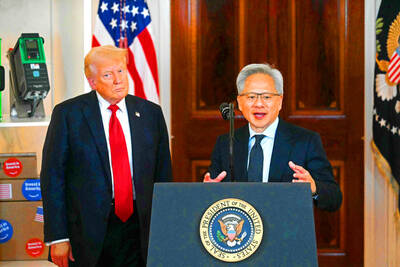
POLICY REVERSAL: The decision to allow sales of Nvidia’s H200 chips to China came after years of tightening controls and has drawn objections among some Republicans US House Republicans are calling for arms-sale-style congressional oversight of artificial intelligence (AI) chip exports as US President Donald Trump’s administration moves to approve licenses for Nvidia Corp to ship its H200 processor to China. US Representative Brian Mast, the Republican chairman of the US House Committee on Foreign Affairs, which oversees export controls, on Friday introduced a bill dubbed the AI Overwatch Act that would require the US Congress to be notified of AI chips sales to adversaries. Any processors equal to or higher in capabilities than Nvidia’s H20 would be subject to oversight, the draft bill says. Lawmakers would have


 RSS
RSS