


TPK Holding Co (宸鴻), which supplies touch panels for Apple Inc’s iPhones and Apple Watches, yesterday said it turned a profit for the second quarter in a row, as a substantial asset disposal gain helped stem operating losses during the traditionally slow season.
Net profits plunged 57 percent to about NT$296 million (US$9.61 million) in the quarter ended Dec. 31 last year, compared with NT$684 million in the previous quarter, a company financial statement showed.
However, the company last quarter swung into an operating loss of NT$45 million from operating income of NT$1.27 billion the previous quarter.
The operating loss was offset by a non-operating gain of NT$564 million, the statement said.
Gross margin sank to 5.5 percent last quarter from 9.6 percent the previous quarter.
The company cited weaker-than-expected demand for smartphones and wearable devices, which reduced factory utilization, and lowered prices for last quarter’s financial results.
Over the past two years, TPK has been struggling to turn around its touch panel business via streamlining its customer portfolios and product line-ups, recouping smartphone touch panel orders from Apple Inc.
Last quarter, half of TPK’s revenue came from Apple, the company said.
Yesterday, TPK said it can see “the light at the end of the tunnel.”
“TPK’s operations hit the bottom in 2016. We expect to see a significant improvement this year,” TPK chief executive officer Michael Chung (鍾依華) told investors during a teleconference yesterday.
“Numerous new products will enter the markets this year, providing robust growth momentum for the company,” Chung said.
The new products are ramping smoothly, with yield rates making good progress, he said.
TPK stumbled in the second quarter last year by incurring a quarterly loss of NT$2.5 billion after failing to boost yield rates for making touch panels used in wearable devices to a profitable level.
TPK aims to turn a profit in each quarter throughout the year, Chung said, adding that revenue is expected to increase each quarter.
The company expects revenue this quarter to exceed the NT$21.24 billion in the same period last year.
If that is realized, TPK will see less than a 10 percent decline this quarter from NT$24.7 billion, TPK chief financial officer Freddie Liu (劉詩亮) said.
That will help lift TPK’s operating margin back to positive territory at 1 percent, Liu said.
He said he also expects a sizable contribution from new asset gains this quarter.
“The seasonal effect in the first quarter will be smaller this year than in previous years,” Liu said. “Tablets and two-in-one computers will become the major growth drivers for TPK, as clients are to launch new models in the first half of the year.”
In the second half, smartphones would overtake tablets and PCs as the company’s main driving force, Liu said.
Apple is expected to unveil its new iPhone in September.
TPK plans to boost capital expenditures this year by 68 percent to NT$4.7 billion from last year’s NT$2.8 billion to finance the production of a 3D touch sensor, which is reportedly to be used in Apple’s new iPhones.

Taiwan Semiconductor Manufacturing Co (TSMC, 台積電) last week recorded an increase in the number of shareholders to the highest in almost eight months, despite its share price falling 3.38 percent from the previous week, Taiwan Stock Exchange data released on Saturday showed. As of Friday, TSMC had 1.88 million shareholders, the most since the week of April 25 and an increase of 31,870 from the previous week, the data showed. The number of shareholders jumped despite a drop of NT$50 (US$1.59), or 3.38 percent, in TSMC’s share price from a week earlier to NT$1,430, as investors took profits from their earlier gains
AI TALENT: No financial details were released about the deal, in which top Groq executives, including its CEO, would join Nvidia to help advance the technology Nvidia Corp has agreed to a licensing deal with artificial intelligence (AI) start-up Groq, furthering its investments in companies connected to the AI boom and gaining the right to add a new type of technology to its products. The world’s largest publicly traded company has paid for the right to use Groq’s technology and is to integrate its chip design into future products. Some of the start-up’s executives are leaving to join Nvidia to help with that effort, the companies said. Groq would continue as an independent company with a new chief executive, it said on Wednesday in a post on its Web

CHINA RIVAL: The chips are positioned to compete with Nvidia’s Hopper and Blackwell products and would enable clusters connecting more than 100,000 chips Moore Threads Technology Co (摩爾線程) introduced a new generation of chips aimed at reducing artificial intelligence (AI) developers’ dependence on Nvidia Corp’s hardware, just weeks after pulling off one of the most successful Chinese initial public offerings (IPOs) in years. “These products will significantly enhance world-class computing speed and capabilities that all developers aspire to,” Moore Threads CEO Zhang Jianzhong (張建中), a former Nvidia executive, said on Saturday at a company event in Beijing. “We hope they can meet the needs of more developers in China so that you no longer need to wait for advanced foreign products.” Chinese chipmakers are in
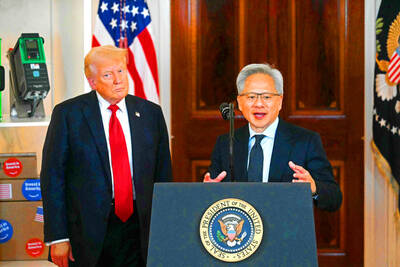
POLICY REVERSAL: The decision to allow sales of Nvidia’s H200 chips to China came after years of tightening controls and has drawn objections among some Republicans US House Republicans are calling for arms-sale-style congressional oversight of artificial intelligence (AI) chip exports as US President Donald Trump’s administration moves to approve licenses for Nvidia Corp to ship its H200 processor to China. US Representative Brian Mast, the Republican chairman of the US House Committee on Foreign Affairs, which oversees export controls, on Friday introduced a bill dubbed the AI Overwatch Act that would require the US Congress to be notified of AI chips sales to adversaries. Any processors equal to or higher in capabilities than Nvidia’s H20 would be subject to oversight, the draft bill says. Lawmakers would have


 RSS
RSS