


The nation’s economy might continue at a slow pace of expansion next year, with GDP set for a 1.8 percent increase as structural constraints limit growth, the Yuanta-Polaris Research Institute (元大寶華綜經院) said yesterday.
The projection came after the Taipei-based think tank raised its growth forecast for this year to 1.37 percent, compared with a projection of 1.1 percent in September, on the back of improving external demand.
“While key barometers have showed positive movements, the economy remains mired in small growth... It would take an industrial policy that encourages radical innovation with cooperation from the private sector to cast off the pattern,” institute president Liang Kuo-yuan (梁國源) said at a news conference.
The Democratic Progressive Party government has introduced a series of measures to help the private sector expand and diversify its markets, moving from a focus on China to Southeast and South Asian nations.
The creation of a digital economy, with the government limited to the role of troubleshooter, might spur incremental innovation, Liang said, but added that what Taiwan really needs is radical innovation, such as the facilitation of the semiconductor industry in the 1980s, when chipmaking was new to Taiwan, but policymakers tapped entrepreneurs such as Taiwan Semiconductor Manufacturing Co (TSMC, 台積電) chairman Morris Chang (張忠謀) to establish operations at Hsinchu Science Park.
The success of TSMC and the science park lend support to the importance of finding the right people to spearhead industrial reform, rather than the opposite approach espoused by the government, he said.
Chang earlier voiced similar concerns, saying that the private sector took part in government-sponsored technology forums in the 1980s and walked away with concrete projections about the industry’s future.
Consequently, companies were founded in a number of technology sectors, he said, adding that in recent years, such forums have mostly drawn the participation of the government and academic circles, focusing their discussions on general and vague subjects, which has left the private sector without direction.
The National Development Council has been unable to find people to head its proposed national investment company, Liang said, adding that a lack of talent and unfavorable tax policies have contributed to the predicament.
The government has sought to strike a balance between encouraging innovation and a more equitable distribution of wealth, goals that are contradictory, Liang quoted Chang as saying.
Instead, the government should place more emphasis on growth and tolerate inequitable wealth distribution, because incentives are necessary to spur growth, Liang said, adding that growth is the key to employment and wealth enhancement.
The government has signaled plans to cut income taxes as part of efforts to attract foreign professionals and curb a brain drain.

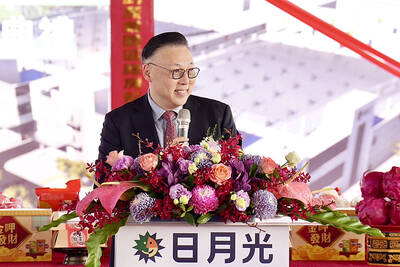
ENERGY ISSUES: The TSIA urged the government to increase natural gas and helium reserves to reduce the impact of the Middle East war on semiconductor supply stability Chip testing and packaging service provider ASE Technology Holding Co (日月光投控) yesterday said it planned to invest more than NT$100 billion (US$3.15 billion) in building a new advanced chip testing facility in Kaohsiung to keep up with customer demand driven by the artificial intelligence (AI) boom. That would be included in the company’s capital expenditure budget next year, ASE said. There is also room to raise this year’s capital spending budget from a record-high US$7 billion estimated three months ago, it added. ASE would have six factories under construction this year, another record-breaking number, ASE chief operating officer Tien Wu

The EU and US are nearing an agreement to coordinate on producing and securing critical minerals, part of a push to break reliance on Chinese supplies. The potential deal would create incentives, such as minimum prices, that could advantage non-Chinese suppliers, according to a draft of an “action plan” seen by Bloomberg. The EU and US would also cooperate on standards, investments and joint projects, as well as coordinate on any supply disruptions by countries like China. The two sides are additionally seeking other “like-minded partners” to join a multicountry accord to help create these new critical mineral supply chains, which feed into

For weeks now, the global tech industry has been waiting for a major artificial intelligence (AI) launch from DeepSeek (深度求索), seen as a benchmark for China’s progress in the fast-moving field. More than a year has passed since the start-up put Chinese AI on the map in early last year with a low-cost chatbot that performed at a similar level to US rivals. However, despite reports and rumors about its imminent release, DeepSeek’s next-generation “V4” model is nowhere in sight. Speculation is also swirling over the geopolitical implications of which computer chips were chosen to train and power the new

Intel Corp is joining Elon Musk’s long-shot effort to develop semiconductors for Tesla Inc, Space Exploration Technologies Corp and xAI, marking a surprising twist in the chipmaker’s comeback bid. Intel would help the Terafab project “refactor” the technology in a chip factory, the company said on Tuesday in a post on X, Musk’s social media platform. That is a stage in the development process that typically helps make chips more powerful or reliable. The chipmaker’s shares jumped 4.2 percent to US$52.91 in New York trading on Tuesday. The Terafab project is a grand plan by Musk to eventually manufacture his own chips for


 RSS
RSS