


Softbank Group Corp plans to build more wind projects in Mongolia as company chairman Masayoshi Son pushes to connect countries across Asia with transmission lines to supply cheap, clean energy.
The Tokyo-based company’s first wind farm in Mongolia is a 50-megawatt project being developed with Newcom LLC in the Gobi Desert. The project is an outgrowth of a venture between Newcom and Softbank’s clean-energy unit called Clean Energy Asia LLC that was set up in 2012.
Softbank is now looking into two more wind projects in Mongolia, with plans to possibly add 200 megawatts of solar and wind at the site of its first project, said Shinsuke Moriya, who manages Softbank’s electricity business planning group.
The expansion, capitalizing on Mongolia’s abundant supply of flat land and attractive wind resources, would be part of a plan to eventually build 7 gigawatts or more of wind in the country.
“We decided to start with a project of a size suitable for domestic power grids,” Moriya said.
“It’s an important step forward, but it is also a stepping stone,” he said.
The 50-megawatt wind project is expected to cost about US$120 million, with 70 percent financed through loans from the Japan International Cooperation Agency and the European Bank for Reconstruction and Development, Moriya said.
It is the first time the Japanese agency is cofinancing a project with the European bank, which has experience in funding wind in Mongolia, said Tetsuo Konaka, director-general of the agency’s private sector partnership and finance department, adding that the agency is ready to support similar projects by the private sector.
“Our agency can take risks in financing developing countries such as Mongolia or low-income nations in Africa, where private banks may have difficulty entering,” Konaka said.
Softbank entered the clean energy business following the 2011 Fukushima earthquake and tsunami, and the resulting nuclear meltdowns. Son also started advocating to link Japan with countries as far away as India to supply cheaper solar and wind power to countries with higher power tariffs.
“Back in 2011, we were the solo voice crying out for setting up the Asia Super Grid, but the idea is gaining traction and various kinds of planning is under way between countries,” Moriya said.
China has emerged as a strong supporter of interconnections. Chinese President Xi Jinping (習近平) proposed discussions on establishing a global energy network to meet power demand with clean energy during his speech at the UN in September last year.
In March, Softbank agreed with State Grid Corp of China, Korea Electric Power Corp and Russian grid firm Rosseti Pjsc to research and plan for interconnected power grids in Northeast Asia.
Adding wind capacity for domestic use will help Mongolia reduce its carbon-dioxide emissions. Coal supplied more than 90 percent of the country’s electricity in 2013, according to World Bank data.
At home, Softbank has more than 300 megawatts of solar and wind in operation, and another 200 megawatts under development, said Masanori Kinugasa, who manages the corporate strategy department at SB Energy Corp, Softbank’s wholly owned clean-energy unit.
While Softbank plans to add more renewables capacity and diversify into biomass, geothermal and small hydro, it is also looking into managing energy storage.
The firm has been taking part in a pilot project to supply excess solar power to storage devices and electric vehicles on a remote island off Nagasaki to address concerns about grids being overwhelmed by an influx of intermittent clean energy.

The domestic unit of the Chinese-owned, Dutch-headquartered chipmaker Nexperia BV will soon be able to produce semiconductors locally within China, according to two company sources. Nexperia is at the center of a global tug-of-war over critical semiconductor technology, with a Dutch court in February ordering a probe into alleged mismanagement at the company. The geopolitical tussle has disrupted supply chains, with some carmakers reportedly forced to cut production due to chip shortages. Local production would allow Nexperia’s domestic arm, Nexperia Semiconductors (China) Ltd (安世半導體中國), to bypass restrictions in place since October on the supply of silicon wafers — etched with tiny components to

Singapore-based ride-hailing and delivery giant Grab Holdings Ltd has applied for regulatory approval to acquire the Taiwan operations of Germany-based Delivery Hero SE's Foodpanda in a deal valued at about US$600 million. Grab submitted the filing to the Fair Trade Commission on Friday last week, with the transaction subject to regulatory review and approval, the company said in a statement yesterday. Its independent governance structure would help foster a healthy and competitive market in Taiwan if the deal is approved, Grab said. Grab, which is listed on the NASDAQ, said in the filing that US-based Uber Technologies Inc holds about 13 percent of

Taiwan Semiconductor Manufacturing Co (TSMC, 台積電) yesterday received government approval to deploy its advanced 3-nanometer (3nm) process at its second fab currently under construction in Japan, the Ministry of Economic Affairs said in a news release. The ministry green-lit the plan for the facility in Kumamoto, which is scheduled to start installing equipment and come online in 2028 with a monthly production capacity of 15,000 12-inch wafers, the ministry said. The Department of Investment Review in June 2024 authorized a US$5.26 billion investment for the facility, slated to manufacture 6- to 12nm chips, significantly less advanced than 3nm process. At a meeting with
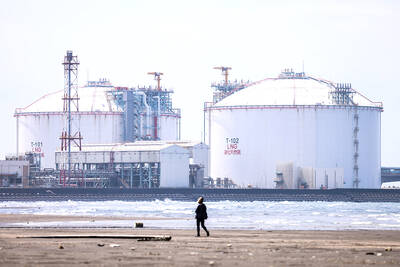
Taiwan is open to joining a global liquefied natural gas (LNG) program if one is created, but on the condition that countries provide delivery even in a scenario where there is a conflict with China, an energy department official said yesterday. While Taiwan’s priority is to have enough LNG at home, the nation is open to exploring potential strategic reserves in other countries such as Japan or South Korea, Energy Administration Deputy Director-General Chen Chung-hsien (陳崇憲) said. While the LNG market does not have a global reserve for emergencies like that of oil, the concept has been raised a few times —


 RSS
RSS