


The stock market will likely encounter technical corrections in the near future after a strong showing over the past week thanks to aggressive foreign institutional buying, Taishin Securities Investment Trust Co (台新投信) fund manager Wei Yung-hsiang (魏永祥) said.
Selling might soon prevail because of worries over a stronger New Taiwan dollar, which could hurt exporters’ profits, especially in the high-tech sector, he said.
The TAIEX ended last week up by 382.32 points, or 4.29 percent, at 9,284.62, its highest level since May 3, when it ended at 9,294.12.
Taiwan Semiconductor Manufacturing Co (台積電) led the gains, rising more than 8 percent to NT$187.50 on Friday. Its market capitalization was up NT$360 billion (US$11.5 billion) last week.
Foreign institutional investors bought a net NT$25.93 billion in shares during the week as a growing number of them moved funds into the region, betting on a weaker US dollar.
The significant upturn in stocks might lead investors to lock in profits in the near future as the market is seen to have overshot a little bit, Wei said.
As the US Federal Reserve is not expected to raise rates until at least December, foreign funds could continue to flow into the region and lift the NT dollar, which could hurt the competitive edge of the nation’s high-tech exporters and prompt investors to sell some of their holdings down the road, Wei said.
Wei said the US presidential election could also affect global financial markets, including Taipei.
If Democrat Hillary Rodham Clinton wins, it would not be seen by the market as a negative lead, but if Republican Donald Trump wins, the specter of US protectionism could have an adverse impact on world markets, he said.
The silver lining is that Taiwan’s economy should improve next year, helping listed companies improve their bottom lines, he said.
That in turn would lend support to the local equity market and help fend off selling from technical corrections, he said.
When the TAIEX falls to a 220-day moving average of about 8,500 to 8,600 points due to short-term corrections, it could be a good time to buy, Wei said.
The Directorate-General of Budget, Accounting and Statistics recently raised its forecast for the nation’s economic growth to 1.22 percent for this year and said that growth could hit 1.88 percent next year.

In Italy’s storied gold-making hubs, jewelers are reworking their designs to trim gold content as they race to blunt the effect of record prices and appeal to shoppers watching their budgets. Gold prices hit a record high on Thursday, surging near US$5,600 an ounce, more than double a year ago as geopolitical concerns and jitters over trade pushed investors toward the safe-haven asset. The rally is putting undue pressure on small artisans as they face mounting demands from customers, including international brands, to produce cheaper items, from signature pieces to wedding rings, according to interviews with four independent jewelers in Italy’s main

Japanese Prime Minister Sanae Takaichi has talked up the benefits of a weaker yen in a campaign speech, adopting a tone at odds with her finance ministry, which has refused to rule out any options to counter excessive foreign exchange volatility. Takaichi later softened her stance, saying she did not have a preference for the yen’s direction. “People say the weak yen is bad right now, but for export industries, it’s a major opportunity,” Takaichi said on Saturday at a rally for Liberal Democratic Party candidate Daishiro Yamagiwa in Kanagawa Prefecture ahead of a snap election on Sunday. “Whether it’s selling food or

CONCERNS: Tech companies investing in AI businesses that purchase their products have raised questions among investors that they are artificially propping up demand Nvidia Corp chief executive officer Jensen Huang (黃仁勳) on Saturday said that the company would be participating in OpenAI’s latest funding round, describing it as potentially “the largest investment we’ve ever made.” “We will invest a great deal of money,” Huang told reporters while visiting Taipei. “I believe in OpenAI. The work that they do is incredible. They’re one of the most consequential companies of our time.” Huang did not say exactly how much Nvidia might contribute, but described the investment as “huge.” “Let Sam announce how much he’s going to raise — it’s for him to decide,” Huang said, referring to OpenAI
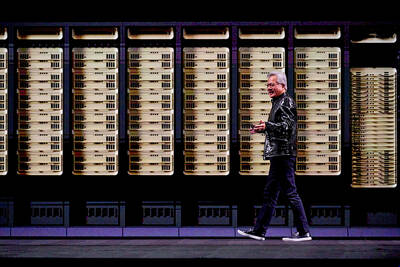
The global server market is expected to grow 12.8 percent annually this year, with artificial intelligence (AI) servers projected to account for 16.5 percent, driven by continued investment in AI infrastructure by major cloud service providers (CSPs), market researcher TrendForce Corp (集邦科技) said yesterday. Global AI server shipments this year are expected to increase 28 percent year-on-year to more than 2.7 million units, driven by sustained demand from CSPs and government sovereign cloud projects, TrendForce analyst Frank Kung (龔明德) told the Taipei Times. Demand for GPU-based AI servers, including Nvidia Corp’s GB and Vera Rubin rack systems, is expected to remain high,


 RSS
RSS