


China has completed production of the world’s largest amphibious aircraft, state media have said, the latest effort in the country’s program to wean itself off dependence on foreign aviation firms.
The state-owned Aviation Industry Corp of China (AVIC, 中國航空工業) unveiled the first of the new planes, dubbed the AG600, on Saturday in the southern port city of Zhuhai, the official Xinhua news agency reported.
MARINE RESCUE
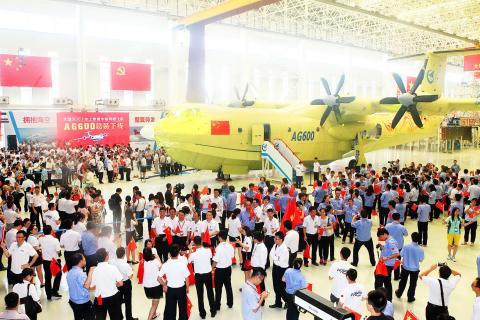
Photo: AFP
The aircraft, which has a maximum range of 4,500km, is intended for fighting forest fires and performing marine rescues, it said.
At about the size of a Boeing 737, it is far larger than any other plane built for marine takeoff and landing, Xinhua quoted AVIC’s deputy general manager Geng Ruguang (耿汝光) as saying.
SPRUCE GOOSE
However, its wingspan is considerably smaller than that of the H-4 Hercules, known as the Spruce Goose, which was designed in the 1940s to carry US-allied troops into battle.
It is regarded as by far the largest seaplane ever built although it only ever made one flight, in 1947.
The Chinese plane, which is targeted at the domestic market, will be “very useful in developing and exploiting marine resources,” the article said, adding that it could be used for “environmental monitoring, resource detection and transportation.”
MILITARY USE
Beijing is currently locked in disputes with several of its neighbors, including Taiwan, Japan, Vietnam and the Philippines, over the rights to develop economic resources in waters off its shores.
The AG600 could potentially extend China’s ability to conduct a variety of operations in the South China Sea, where it has built a series of artificial islands featuring air strips, among other infrastructure with the potential for either civilian or military use.
Xinhua said Aviation Industry Corporation of China has received 17 orders for the plane so far.
AVIATION SECTOR
China is seeking to develop its own aviation sector to reduce dependence on and even challenge foreign giants, such as European consortium Airbus and Boeing of the US, though analysts said it could take years.
Despite a history of delays and problems, China’s aviation industry has made rapid progress in the past year.
Last month, the Chinese-made ARJ21 — which stands for Advanced Regional Jet for the 21st century — made its first commercial flight, when Chengdu Airlines flew one from its home base to Shanghai, and the country’s military began using its homegrown Y-20 heavy transport plane earlier this month.
It rolled out the C919, China’s first domestically developed narrow-body passenger plane, in November last year.
The government yesterday approved applications by Alphabet Inc’s Google to invest NT$27.08 billion (US$859.98 million) in Taiwan, the Ministry of Economic Affairs said in a statement. The Department of Investment Review approved two investments proposed by Google, with much of the funds to be used for data processing and electronic information supply services, as well as inventory procurement businesses in the semiconductor field, the ministry said. It marks the second consecutive year that Google has applied to increase its investment in Taiwan. Google plans to infuse NT$25.34 billion into Charter Investments Ltd (特許投資顧問) through its Singapore-based subsidiary Fructan Holdings Singapore Pte Ltd, and

Micron Technology Inc is a driving force pushing the US Congress to pass legislation that would put new export restrictions on equipment its Chinese competitors use to make their chips, according to people familiar with the matter. A US House of Representatives panel yesterday was to vote on the “MATCH Act,” a bill designed to close gaps in restrictions on chipmaking equipment. It would also pressure foreign companies that sell equipment to Chinese chipmaking facilities to align with export curbs on US companies like Lam Research Corp and Applied Materials Inc. The bill targets facilities operated by China’s ChangXin Memory Technologies Inc

Singapore-based ride-hailing and delivery giant Grab Holdings’ planned acquisition of Foodpanda’s Taiwan operations has yet to enter the formal review stage, as regulators await supplementary documents, the Fair Trade Commission (FTC) said yesterday. Acting FTC Chairman Chen Chih-min (陳志民) told the legislature’s Economics Committee that although Grab submitted its application on March 27, the case has not been officially accepted because required materials remain incomplete. Once the filing is finalized, the FTC would launch a formal probe into the deal, focusing on issues such as cross-shareholding and potential restrictions on market competition, Chen told lawmakers. Grab last month announced that it would acquire

SECOND-RATE: Models distilled from US products do not perform the same as the original and undo measures that ensure the systems are neutral, the US’ cable said The US Department of State has ordered a global push to bring attention to what it said are widespread efforts by Chinese companies, including artificial intelligence (AI) start-up DeepSeek (深度求索), to steal intellectual property from US AI labs, according to a diplomatic cable. The cable, dated Friday and sent to diplomatic and consular posts around the world, instructs diplomatic staff to speak to their foreign counterparts about “concerns over adversaries’ extraction and distillation of US AI models.” Distillation is the process of training smaller AI models using output from larger, more expensive ones to lower the costs of training a powerful new


 RSS
RSS