


Shares in Taiwan yesterday closed above the 9,000-point mark, the first time in almost a year the weighted index ended above that level, with foreign institutional investors holding a large chunk of long-position contracts in the futures market, dealers said.
Apple concept stocks continued to move ahead, led by smartphone camera lens maker Largan Precision Co (大立光), while rotational interest focused on select old-economy stocks and certain financial issues, which pushed up the boarder market even higher at the close, the dealers said.
The weighted index on the Taiwan Stock Exchange (TWSE) closed up 58.36 points, or 0.65 percent, at the day’s high of 9,008.21, on turnover of NT$92.67 billion (US$2.89 billion).
It was the first time the index ended above the 9,000-point level since July 21 last year, when the TAIEX closed at 9,005.96.
Buying turned intensive as investors rushed to pick up some of the Taiwanese suppliers of Apple Inc amid hopes that the launch of the next iPhone models will boost their shipments in the second half of this year, the dealers added.
Buying also spread to non-high-tech stocks, in particular to the petrochemical and textile sectors, boosting the TAIEX to the day’s high, the dealers said.
“It was a futures-led session in the spot market, as foreign institutional investors tried to push up spot share prices in a bid to profit in futures,” Ta Ching Securities (大慶證券) analyst Andy Hsu (許博傑) said.
Foreign institutional investors held a net total of about 68,000 long-position contracts in the futures market as of Friday last week, Hsu said.
“With effects of Brexit and the terror attacks in France fading, foreign institutional investors have been aggressive in moving their funds into Asia, and the equity market in Taiwan remains one of the beneficiaries,” Hsu said.
“More importantly, the US Federal Reserve is unlikely to hike interest rates any time soon and other major central banks have kept easing their monetary policies, allowing foreign investors to continue to play a role in pushing domestic share prices higher,” Hsu said.
According to the TWSE, foreign institutional investors yesterday bought a net NT$14.82 billion of shares on the main board after a net purchase of NT$14.97 billion on Friday.
Among the Apple concept stocks, Largan gained 2.19 percent to close at NT$3,505, remaining the most expensive stock in the local market after a Hong Kong-based brokerage raised its target price on the stock from NT$3,700 to NT$4,050 amid optimism over the firm’s profit margin and the new iPhones.
Hon Hai Precision Industry Co (鴻海精密), an assembler of iPhones and iPads, rose 1.78 percent to close at NT$86, while metal casing maker Catcher Technology Co (可成) added 1.67 percent to close at NT$244.
However, Taiwan Semiconductor Manufacturing Co (台積電), the most heavily weighted stock in Taiwan, closed unchanged at NT$169.50, falling into consolidation mode after a recent strong showing.
“As futures contracts for this month are scheduled to be settled tomorrow, I expect that the spot market will face some volatility then,” Hsu said.
“It is possible that the index will fall below 9,000 points and consolidate for a while before taking off again,” he added.
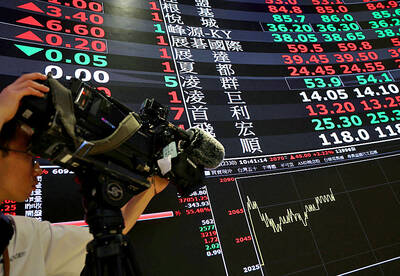
After several years flying high as Asia’s best Nvidia Corp proxy, Taiwan Semiconductor Manufacturing Co (TSMC, 台積電) is increasingly vying with other artificial intelligence (AI) stocks for investor attention. Stock traders are chasing a wider array of beneficiaries as mainstream usage of AI creates demand for hardware beyond the most-advanced chips TSMC makes for Nvidia. Subthemes from the deepening memory crunch to advances in robotics are also luring bids. At the same time, investment caps on single stocks are pushing funds to diversify, while retail investors long familiar with TSMC through its US depositary receipts are being offered a broader set of

UNDER MICROSCOPE: Taiwan detained three people who allegedly conspired to buy servers in Taiwan and export them using fraudulent documentation, prosecutors said Nvidia Corp chief executive officer Jensen Huang (黃仁勳) on Saturday urged Super Micro Computer Inc to tighten up on compliance after Taiwan detained three people this week for allegedly making fraudulent declarations about artificial intelligence (AI) servers made by its US partner. The development marked the nation’s first crackdown on semiconductor smuggling, which grew after the US slapped restrictions on exports of high-end chips such as Nvidia AI accelerators to China. Nvidia is “rigorous” in explaining regulations to all of its partners, Huang told reporters after arriving in Taipei. “Ultimately Super Micro has to run their own company,” he said in response to
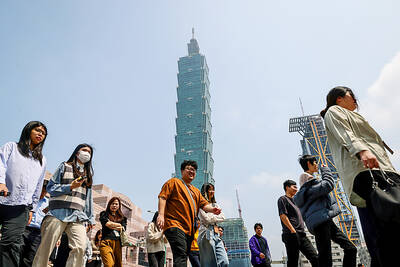
TECH RELIANCE: Growth is increasingly reflecting an unequal K-shaped distribution, where technology sectors outperform and other industries struggle, an expert said Standard Chartered Bank has significantly raised its forecast for Taiwan’s economic growth to 9.5 percent this year, up from 7.6 percent previously, citing surging artificial intelligence (AI) demand driving exports, semiconductor production and investment. The upgrade reflects a sustained AI supercycle that continues to fuel demand for advanced chips and technology infrastructure, which form the backbone of Taiwan’s exports, the bank said in a report this week. “We raise our 2026 growth forecast to reflect a much stronger-than-expected first-quarter GDP figure,” Standard Chartered senior economist for greater China and Asia Tommy Wu (胡東安) said in the report. Driven largely by a 35.3 percent
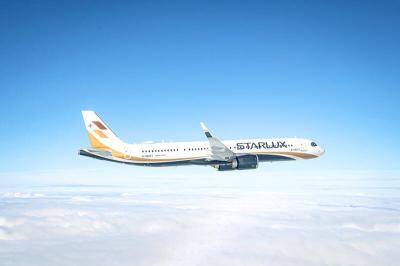
Two of Taiwan’s international carriers, Starlux Airlines Co (星宇航空) and EVA Airways Corp (長榮航空), have retained the five-star airline rating awarded by international airline review organization Skytrax. Starlux was awarded the distinction for a second consecutive year, while EVA Air received it for the 11th straight year, Skytrax said in statements released yesterday and on Thursday last week, respectively. The five-star rating is considered one of the airline industry's highest honors and is awarded following professional audits of airline product and frontline service standards, Skytrax said. The ratings are based on in-depth assessments using unified global quality standards rather than customer review scores


 RSS
RSS