


Everlight Electronics Co (億光) and Epistar Corp (晶電) are expected to perform better in the second half of this year, driven by improving demand for LED lighting products and infrared applications, analysts said.
“We estimate Everlight will see 10 percent annual growth in revenue in the second half of this year, as all of its product lines are seeing better demand from a year ago,” Credit Suisse Group AG analyst Derrick Yang (楊泓極) said in a note on Wednesday last week.
Yang’s forecast came after Everlight, the nation’s leading LED chip packager and lighting products provider, reported annual growth of 1.13 percent in its second-quarter revenue to NT$7.13 billion (US$222.88 million).
On a quarterly basis, revenue climbed 2.58 percent from the previous quarter’s NT$6.96 billion, according to the company’s filing with the Taiwan Stock Exchange.
Yang attributed the revenue growth to Everlight’s better-than-expected sales of LED consumer lighting products and growing demand for high-margin infrared applications.
Everlight’s growth momentum will extend to the second half of this year on the back of the robust outlook for the company’s general lighting and backlight units and infrared applications, Yang said in the note.
China’s national holiday in October is also expected to boost demand for TVs, lifting sales of Everlight’s backlight units used in TVs, SinoPac Securities Co (永豐金證券) said in a separate note last week.
In addition, the Christmas holiday season might lend support to shipments of Everlight’s backlight units and LED flashes used in smartphones to the European and US markets in the fourth quarter, SinoPac analyst Hsiao Ho-shun (蕭合順) said in a note on Tuesday.
Epistar, the leading LED chipmaker, might post a double-digit percentage increase in revenue from NT$6.55 billion last quarter to NT$7.53 billion this quarter, supported by solid demand for LED lighting chips and LED four-element products, such as infrared applications, Yang said.
The company’s efforts to reduce operational costs and develop a better product portfolio will also help improve its gross margin from about 8.7 percent last quarter to 12.7 percent this quarter, Yang said.
At the company’s annual general meeting on June 17, Epistar said it has built alliances with LED component makers to provide semi-module products, while avoiding direct competition with Chinese peers.
As the company has built an intellectual property portfolio of 1,794 patents through self-developed technologies and cross-licensing, the combination of its portfolio and vertical integration in the industry might help the company to target US customers and poses a solution to grow its business amid intensifying competition from Chinese peers led by Sanan Optoelectronics Co (三安光電), analysts at Macquarie Capital Securities Ltd’s Taiwan branch said in a report last month.
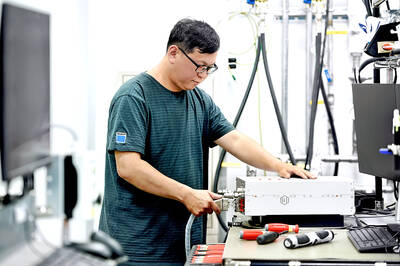
SEMICONDUCTORS: The German laser and plasma generator company will expand its local services as its specialized offerings support Taiwan’s semiconductor industries Trumpf SE + Co KG, a global leader in supplying laser technology and plasma generators used in chip production, is expanding its investments in Taiwan in an effort to deeply integrate into the global semiconductor supply chain in the pursuit of growth. The company, headquartered in Ditzingen, Germany, has invested significantly in a newly inaugurated regional technical center for plasma generators in Taoyuan, its latest expansion in Taiwan after being engaged in various industries for more than 25 years. The center, the first of its kind Trumpf built outside Germany, aims to serve customers from Taiwan, Japan, Southeast Asia and South Korea,

Gasoline and diesel prices at domestic fuel stations are to fall NT$0.2 per liter this week, down for a second consecutive week, CPC Corp, Taiwan (台灣中油) and Formosa Petrochemical Corp (台塑石化) announced yesterday. Effective today, gasoline prices at CPC and Formosa stations are to drop to NT$26.4, NT$27.9 and NT$29.9 per liter for 92, 95 and 98-octane unleaded gasoline respectively, the companies said in separate statements. The price of premium diesel is to fall to NT$24.8 per liter at CPC stations and NT$24.6 at Formosa pumps, they said. The price adjustments came even as international crude oil prices rose last week, as traders
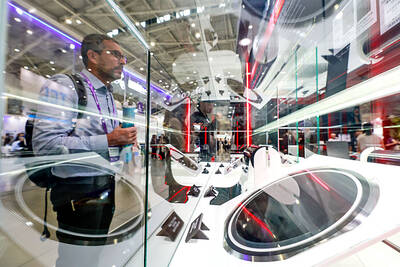
SIZE MATTERS: TSMC started phasing out 8-inch wafer production last year, while Samsung is more aggressively retiring 8-inch capacity, TrendForce said Chipmakers are expected to raise prices of 8-inch wafers by up to 20 percent this year on concern over supply constraints as major contract chipmakers Taiwan Semiconductor Manufacturing Co (TSMC, 台積電) and Samsung Electronics Co gradually retire less advanced wafer capacity, TrendForce Corp (集邦科技) said yesterday. It is the first significant across-the-board price hike since a global semiconductor correction in 2023, the Taipei-based market researcher said in a report. Global 8-inch wafer capacity slid 0.3 percent year-on-year last year, although 8-inch wafer prices still hovered at relatively stable levels throughout the year, TrendForce said. The downward trend is expected to continue this year,
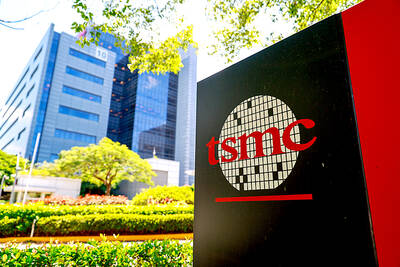
Taiwan Semiconductor Manufacturing Co (TSMC, 台積電), which supplies advanced chips to Nvidia Corp and Apple Inc, yesterday reported NT$1.046 trillion (US$33.1 billion) in revenue for last quarter, driven by constantly strong demand for artificial intelligence (AI) chips, falling in the upper end of its forecast. Based on TSMC’s financial guidance, revenue would expand about 22 percent sequentially to the range from US$32.2 billion to US$33.4 billion during the final quarter of 2024, it told investors in October last year. Last year in total, revenue jumped 31.61 percent to NT$3.81 trillion, compared with NT$2.89 trillion generated in the year before, according to


 RSS
RSS