


Asian markets headed for their biggest weekly advance in three months as data suggested China’s economy is responding to government support.
Taiwan became the latest regional bourse to enter a bull market. The TAIEX rose 0.94 percent to 8,949.85, up from 8,640.91 on Thursday last week and closing more than 20 percent above its low in August last year, as global investors pumped cash into equities, drawn by upbeat earnings and high company dividends. Taiwanese markets were closed on Friday last week due to Typhoon Nepertak.
Thailand, India and Indonesia have also recently entered bull markets.
The MSCI Asia Pacific Index rose for a fifth day, adding 0.4 percent to 133.84 as of 4pm in Hong Kong. That took its weekly gain to 4.4 percent, the most since April 15.
Japan’s TOPIX closed up 0.5 percent, rising 8.9 percent for the week in the biggest advance since 2009.
China’s economic growth held at 6.7 percent in the second quarter from a year earlier, beating the 6.6 percent expansion forecast in a Bloomberg survey.
More than US$4 trillion has been added to the value of global equities since June 27 as the US economy shows signs of health and speculation increases that policymakers worldwide will boost stimulus to stave off a global slowdown.
Japanese shares led gains this week and the yen fell the most since 1999 after Japanese Prime Minister Shinzo Abe’s party won upper-house elections, giving him a fresh mandate to boost efforts to revive the economy.
China’s factory output, retail sales and new lending for last month also topped estimates, while investment slowed. The US also has a data dump coming on Friday, with gauges of household spending, inflation, industrial production and consumer confidence scheduled.
Fast Retailing Co jumped 18 percent in Tokyo, the most since 1998, after the Uniqlo clothing chain owner posted a profit that beat estimates.
Line Corp shot up 32 percent in its Japan trading debut after the messaging company raised more than US$1 billion in the biggest technology initial public offering of the year.
Australia’s S&P/ASX 200 Index climbed 0.3 percent, South Korea’s KOSPI advanced 0.4 percent, while New Zealand’s S&P/NZX 50 Index slipped 0.1 percent.
Singapore Exchange Ltd reopened after a disruption shut trading on Thursday. The benchmark Straits Times Index climbed 0.6 percent.
Hong Kong’s Hang Seng Index gained 0.4 percent and the Shanghai Composite was steady. The 14-day relative-strength index on the mainland Chinese gauge this week edged above 70 for the first time since just before last summer’s US$5 trillion rout.
India’s S&P BSE SENSEX Index lost 0.3 percent.
Additional reporting by staff writer, with CNA
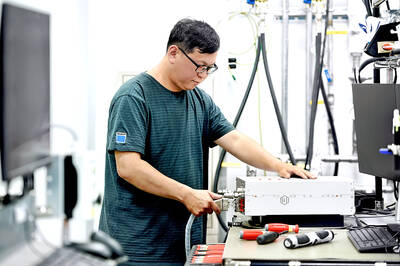
SEMICONDUCTORS: The German laser and plasma generator company will expand its local services as its specialized offerings support Taiwan’s semiconductor industries Trumpf SE + Co KG, a global leader in supplying laser technology and plasma generators used in chip production, is expanding its investments in Taiwan in an effort to deeply integrate into the global semiconductor supply chain in the pursuit of growth. The company, headquartered in Ditzingen, Germany, has invested significantly in a newly inaugurated regional technical center for plasma generators in Taoyuan, its latest expansion in Taiwan after being engaged in various industries for more than 25 years. The center, the first of its kind Trumpf built outside Germany, aims to serve customers from Taiwan, Japan, Southeast Asia and South Korea,

Gasoline and diesel prices at domestic fuel stations are to fall NT$0.2 per liter this week, down for a second consecutive week, CPC Corp, Taiwan (台灣中油) and Formosa Petrochemical Corp (台塑石化) announced yesterday. Effective today, gasoline prices at CPC and Formosa stations are to drop to NT$26.4, NT$27.9 and NT$29.9 per liter for 92, 95 and 98-octane unleaded gasoline respectively, the companies said in separate statements. The price of premium diesel is to fall to NT$24.8 per liter at CPC stations and NT$24.6 at Formosa pumps, they said. The price adjustments came even as international crude oil prices rose last week, as traders

SIZE MATTERS: TSMC started phasing out 8-inch wafer production last year, while Samsung is more aggressively retiring 8-inch capacity, TrendForce said Chipmakers are expected to raise prices of 8-inch wafers by up to 20 percent this year on concern over supply constraints as major contract chipmakers Taiwan Semiconductor Manufacturing Co (TSMC, 台積電) and Samsung Electronics Co gradually retire less advanced wafer capacity, TrendForce Corp (集邦科技) said yesterday. It is the first significant across-the-board price hike since a global semiconductor correction in 2023, the Taipei-based market researcher said in a report. Global 8-inch wafer capacity slid 0.3 percent year-on-year last year, although 8-inch wafer prices still hovered at relatively stable levels throughout the year, TrendForce said. The downward trend is expected to continue this year,
Taiwan Semiconductor Manufacturing Co (TSMC, 台積電), which supplies advanced chips to Nvidia Corp and Apple Inc, yesterday reported NT$1.046 trillion (US$33.1 billion) in revenue for last quarter, driven by constantly strong demand for artificial intelligence (AI) chips, falling in the upper end of its forecast. Based on TSMC’s financial guidance, revenue would expand about 22 percent sequentially to the range from US$32.2 billion to US$33.4 billion during the final quarter of 2024, it told investors in October last year. Last year in total, revenue jumped 31.61 percent to NT$3.81 trillion, compared with NT$2.89 trillion generated in the year before, according to


 RSS
RSS