


Exports contracted by 2.1 percent annually to US$22.89 billion last month, the smallest decline in 17 months, as demand for technology products gained traction while non-technology exports remained weak, the Ministry of Finance said yesterday.
Trade figures might return to positive territory this month, ending 17 consecutive months of declines, as demand spurred by inventory-building looks healthy and sustainable if Brexit and other downside risks prove to be controllable, Department of Statistics Director-General Yeh Maan-tzwu (葉滿足) said.
“The growth momentum for electronic component exports is likely to be sustainable given the sanguine guidance by major technology firms and continued increase in their capital spending,” Yeh said by telephone.
Virtual reality, handheld and Internet of Things gadgets are acting as catalysts in an upward trend that might further improve with the expected launches of Apple Inc’s next-generation iPhone, iPad and other products in September, Yeh said.
Barring price disruptions, outbound shipments have registered a 4.1 percent increase, Yeh said, adding that lower crude oil and raw material costs decreased export prices by 6.2 percent.
Imports shrank 10 percent to US$19.31 billion last month, leading to a trade surplus of US$3.58 billion, an improvement of 85.2 percent from a year earlier, the ministry said.
During the April-to-June period, exports fell 6.2 percent from the same period last year, but still fared better than the 6.82 percent decline forecast by the Directorate-General of Budget, Accounting and Statistics (DGBAS) in May.
The trade data would lend support to the agency’s GDP growth forecast for this year’s fourth quarter if private consumption holds steady, Yeh said.
The economy is expected to grow 0.48 percent in the second quarter, ending three quarters of recession, the DGBAS projected.
Exports of electronic components grew 11.5 percent to US$7.44 billion, while information and communication devices rose 4.3 percent to US$2.5 billion, the report said.
However, exports of mineral and optical products, as well as transportation machinery, declined by about 20 percent, due to weak demand, the report said.
Exports to China fell by 4.5 percent, while exports to ASEAN members dropped by 4.4 percent, both easing from double-digit declines seen in previous months, according to the ministry data.
Exports to the US, Japan and Europe increased by 3.1 percent, 0.8 percent and 0.1 percent respectively, the report said, suggesting the recovery is slow and fragile.
Credit Suisse Group AG said that pickup in technology production might extend into the the second half of the year.
Taiwanese semiconductor companies have increased their purchases of capital equipment to help maintain their leadership.
However, Credit Suisse expects the slowdown in China’s private fixed investment to weigh on Taiwan’s exports and private investment despite stabilizing oil prices.
In the first half of the year, exports totaled US$131.33 billion, down 9.1 percent from a year earlier, while imports declined 10.7 percent year-on-year to US$107.3 billion, with the trade surplus dropping US$270 million from a year earlier to US$24.03 billion during the period, the ministry’s report said.

ENERGY ISSUES: The TSIA urged the government to increase natural gas and helium reserves to reduce the impact of the Middle East war on semiconductor supply stability Chip testing and packaging service provider ASE Technology Holding Co (日月光投控) yesterday said it planned to invest more than NT$100 billion (US$3.15 billion) in building a new advanced chip testing facility in Kaohsiung to keep up with customer demand driven by the artificial intelligence (AI) boom. That would be included in the company’s capital expenditure budget next year, ASE said. There is also room to raise this year’s capital spending budget from a record-high US$7 billion estimated three months ago, it added. ASE would have six factories under construction this year, another record-breaking number, ASE chief operating officer Tien Wu

The EU and US are nearing an agreement to coordinate on producing and securing critical minerals, part of a push to break reliance on Chinese supplies. The potential deal would create incentives, such as minimum prices, that could advantage non-Chinese suppliers, according to a draft of an “action plan” seen by Bloomberg. The EU and US would also cooperate on standards, investments and joint projects, as well as coordinate on any supply disruptions by countries like China. The two sides are additionally seeking other “like-minded partners” to join a multicountry accord to help create these new critical mineral supply chains, which feed into

For weeks now, the global tech industry has been waiting for a major artificial intelligence (AI) launch from DeepSeek (深度求索), seen as a benchmark for China’s progress in the fast-moving field. More than a year has passed since the start-up put Chinese AI on the map in early last year with a low-cost chatbot that performed at a similar level to US rivals. However, despite reports and rumors about its imminent release, DeepSeek’s next-generation “V4” model is nowhere in sight. Speculation is also swirling over the geopolitical implications of which computer chips were chosen to train and power the new
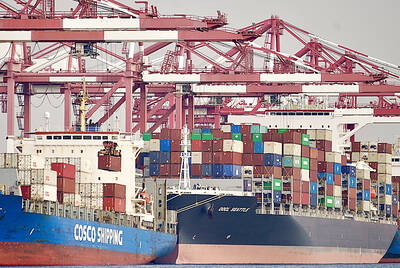
TECH WINNERS: Taiwan and South Korea reported robust trade, which suggests that they have critical advantages in the rapidly expanding AI supply chain, an official said Exports last month surged to a new high, as booming demand tied to artificial intelligence (AI) infrastructure fueled shipments of advanced technology components, underscoring the nation’s pivotal role in the global semiconductor supply chain. Outbound shipments climbed to US$80.18 billion, the highest ever for a single month, rising 61.8 percent from a year earlier and marking the 29th consecutive month of growth, the Ministry of Finance said yesterday. “The surge was driven primarily by global investment in AI infrastructure,” Department of Statistics Director-General Beatrice Tsai (蔡美娜) said. The mass production of next-generation AI computing systems has accelerated procurement across the semiconductor supply


 RSS
RSS