


The TAIEX is set to slump further today — after shedding 2.3 percent on Friday — as it reflects nosedives in Wall Street and European bourses following Britain’s vote to leave the EU, analysts said yesterday.
The dividend issuances of major technology and financial companies would also put pressure on their market values and the main board, the analysts said.
“The local bourse is bound to open lower on Monday as ‘Brexit’-linked uncertainty continues to unnerve investors and drive changes in fund allocation strategies,” state-run Hua Nan Securities Co (華南永昌投顧) chairman David Chu (儲祥生) said by telephone.
Wall Street tumbled 3.39 percent on Friday after the pan-European STOXX 600 Index closed down about 7 percent, with France’s CAC 40 Index plummeting about 8 percent, Germany’s DAX Index dropping 6.8 percent and Italy’s FTSE MIB and Spain’s IBEX 35 falling more than 12 percent.
The declines are deeper than those of the TAIEX, suggesting room for more corrections in trade between Taiwan and the UK is quite limited, Chu said.
If foreign funds pull out of emerging markets — as has happened before in times of global financial turmoil — Taiwanese shares would suffer, as retail investors have mostly lost interest, Chu said.
Foreign institutional players sold NT$13.02 billion (US$400.6 million) worth of local shares on Friday, and it remains to be seen if that is just an isolated incidence or the start of a sustained pullout, Chu said.
Prior to Britain’s vote to leave the EU, foreign funds increased holdings in local shares by NT$42.79 billion, as the high sales season for upstream technology products is approaching, the analyst said.
The National Financial Stabilization Fund has indicated it is willing to intervene today if necessary to help stabilize the market.
Taiwan Semiconductor Manufacturing Co (台積電), Cathay Financial Holding Co (國泰金), Fubon Financial Holding Co (富邦金) and other firms are due to issue cash dividends today, which could knock 70 points off the TAIEX when the market opens, Masterlink Securities Investment Advisory Corp (元富投顧) president Liu Kun-hsi (劉坤錫) said.
The local bourse is fragile to external shocks, but this time the magnitude could be moderate due to limited exposure of local firms to the UK, Liu said by telephone.
The TAIEX might find support at 8,350, because the peak sales season for technology products is approaching, Liu said.
Brexit has increased the chance of a rate cut by the central bank, which is to review its rate policy in a board meeting on Thursday, both analysts said.
Volatile financial markets might disrupt economic growth for most nations worldwide, giving the central bank reasons to further ease monetary policy, Chu and Liu said.
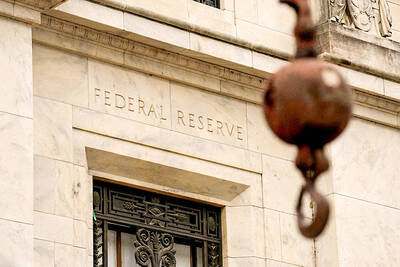
DAMAGE REPORT: Global central banks are assessing war-driven inflation risks as the law of unintended consequences careens around the world, spiking oil prices Central banks from Washington to London and from Jakarta to Taipei are about to make their first assessments of economic damage after more than two weeks of conflict between the US and Iran. Decisions this week encompassing every member of the G7 and eight of the world’s 10 most-traded currency jurisdictions are likely to confirm to investors that the specter of a new inflation shock is already worrying enough to prompt heightened caution. The US Federal Reserve is widely expected to do exactly what everyone anticipated weeks ahead of its March 17-18 policy gathering: hold rates steady. The narrative surrounding that
Taiwan Semiconductor Manufacturing Co’s (TSMC, 台積電) share of the global foundry market rose to almost 70 percent last year amid booming demand for artificial intelligence (AI), market information advisory firm TrendForce Corp (集邦科技) said on Thursday. The contract chipmaker posted US$122.54 billion in revenue, up 36.1 percent from a year earlier, accounting for 69.9 percent of the global market, TrendForce said. Its share was up from 64.4 percent in 2024, it said. TSMC’s closest rival, Samsung Electronics, was a distant second, posting US$12.63 billion in sales, down 3.9 percent from a year earlier, for a 7.2 percent share of the global market. In the

HEADWINDS: The company said it expects its computer business, as well as consumer electronics and communications segments to see revenue declines due to seasonality Pegatron Corp (和碩) yesterday said it aims to grow its artificial intelligence (AI) server revenue more than 10-fold this year from last year, driven by orders from neocloud solutions clients and large cloud service providers. The electronics manufacturing service provider said AI server revenue growth would be driven primarily by the Nvidia Corp GB300 server platform. Server shipments are expected to increase each quarter this year, with the second half likely to outperform the first half, it said. The AI server market is expected to broaden this year as more inference applications emerge, which would drive demand for system-on-chip, application-specific integrated circuits
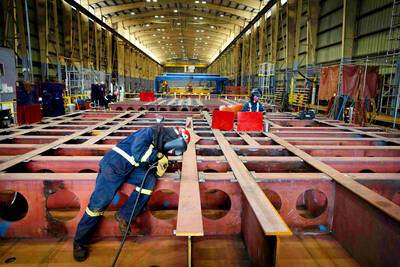
At a massive shipyard in North Vancouver, Canadian workers grind metal beams for a powerful new icebreaker crucial to cementing the country’s presence in the increasingly contested arctic. Icebreakers are specialized, expensive vessels able to navigate in the frozen far north. And “this is the crown jewel,” said Eddie Schehr, vice president of production at the Seaspan shipyard. For Canadian Prime Minister Mark Carney, who heads to Norway next Friday to observe arctic defense drills involving troops from 14 NATO states, Canada’s extreme north has emerged as a strategic priority. “Canada is and forever will be an Arctic nation,” he said ahead of


 RSS
RSS