


Electric scooter vendor Gogoro Inc (睿能創意) said it is collaborating with hypermarket chain Carrefour Taiwan (家樂福) to broaden its sales network to accelerate vehicle sales.
The collaboration is to make Carrefour Gogoro’s first partner in expanding its sales network to target potential buyers for its vehicles.
Three Carrefour outlets in northern Taiwan, one each in Taipei, New Taipei City and Taoyuan, are to start selling Gogoro’s Smartscooter from this month, adding to 12 existing stores operated by Gogoro.
“We are glad to have a partner from a different sector, Carrefour. From April 1, three Carrefour stores are to start selling our smart vehicles and provide test ride services,” Gogoro co-founder and chief executive officer Horace Luke (陸學森) said in a statement released on Wednesday last week.
Gogoro made the announcement one year after it started selling the Smartscooter.
As of February, Gogoro had sold 5,000 vehicles in total, taking a more than 44 percent share of Taiwan’s scooter market.
Gogoro only operates 12 brick-and-mortar stores, all in northern Taiwan, which might be due to the limited lithium-ion battery swapping network.
The number of battery swapping stations, or GoStations, has increased to 175, including those under construction, with all of them located in the nation’s northern cities, including Taipei, Keelung, Taoyuan and Hsinchu.
The company said that over the past year it has broadened its GoStation network to 21 MRT stations in Taipei, local convenience store chains and coffee shops, as well as those built in gas stations.
Gogoro’s Smartscooter can travel about 60km with a single charge.
The electric scooter company early this year launched a program called Gogoro OPEN Initiative to encourage homeowners and businesses to install its new mini-chargers in homes and retail stores to increase the number of places where Smartscooter riders can change batteries.
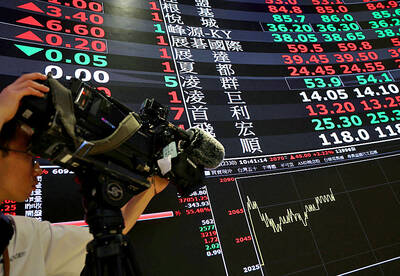
After several years flying high as Asia’s best Nvidia Corp proxy, Taiwan Semiconductor Manufacturing Co (TSMC, 台積電) is increasingly vying with other artificial intelligence (AI) stocks for investor attention. Stock traders are chasing a wider array of beneficiaries as mainstream usage of AI creates demand for hardware beyond the most-advanced chips TSMC makes for Nvidia. Subthemes from the deepening memory crunch to advances in robotics are also luring bids. At the same time, investment caps on single stocks are pushing funds to diversify, while retail investors long familiar with TSMC through its US depositary receipts are being offered a broader set of
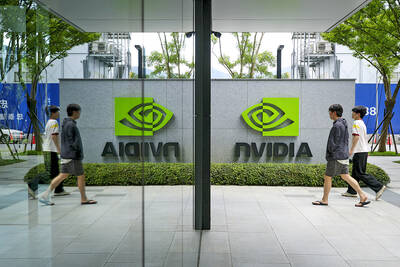
UNDER MICROSCOPE: Taiwan detained three people who allegedly conspired to buy servers in Taiwan and export them using fraudulent documentation, prosecutors said Nvidia Corp chief executive officer Jensen Huang (黃仁勳) on Saturday urged Super Micro Computer Inc to tighten up on compliance after Taiwan detained three people this week for allegedly making fraudulent declarations about artificial intelligence (AI) servers made by its US partner. The development marked the nation’s first crackdown on semiconductor smuggling, which grew after the US slapped restrictions on exports of high-end chips such as Nvidia AI accelerators to China. Nvidia is “rigorous” in explaining regulations to all of its partners, Huang told reporters after arriving in Taipei. “Ultimately Super Micro has to run their own company,” he said in response to

Netherlands-based semiconductor equipment supplier ASML Holding NV yesterday said that it is planning to hire an additional 1,000 people in Taiwan this year in response to growing demand from clients. ASML had previously planned to recruit 600 people this year, but that the plan has been adjusted upward, ASML vice president and ASML Taiwan general manager Grace Wang (汪佳慧) told reporters. ASML has a workforce of more than 4,500 in Taiwan, accounting for about 10 percent of its global total, Wang said. This year’s recruitment campaign would focus on adding people in the customer support, manufacturing and supply chain domains to assist ASML
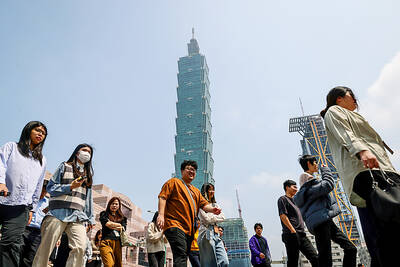
TECH RELIANCE: Growth is increasingly reflecting an unequal K-shaped distribution, where technology sectors outperform and other industries struggle, an expert said Standard Chartered Bank has significantly raised its forecast for Taiwan’s economic growth to 9.5 percent this year, up from 7.6 percent previously, citing surging artificial intelligence (AI) demand driving exports, semiconductor production and investment. The upgrade reflects a sustained AI supercycle that continues to fuel demand for advanced chips and technology infrastructure, which form the backbone of Taiwan’s exports, the bank said in a report this week. “We raise our 2026 growth forecast to reflect a much stronger-than-expected first-quarter GDP figure,” Standard Chartered senior economist for greater China and Asia Tommy Wu (胡東安) said in the report. Driven largely by a 35.3 percent


 RSS
RSS