


Beneath the surface of the global financial system lurks a multitrillion-dollar problem that could sap the strength of large economies for years to come.
The problem is the giant, stagnant pool of loans that companies and people around the world are struggling to pay back. Bad debts have been a drag on economic activity ever since the financial crisis of 2008, but in recent months, the threat posed by an overhang of bad loans appears to be rising.
China is the biggest source of worry. Some analysts estimate that China’s troubled credit could exceed US$5 trillion, a staggering number that is equivalent to half the size of the country’s annual economic output.
Official figures show that Chinese banks pulled back on their lending in December last year. If such trends persist, China’s economy, the second-largest in the world behind the US, might then slow even more than it has, further harming the many countries that have for years relied on China for their growth.
However, it is not just China. Wherever governments and central banks unleashed aggressive stimulus policies in recent years, a toxic debt hangover has followed. In the US, it took many months for mortgage defaults to fall after the most recent housing bust — and energy companies are struggling to pay off the cheap money that they borrowed to pile into the shale boom.
In Europe, analysts say bad loans total more than US$1 trillion. Many large European banks are still weighed down with defaulted loans, complicating policymakers’ efforts to revive the continent’s economy. Italy, for instance, announced a plan last week to clean out bad loans from its plodding banking industry.
In theory, it makes sense for banks to swiftly recognize the losses embedded in bad loans — and then make up for those losses by raising fresh capital. The cleaned-up banks are more likely to start lending again — and thus play their part in fueling the recovery.
In reality, this approach can be difficult to carry out.
Recognizing losses on bad loans can mean pushing corporate borrowers into bankruptcy and households into foreclosure. Such disruption can send a chill through the economy, require unpopular taxpayer bailouts and have painful social consequences. And in some cases, the banks might find it extremely difficult to raise fresh capital in the markets.
Even so, the drawback of delaying the cleanup is that the banks remain wounded and reluctant to lend, damping any recovery that takes place. Japan, economists say, waited far too long after its credit boom of the 1980s to force its banks to recognize huge losses — and the economy suffered for years after as a result.
Now, many banking experts are beginning to worry about China’s bad loans.
Fears that the country’s economy is slowing have weighed heavily on global markets in recent months because a weak China can drag down growth globally.
Many of these concerns focus on China’s banking industry. In recent years, banks and other financial companies in China issued a tidal wave of new loans and other credit products, many of which will not get paid back in full.
Although there is not enough official data to come up with a precise figure for bad loans, some analysts have come up with estimates of around US$5 trillion.
Given the murkiness of the Chinese financial industry, other analysts arrive at estimates for a “baseline” figure for bad loans. Christopher Balding, an associate professor at the HSBC School of Business at Peking University, said that an analysis of corporations’ interest payments to Chinese banks suggested that 8 percent of loans to companies might be troubled.
However, Balding said it was possible that the bad loan number for China’s overall financial system could be higher.
The looming question for the global economy is how China might deal with a vast pool of bad debts.
After a previous credit boom in the 1990s, the Chinese government provided financial support to help clean up the country’s banks. However, the cost of similar interventions today could be dauntingly high given the size of the latest credit boom. And more immediately, rising bad debts could crimp lending to strong companies, undermining economic growth in the process.
“My sense is that the Chinese policymakers seem like a deer in the headlights,” Balding said. “They really don’t know what to do.”
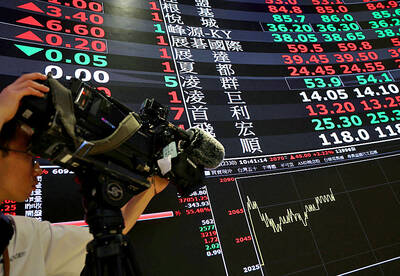
After several years flying high as Asia’s best Nvidia Corp proxy, Taiwan Semiconductor Manufacturing Co (TSMC, 台積電) is increasingly vying with other artificial intelligence (AI) stocks for investor attention. Stock traders are chasing a wider array of beneficiaries as mainstream usage of AI creates demand for hardware beyond the most-advanced chips TSMC makes for Nvidia. Subthemes from the deepening memory crunch to advances in robotics are also luring bids. At the same time, investment caps on single stocks are pushing funds to diversify, while retail investors long familiar with TSMC through its US depositary receipts are being offered a broader set of
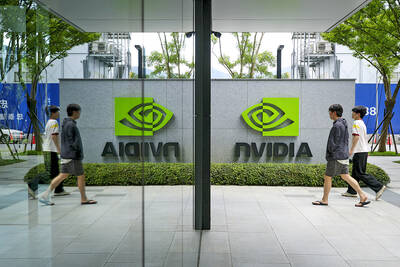
UNDER MICROSCOPE: Taiwan detained three people who allegedly conspired to buy servers in Taiwan and export them using fraudulent documentation, prosecutors said Nvidia Corp chief executive officer Jensen Huang (黃仁勳) on Saturday urged Super Micro Computer Inc to tighten up on compliance after Taiwan detained three people this week for allegedly making fraudulent declarations about artificial intelligence (AI) servers made by its US partner. The development marked the nation’s first crackdown on semiconductor smuggling, which grew after the US slapped restrictions on exports of high-end chips such as Nvidia AI accelerators to China. Nvidia is “rigorous” in explaining regulations to all of its partners, Huang told reporters after arriving in Taipei. “Ultimately Super Micro has to run their own company,” he said in response to

TECH RELIANCE: Growth is increasingly reflecting an unequal K-shaped distribution, where technology sectors outperform and other industries struggle, an expert said Standard Chartered Bank has significantly raised its forecast for Taiwan’s economic growth to 9.5 percent this year, up from 7.6 percent previously, citing surging artificial intelligence (AI) demand driving exports, semiconductor production and investment. The upgrade reflects a sustained AI supercycle that continues to fuel demand for advanced chips and technology infrastructure, which form the backbone of Taiwan’s exports, the bank said in a report this week. “We raise our 2026 growth forecast to reflect a much stronger-than-expected first-quarter GDP figure,” Standard Chartered senior economist for greater China and Asia Tommy Wu (胡東安) said in the report. Driven largely by a 35.3 percent

Two of Taiwan’s international carriers, Starlux Airlines Co (星宇航空) and EVA Airways Corp (長榮航空), have retained the five-star airline rating awarded by international airline review organization Skytrax. Starlux was awarded the distinction for a second consecutive year, while EVA Air received it for the 11th straight year, Skytrax said in statements released yesterday and on Thursday last week, respectively. The five-star rating is considered one of the airline industry's highest honors and is awarded following professional audits of airline product and frontline service standards, Skytrax said. The ratings are based on in-depth assessments using unified global quality standards rather than customer review scores


 RSS
RSS