


Industrial production declined 6.17 percent last month, the eighth consecutive month of annual contraction, the Ministry of Economic Affairs said yesterday.
The result translated into a 1.66 percent decline in industrial output from 2014 and was the first annual decline since 2013, the ministry said.
“The annual decline last year was the largest drop since the global financial crisis in 2009,” Department of Statistics Deputy Director-General Yang Kuei-hsien (楊貴顯) told a news conference.
The government’s industrial production gauge measures output in five major industries: manufacturing; mining and quarrying; electricity and gas supply; water supply; and architectural engineering.
Last month, the manufacturing sector’s output — which contributes more than 90 percent of industrial output — fell 5.52 percent year-on-year.
“The manufacturing sector’s fall in output last month was mainly because of a soft global economy and fewer orders before the Lunar New Year holiday,” Yang said.
Output of computer electronics, optical electronics, stainless steel and machinery goods last month registered a double-digit percentage point plunge from a year earlier.
Production in the electronics components sector, which is a pillar of the nation’s manufacturing industry, fell 4.09 percent from a year earlier, amid weak demand for consumer electronics products and flat panels, Yang said.
The only bright spot was the petrochemical sector, with output last month increasing 4.62 percent year-on-year due to inventory restocking and a lower base of comparison, Yang said.
Overall, the manufacturing sector’s inventory-to-sales ratio grew 1.6 percentage points to 74.6 percent from a month earlier, because some semiconductor companies and flat-panel makers received rush orders from clients, Yang said.
However, the sales situation in the end market remained weak, he added.
The ministry will only consider industrial production to be at a healthy level when the inventory-to-sales ratio falls to less than 65 percent, Yang said
The ministry foresees output this month to continue falling from a year earlier, but the size of the annual contraction is expected to be within 5 percent, as the semiconductor industry is likely to complete its inventory digestion and demand for solar power products might increase, Yang said.
If global demand stabilizes in the near term, industrial output might have a chance to swing into positive territory next quarter at the earliest, he said.
Separately yesterday, the ministry also released the latest statistics on the nation’s commercial sales, which showed that domestic trade dropped 1.78 percent from NT$14.59 trillion (US$432.87 billion) in 2014 to NT$14.33 trillion last year, due mainly to falling sales in the wholesale sector.
Revenue from the wholesale sector, which contributed 67.82 percent of total commercial sales, fell 3.9 percent annually to NT$9.72 trillion last year because of a sharp decline in TV and notebook orders from Japan, the ministry said.
Sales in the retail and restaurant sectors both posted record highs last year, with retail revenue edging up 0.3 percent annually to NT$4.19 trillion and restaurant sales climbing 2.7 percent to NT$424.1 billion from a year earlier, the data showed.
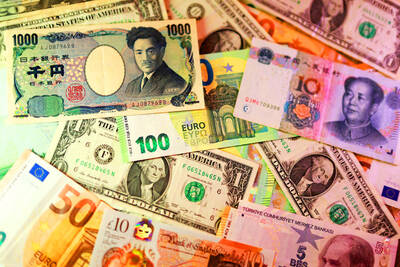
Taiwan’s foreign exchange reserves fell below the US$600 billion mark at the end of last month, with the central bank reporting a total of US$596.89 billion — a decline of US$8.6 billion from February — ending a three-month streak of increases. The central bank attributed the drop to a combination of factors such as outflows by foreign institutional investors, currency fluctuations and its own market interventions. “The large-scale outflows disrupted the balance of supply and demand in the foreign exchange market, prompting the central bank to intervene repeatedly by selling US dollars to stabilize the local currency,” Department of Foreign
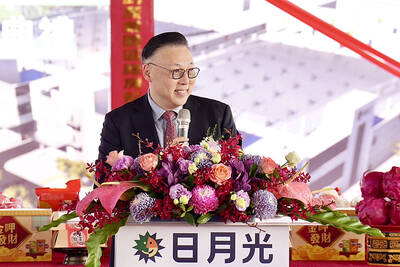
ENERGY ISSUES: The TSIA urged the government to increase natural gas and helium reserves to reduce the impact of the Middle East war on semiconductor supply stability Chip testing and packaging service provider ASE Technology Holding Co (日月光投控) yesterday said it planned to invest more than NT$100 billion (US$3.15 billion) in building a new advanced chip testing facility in Kaohsiung to keep up with customer demand driven by the artificial intelligence (AI) boom. That would be included in the company’s capital expenditure budget next year, ASE said. There is also room to raise this year’s capital spending budget from a record-high US$7 billion estimated three months ago, it added. ASE would have six factories under construction this year, another record-breaking number, ASE chief operating officer Tien Wu

The EU and US are nearing an agreement to coordinate on producing and securing critical minerals, part of a push to break reliance on Chinese supplies. The potential deal would create incentives, such as minimum prices, that could advantage non-Chinese suppliers, according to a draft of an “action plan” seen by Bloomberg. The EU and US would also cooperate on standards, investments and joint projects, as well as coordinate on any supply disruptions by countries like China. The two sides are additionally seeking other “like-minded partners” to join a multicountry accord to help create these new critical mineral supply chains, which feed into

For weeks now, the global tech industry has been waiting for a major artificial intelligence (AI) launch from DeepSeek (深度求索), seen as a benchmark for China’s progress in the fast-moving field. More than a year has passed since the start-up put Chinese AI on the map in early last year with a low-cost chatbot that performed at a similar level to US rivals. However, despite reports and rumors about its imminent release, DeepSeek’s next-generation “V4” model is nowhere in sight. Speculation is also swirling over the geopolitical implications of which computer chips were chosen to train and power the new


 RSS
RSS