


The National Stabilization Fund (NSF, 國安基金) is to be used to extend support for local shares for another quarter, a decision that yesterday helped the TAIEX to close up 0.63 percent after Saturday’s elections and Wall Street’s slump on Friday.
The National Stabilization Fund Committee reached the decision after meeting in Taipei for one-and-a-half hours, based on lingering international uncertainties, such as the drastic financial market volatility, oil price swings, China’s economic slowdown and possible further interest rate hikes by the US Federal Reserve, Deputy Minister of Finance Wu Tang-chieh (吳當傑) said.
“The fund will continue to shore up local shares until its next meeting on April 15, but may pull out beforehand, if the financial situation at home and abroad shows steady signs of improvement,” Wu told reporters at noon.
The fund moved its quarterly meeting, which was scheduled for yesterday afternoon, to the morning because the Cabinet’s collective resignation called the fund’s legality into question, Wu said.
The fund, sized at NT$500 billion (US$14.78 billion at current exchange rates), has been in the market since August last year, playing a key role in the TAIEX’s 4.75 percent increase as of Friday, Wu said.
Taking cues from the US bourse, the TAIEX opened low and soon shed 130 points or 1.67 percent before staging a dramatic rebound at about 10am, Taiwan Stock Exchange data indicated.
Turnover remained modest at NT$80.97 billion, as foreign institutional players trimmed positions by NT$2.82 billion and mutual funds by a net NT$248.33 million.
“The topmost guidelines for investors these days are ‘caution, caution and caution’ as the power transition plays out,” Marbo Securities Consultant Co (萬寶證券投顧) analyst Winson Wang (王榮旭) said by telephone.
Premier Mao Chi-kuo (毛治國) insisted on stepping down after the Chinese Nationalist Party (KMT) lost Saturday’s presidential and legislative elections by a landslide.
President-elect Tsai Ing-wen (蔡英文), who will not be inaugurated until May 20, has turned down President Ma Ying-jeou’s (馬英九) invitation to discuss the new Cabinet lineup.
The government is likely to be at a standstill for the next four months, leaving the financial markets directionless and vulnerable to external shocks, Wang said.
The New Taiwan dollar yesterday slipped NT$0.016 to finish at nearly a seven-year low of NT$33.818 against the US greenback in Taipei trading, as investors favor the US currency in times of uncertainty, dealers said.
The NT dollar is moving closer to the NT$34 defense with traders shy from speculating on the resistance level.
Combined turnover on the Taipei Foreign Exchange and Cosmos Foreign Exchange markets totaled US$857 million.
The stabilization fund has bought NT$19 billion worth of shares as of Friday and incurred NT$400 million in unrealized losses, Wu said.
Global bourses have taken a hit so far this year and TAIEX proved no exception with plunge of 6.91 percent, deeper than 4.2 percent fall experienced by its South Korean counterpart, Wu said.
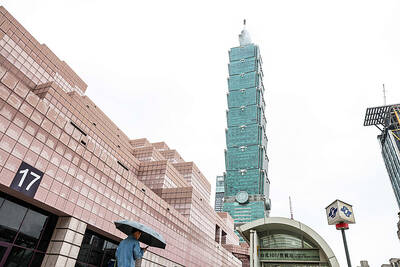
MANAGING RISKS: Taiwan has secured LNG sufficient to cover 95 percent of electricity demand for next month, UBS said, describing the government’s approach as proactive UBS Group AG has raised its forecast for Taiwan’s economic growth this year to 8 percent, up from 6.9 percent previously, and said expansion could reach as high as 8.6 percent if external energy shocks are avoided. The upgrade reflects a stronger-than-expected first-quarter performance and sustained momentum in artificial intelligence (AI)-driven exports, which UBS said are providing a firm foundation for growth despite geopolitical and energy risks. Taiwan’s GDP expanded 13.69 percent year-on-year in the first quarter, the fastest growth since the second quarter of 1987, the Directorate-General of Budget, Accounting and Statistics (DGBAS) reported on Thursday. On a seasonally
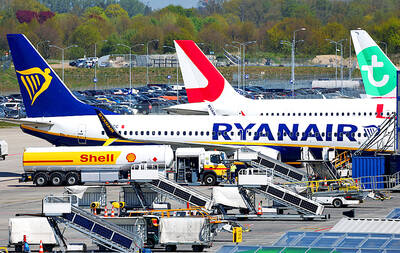
Ryanair, Transavia, Volotea and other low-cost airlines are feeling the financial pain from high jet fuel prices as a result of the Middle East war and are cutting flights. The closure of the Strait of Hormuz has taken a huge chunk of oil supplies off the market, sending the price of jet fuel soaring and triggering fears of shortages that could force airlines to cancel flights. Airlines are not waiting for a lack of supplies to react. “Travel alert: Airlines are cutting thousands of flights right now,” Travel Therapy host Karen Schaler said in an Instagram reel this past weekend.
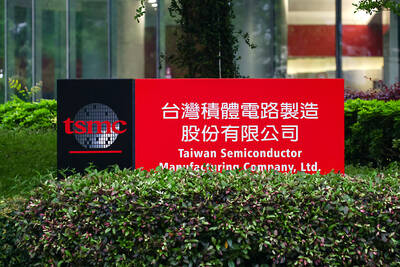
Shares of Taiwan Semiconductor Manufacturing Co (TSMC, 台積電) have repeatedly hit new highs, but an equity analyst said the stock’s valuation remains within a reasonable range and any pullback would likely be technical. The contract chipmaker’s historical price-to-earnings (P/E) ratio has ranged between 20 and 30, Cathay Futures Consultant Co (國泰證期) analyst Tsai Ming-han (蔡明翰) told Central News Agency. With market consensus projecting that TSMC would post earnings per share of about NT$100 (US$3.17) this year, supported by strong global demand for artificial intelligence (AI) applications, and the stock currently trading at a P/E ratio of below 25, Tsai said the valuation

The US Department of Commerce last week ordered multiple chip equipment companies to halt shipments of certain tools to China’s second-largest chipmaker, Hua Hong Semiconductor Ltd (華虹半導體), its latest action to slow the country’s development of advanced chips, two people familiar with the matter said. The department sent letters to at least a handful of companies informing them of restrictions on tools and other materials destined for two Hua Hong facilities US officials believe make China’s most sophisticated chips, the people said. Top US chip equipment companies Lam Research Corp, Applied Materials Inc and KLA Corp, each of which has significant


 RSS
RSS