


Taiwan Semiconductor Manufacturing Co (TSMC, 台積電), which supplies chips for Apple Inc’s iPhones, yesterday reported its poorest monthly revenue in 21 months amid growing concern over lackluster sales of iPhone 6S handsets and other smartphone brands.
However, the firm managed to reach its quarterly revenue goal and hit double-digit annual growth for its full-year revenue last year.
Revenue fell 8 percent to NT$58.35 billion (US$1.74 billion) last month from November’s NT$63.43 billion, it said in a statement.
That brought last quarter’s revenue to NT$203.52 billion, reaching the firm’s forecast of NT$204 billion. On a quarterly basis, revenue shrank 4.2 percent as customers digested inventories and reduced orders for smartphone chips amid faltering global economy.
For the whole of last year, TSMC’s revenue grew 10.6 percent annually to NT$843.5 billion, setting another record.
Weak local currency against US dollar and new orders for advanced chips were the main reasons behind the growth, company co-chief executive officer Mark Liu (劉德音) told investors in October.
TSMC’s revenue last year was in line with the NT$843.52 billion projection made by CIMB Securities Ltd analyst Eric Lin (林育名) and slightly surpassed Credit Suisse Group AG analyst Randy Abrams’ forecast of NT$842.69 billion.
However, TSMC might see a rough start to this year due to slowing iPhone demand.
“TSMC saw a 10 percent cut in orders in November, which we believe is due to Apple, with the impact expected to last until the end of the first quarter or early second quarter of this year,” JPMorgan Securities Ltd said in a report on Dec. 13, last year.
TSMC’s rival United Microelectronics Corp (UMC, 聯電) yesterday said that its revenue decreased by 4.05 percent to NT$10.67 billion last month from NT$11.12 billion in November.
UMC made NT$33.85 billion in revenue last quarter, down 4.16 percent from a quarter ago and reported a full-year revenue of NT$144.83 billion, up 3.44 percent from 2014, the company said.
Meanwhile, leading handset chip designer MediaTek Inc (聯發科) yesterday posted a 11.62 percent drop in revenue for last month at NT$18.52 billion, compared with NT$20.96 billion in November.
In the final quarter of last year, MediaTek said its revenue climbed 8.36 percent quarter-on-quarter to NT$61.72 billion. The result beat the company’s forecast of between NT$57 billion and NT$60.4 billion, partly due to the contribution from the newly acquired Richtek Technology Corp (立錡).
MediaTek, which counts Chinese phone brands such as Huawei Technologies Co (華為) and Meizu Technology Co (魅族) among its customers, said revenue last year inched up 0.09 percent to NT$213.26 billion from NT$213.06 billion in 2014.
Last year’s figure beat HSBC analyst Yolanda Wang’s (王郁雅) forecast of NT$206.87 billion and the NT$209.14 billion projected by CIMB analyst Peter Chan (詹逸群). Wang and Chan had forecast MediaTek to report an annual revenue decline of 2.9 percent and 1.8 percent respectively.
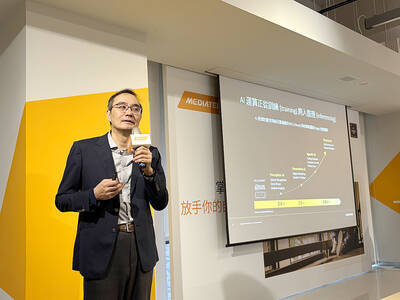
MediaTek Inc (聯發科), the world’s biggest smartphone chip supplier, yesterday said it plans to double investment in data center-related technologies, including advanced packaging and high-speed interconnect technologies, to broaden the new business’ customer and service portfolios. The chip designer is redirecting its resources to data centers, mainly designing application-specific integrated circuits (ASIC) with artificial intelligence (AI) capabilities for cloud service providers. The data center business is forecast to lead growth in the next three years and become the company’s second-biggest revenue source, replacing chips used in smart devices, MediaTek president Joe Chen (陳冠州) told a media event in Taipei. “Three or four years

Until US President Donald Trump’s return a year ago, when the EU talked about cutting economic dependency on foreign powers — it was understood to mean China, but now Brussels has US tech in its sights. As Trump ramps up his threats — from strong-arming Europe on trade to pushing to seize Greenland — concern has grown that the unpredictable leader could, should he so wish, plunge the bloc into digital darkness. Since Trump’s Greenland climbdown, top officials have stepped up warnings that the EU is dangerously exposed to geopolitical shocks and must work toward strategic independence — in defense, energy and

Motorists ride past a mural along a street in Varanasi, India, yesterday.

For the second year in a row, a Brazilian movie has wowed international audiences and critics, securing multiple Oscar nominations and drawing fresh interest in the Latin American giant’s film industry. Experts say the success of The Secret Agent, which has won four Oscar nominations, a year after I Am Still Here won Brazil its first Oscar, is no fluke, with a bit of a push from the country’s political climate. “This is neither a coincidence nor a miracle. It is the result of a lot of work, consistent policies, and, of course, talent,” Ilda Santiago, director of the Rio International Film


 RSS
RSS