


The official manufacturing purchasing managers’ index (PMI) stood at 46.6 last month, up from 45.1 in November, as local manufacturers have yet to finalize inventory adjustments due to tepid external demand and the absence of any major innovations for technology devices, the Chung-Hua Institution for Economic Research (CIER, 中華經濟研究院) said yesterday.
Operating conditions for the manufacturing industry have deteriorated over the past six months, and firms have dim business outlooks, the Taipei-based think tank said.
“Despite the easing pace of deterioration, the global slowdown has yet to bottom out judging from the latest data,” CIER president Wu Chung-shu (吳中書) told a media briefing.
The December data confirmed a disappointing year for Taiwanese firms’ exports and industrial output, both of which might drop to their lowest levels since the global financial crisis struck in 2008 to 2009.
The PMI seeks to gauge the health of local manufacturers, with scores above 50 signifying business expansion and values below the neutral mark indicating contraction.
The sub-indices on new orders and exports registered 45.7 and 43.8 last month, a small improvement from 44.9 and 45.7 in November, the monthly survey found.
Supply Management Institute in Taiwan (SMIT, 中華採購與供應管理協會) executive director Steve Lai (賴樹鑫) said he was not surprised at the results given the lackluster sales of Apple Inc’s iPhone 6S, iPad Pro and Apple Watch.
“Apple Watch failed to create a big splash and the iPad Pro failed to knock out laptops as the US technology giant had boasted,” Lai said, adding that iPhone 6S sales waned after first weekend sales hit a record high.
Smarter and friendlier innovations are necessary to impress users and local firms in the supply chain, Lai said.
Customers at home and abroad would refrain from active inventory building in the short term, as the first quarter is usually a slow season for consumer electronics sales, Wu said.
The slowdown in China might also raise uncertainty about the Lunar New Year demand, Wu said.
Caixin’s purchasing managers’ index for China came in weaker at 48.2 last month, down from 48.6 in November, according to a survey released yesterday.
In related news, non-manufacturing activity in Taiwan fared better last month when the NMI recovered to the neutral state with a 50 point, the CIER said.
The advent of the Lunar New Year next month and the government’s stimulus program helped shore up domestic demand, the institute said.
However, firms in services sectors are pessimistic about the landscape in the coming six months, with concerns poor exports could drag on businesses, Wu said.
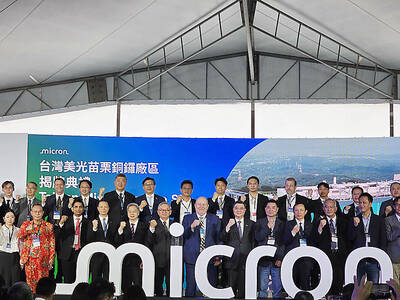
UNPRECEDENTED PACE: Micron Technology has announced plans to expand manufacturing capabilities with the acquisition of a new chip plant in Miaoli Micron Technology Inc unveiled a newly acquired chip plant in Miaoli County yesterday, as the company expands capacity to meet growing demand for advanced DRAM chips, including high-bandwidth memory chips amid the artificial intelligence boom. The plant in Miaoli County’s Tongluo Township (銅鑼), which Micron acquired from Powerchip Semiconductor Manufacturing Corp (力積電) for US$1.8 billion, is expected to make a sizeable capacity contribution to the company from fiscal 2028, the company said in a statement. It would be an extended production site of Micron’s large-scale manufacturing hub in Taichung, the company said. As the global semiconductor industry is racing to reach US$1 trillion

Singapore-based ride-hailing and delivery giant Grab Holdings Ltd has applied for regulatory approval to acquire the Taiwan operations of Germany-based Delivery Hero SE's Foodpanda in a deal valued at about US$600 million. Grab submitted the filing to the Fair Trade Commission on Friday last week, with the transaction subject to regulatory review and approval, the company said in a statement yesterday. Its independent governance structure would help foster a healthy and competitive market in Taiwan if the deal is approved, Grab said. Grab, which is listed on the NASDAQ, said in the filing that US-based Uber Technologies Inc holds about 13 percent of

Taiwan’s food delivery market could undergo a major shift if Singapore-based Grab Holdings Ltd completes its planned acquisition of Delivery Hero SE’s Foodpanda business in Taiwan, industry experts said. Grab on Monday last week announced it would acquire Foodpanda’s Taiwan operations for US$600 million. The deal is expected to be finalized in the second half of this year, with Grab aiming to complete user migration to its platform by the first half of next year. A duopoly between Uber Eats and Foodpanda dominates Taiwan’s delivery market, a structure that has remained intact since the Fair Trade Commission (FTC) blocked Uber Technologies Inc’s

Memory chip stocks extended their losses yesterday after Alphabet Inc’s Google publicized research that could allow more efficient use of the storage needed for artificial intelligence (AI) development. SK Hynix Inc and Samsung Electronics Co, South Korean leaders in the market, fell more than 6 percent and about 5 percent respectively in Seoul. In the US, Micron Technology Inc, Western Digital Corp and Sandisk Corp slid more than 2 percent in pre-market trading, after they all closed lower on Wednesday. Memory companies have been on a tear in recent months as the rapid development of AI infrastructure triggered a spike in chip


 RSS
RSS