


Taiwan Semiconductor Manufacturing Co (TSMC, 台積電), the world’s largest contract chipmaker, yesterday said that it expects the overall semiconductor industry to return to growth next year after a prolonged period of inventory correction.
TSMC said that is a positive sign for the industry, which might head for a recovery next quarter.
“Inventory correction in the industry would be mostly finished by the end of this year,” TSMC co-chief executive officer Mark Liu (劉德音) said in a keynote speech during the company’s annual Supply Chain Management Forum in Hsinchu.
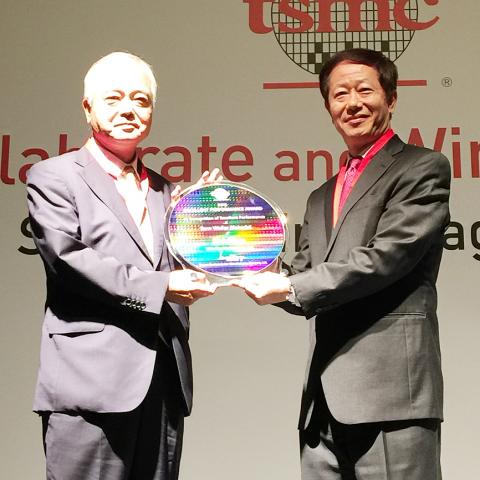
Photo: Hung Yu-fang, Taipei Times
“When we enter next year with a healthy level of inventory, we expect the semiconductor industry to return to growth trajectory,” Liu said.
Two months ago, Liu said he was not sure about the inventory correction issue and told investors that some uncertainties remained for the industry this quarter.
In October, TSMC cut its forecast for the world semiconductor industry’s revenue growth to zero this year from its previously estimated annual expansion of 3 percent.
The company is expected to outstrip the overall semiconductor industry next year, thanks to a market share gain from the 16-nanometer (nm) technology, Liu said, adding that the new technology would help the chipmaker continue to grow its annual revenue next year.
This year, TSMC is likely to grow its revenue by double digits from last year’s NT$762.81 billion (US$23.16 billion), partly because of the New Taiwan dollar’s depreciation against the US dollar and the company’s advances in technology, Liu said.
TSMC started mass producing 16nm chips in the third quarter and expects to launch a compact version of 16nm chips, mostly for low-end smartphones, in the second quarter of next year and start producing 10nm chips from the fourth quarter of next year, he said.
The company plans to start construction of a new production line in February at its Taichung factory, which is expected to produce 10nm chips to be used in various applications such as mobile phones, he said.
In its effort to push for more advanced technologies, TSMC is scheduled to start early production of 7nm chips in the first quarter of 2017 and is preparing to develop 5nm technology, Liu said.

SECOND-RATE: Models distilled from US products do not perform the same as the original and undo measures that ensure the systems are neutral, the US’ cable said The US Department of State has ordered a global push to bring attention to what it said are widespread efforts by Chinese companies, including artificial intelligence (AI) start-up DeepSeek (深度求索), to steal intellectual property from US AI labs, according to a diplomatic cable. The cable, dated Friday and sent to diplomatic and consular posts around the world, instructs diplomatic staff to speak to their foreign counterparts about “concerns over adversaries’ extraction and distillation of US AI models.” Distillation is the process of training smaller AI models using output from larger, more expensive ones to lower the costs of training a powerful new

Micron Technology Inc is a driving force pushing the US Congress to pass legislation that would put new export restrictions on equipment its Chinese competitors use to make their chips, according to people familiar with the matter. A US House of Representatives panel yesterday was to vote on the “MATCH Act,” a bill designed to close gaps in restrictions on chipmaking equipment. It would also pressure foreign companies that sell equipment to Chinese chipmaking facilities to align with export curbs on US companies like Lam Research Corp and Applied Materials Inc. The bill targets facilities operated by China’s ChangXin Memory Technologies Inc

Singapore-based ride-hailing and delivery giant Grab Holdings’ planned acquisition of Foodpanda’s Taiwan operations has yet to enter the formal review stage, as regulators await supplementary documents, the Fair Trade Commission (FTC) said yesterday. Acting FTC Chairman Chen Chih-min (陳志民) told the legislature’s Economics Committee that although Grab submitted its application on March 27, the case has not been officially accepted because required materials remain incomplete. Once the filing is finalized, the FTC would launch a formal probe into the deal, focusing on issues such as cross-shareholding and potential restrictions on market competition, Chen told lawmakers. Grab last month announced that it would acquire
The artificial intelligence (AI) boom has triggered a seismic reshuffling of global equity markets, with Taiwan and South Korea muscling past European nations one by one. With its stock market now valued at nearly US$4.3 trillion, Taiwan surpassed the UK, Europe’s biggest market, earlier this month, data compiled by Bloomberg showed. South Korea is about US$140 billion away from doing the same. The tech-heavy Asian markets have shot past Germany and France in the past seven months. The shift is largely down to massive gains in shares of three companies that provide essential hardware for AI: Taiwan Semiconductor Manufacturing Co (TSMC, 台積電),


 RSS
RSS