


Taishin International Bank (台新銀行) yesterday said that its collaboration with 17Life had propelled credit-card spending at the online-to-offline platform by nearly twofold during a 29-day campaign that began in the middle of October.
Customers voted with their wallets on 17Life, an e-commerce marketplace focused on selling group discount coupons and crowned 30 award-winning restaurants and hotels who topped their peers in sales.
During the campaign, spending by more than 520,000 Taishin International Bank credit-card holders at 17Life surged 170 percent annually to NT$55 million (US$1.67 million), and drove up traffic to the online marketplace by 7 million visits. Two popular hot pot restaurants that had garnered top votes reported NT$9 million in sales during the period.
“The campaign is part of Taishin International Bank’s innovation efforts as the financial sector migrates toward digitization,” Taishin Financial Holding Co (台新金控) retail banking group chief executive officer Oliver Shang (尚瑞強) said.
In addition, the bank would provide loans at more favorable terms to the 30 winning restaurants and hotels, Shang said.
“We have gained valuable data from the campaign, and factors such as the number of votes and sales garnered by the winning businesses will be included in our loan consideration process,” Shang said. “In accordance with the Financial Supervisory Commission’s calls to hasten the process toward cashless transactions, we are working to develop our credit cards into a platform for electronic payment processing, in addition to its role as a form of consumer financing.”
The company hopes to identify with the next generation of consumers who grew up with the Internet and mobile devices, Shang said.
“We are striving to build a relationship with the ‘digital native’ demographic starting with electronic payments based on deposit accounts at Taishin International Bank, and gradually offering personal financing services,” Shang said.
However, its exclusive deal with 17Life came at a cost, as Taishin International Bank had offered a NT$50 discount for each transaction exceeding NT$450, Shang said, adding that such costs are acceptable in light of the immense amount of shopping behavior data collected by the bank.
The company is to launch a credit card catering to the specific needs of digital natives in the first quarter of next year, Shang said.
“While the technology, backend infrastructure and regulations have matured in the past three years since our push into the mobile payment segment, different smartphones’ hardware specifications remains a challenge,” Shang said, referring to the iPhone, which is limited to its manufacturer’s proprietary Apple Pay service.
“As the O2O model proliferates, the line separating e-commerce and physical retail is blurring,” 17Life chairman Jan Hung-tze (詹宏志) said, adding that it is difficult to classify a transaction in which consumers purchase coupons from the Internet and use them at restaurants.

SECOND-RATE: Models distilled from US products do not perform the same as the original and undo measures that ensure the systems are neutral, the US’ cable said The US Department of State has ordered a global push to bring attention to what it said are widespread efforts by Chinese companies, including artificial intelligence (AI) start-up DeepSeek (深度求索), to steal intellectual property from US AI labs, according to a diplomatic cable. The cable, dated Friday and sent to diplomatic and consular posts around the world, instructs diplomatic staff to speak to their foreign counterparts about “concerns over adversaries’ extraction and distillation of US AI models.” Distillation is the process of training smaller AI models using output from larger, more expensive ones to lower the costs of training a powerful new

Micron Technology Inc is a driving force pushing the US Congress to pass legislation that would put new export restrictions on equipment its Chinese competitors use to make their chips, according to people familiar with the matter. A US House of Representatives panel yesterday was to vote on the “MATCH Act,” a bill designed to close gaps in restrictions on chipmaking equipment. It would also pressure foreign companies that sell equipment to Chinese chipmaking facilities to align with export curbs on US companies like Lam Research Corp and Applied Materials Inc. The bill targets facilities operated by China’s ChangXin Memory Technologies Inc

Singapore-based ride-hailing and delivery giant Grab Holdings’ planned acquisition of Foodpanda’s Taiwan operations has yet to enter the formal review stage, as regulators await supplementary documents, the Fair Trade Commission (FTC) said yesterday. Acting FTC Chairman Chen Chih-min (陳志民) told the legislature’s Economics Committee that although Grab submitted its application on March 27, the case has not been officially accepted because required materials remain incomplete. Once the filing is finalized, the FTC would launch a formal probe into the deal, focusing on issues such as cross-shareholding and potential restrictions on market competition, Chen told lawmakers. Grab last month announced that it would acquire
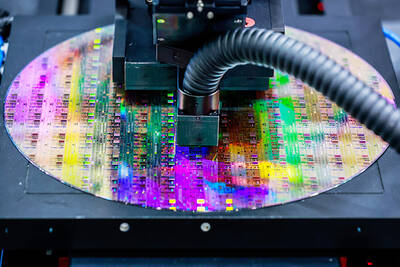
The artificial intelligence (AI) boom has triggered a seismic reshuffling of global equity markets, with Taiwan and South Korea muscling past European nations one by one. With its stock market now valued at nearly US$4.3 trillion, Taiwan surpassed the UK, Europe’s biggest market, earlier this month, data compiled by Bloomberg showed. South Korea is about US$140 billion away from doing the same. The tech-heavy Asian markets have shot past Germany and France in the past seven months. The shift is largely down to massive gains in shares of three companies that provide essential hardware for AI: Taiwan Semiconductor Manufacturing Co (TSMC, 台積電),


 RSS
RSS